 Add to Chrome
 Add to Firefox
 Add to Edge
Expanding Data-Agnostic Pivotal Instances Selection Models with Proximity Trees and Ensemble Learning
Jul 29, 2026
As decision-making processes grow more complex, machine learning tools have become essential for tackling business and societal challenges. However, many existing methods rely on decision-making procedures that are difficult to interpret. Since humans naturally make decisions by comparing new cases with a few representative examples, we aim to design an approach that selects such pivots to construct an interpretable predictive model. Inspired by decision trees, we propose a hierarchical, interpretable-by-design pivot selection model based on the similarity between pivots and input instances. Our method functions both as a pivot selection technique and a standalone predictive model. Extending beyond single pivots, we incorporate pairs of pivots that are used by proximity and oblique trees, as well as ensembles, which enhance the versatility and effectiveness of our proposal. Additionally, our approach is data modality-agnostic, leveraging pre-trained networks for data transformation. Experiments across diverse datasets, including tabular data, text, images, and time series, demonstrate the effectiveness of our approach, outperforming alternative instance selection strategies and achieving competitive results against state-of-the-art interpretable models while maintaining a minimal number of pivots.

PYRREGULAR: A Unified Framework for Irregular Time Series, with Classification Benchmarks
May 09, 2025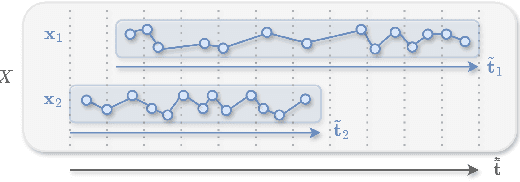
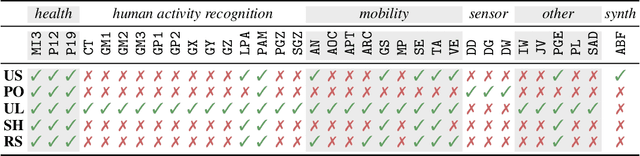

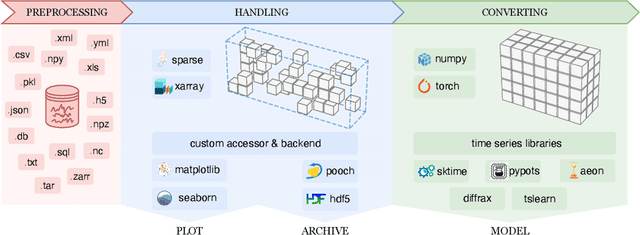
Irregular temporal data, characterized by varying recording frequencies, differing observation durations, and missing values, presents significant challenges across fields like mobility, healthcare, and environmental science. Existing research communities often overlook or address these challenges in isolation, leading to fragmented tools and methods. To bridge this gap, we introduce a unified framework, and the first standardized dataset repository for irregular time series classification, built on a common array format to enhance interoperability. This repository comprises 34 datasets on which we benchmark 12 classifier models from diverse domains and communities. This work aims to centralize research efforts and enable a more robust evaluation of irregular temporal data analysis methods.