 Add to Chrome
 Add to Firefox
 Add to Edge
TriGen: NPU Architecture for End-to-End Acceleration of Large Language Models based on SW-HW Co-Design
Feb 13, 2026
Recent studies have extensively explored NPU architectures for accelerating AI inference in on-device environments, which are inherently resource-constrained. Meanwhile, transformer-based large language models (LLMs) have become dominant, with rapidly increasing model sizes but low degree of parameter reuse compared to conventional CNNs, making end-to-end execution on resource-limited devices extremely challenging. To address these challenges, we propose TriGen, a novel NPU architecture tailored for resource-constrained environments through software-hardware co-design. Firstly, TriGen adopts low-precision computation using microscaling (MX) to enable additional optimization opportunities while preserving accuracy, and resolves the issues that arise by employing such precision. Secondly, to jointly optimize both nonlinear and linear operations, TriGen eliminates the need for specialized hardware for essential nonlinear operations by using fast and accurate LUT, thereby maximizing performance gains and reducing hardware-cost in on-device environments, and finally, by taking practical hardware constraints into account, further employs scheduling techniques to maximize computational utilization even under limited on-chip memory capacity. We evaluate the performance of TriGen on various LLMs and show that TriGen achieves an average 2.73x performance speedup and 52% less memory transfer over the baseline NPU design with negligible accuracy loss.

Continuum Dropout for Neural Differential Equations
Nov 18, 2025Neural Differential Equations (NDEs) excel at modeling continuous-time dynamics, effectively handling challenges such as irregular observations, missing values, and noise. Despite their advantages, NDEs face a fundamental challenge in adopting dropout, a cornerstone of deep learning regularization, making them susceptible to overfitting. To address this research gap, we introduce Continuum Dropout, a universally applicable regularization technique for NDEs built upon the theory of alternating renewal processes. Continuum Dropout formulates the on-off mechanism of dropout as a stochastic process that alternates between active (evolution) and inactive (paused) states in continuous time. This provides a principled approach to prevent overfitting and enhance the generalization capabilities of NDEs. Moreover, Continuum Dropout offers a structured framework to quantify predictive uncertainty via Monte Carlo sampling at test time. Through extensive experiments, we demonstrate that Continuum Dropout outperforms existing regularization methods for NDEs, achieving superior performance on various time series and image classification tasks. It also yields better-calibrated and more trustworthy probability estimates, highlighting its effectiveness for uncertainty-aware modeling.
DGSAM: Domain Generalization via Individual Sharpness-Aware Minimization
Mar 30, 2025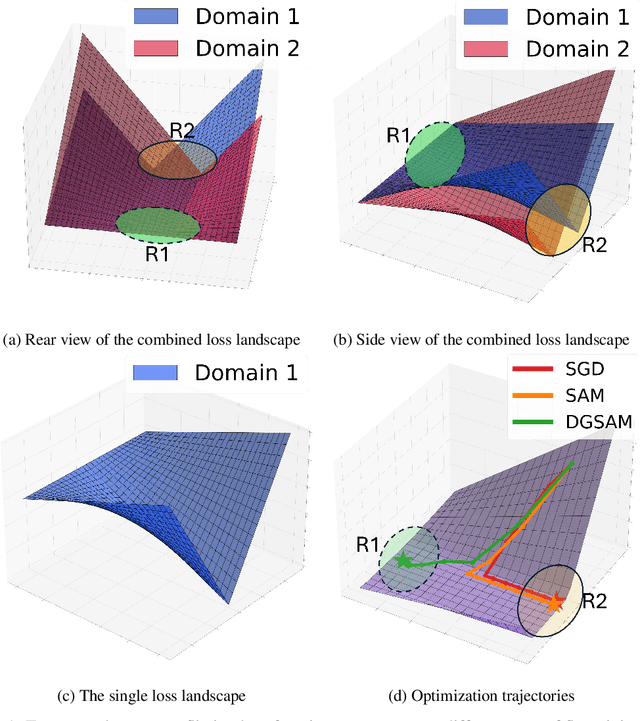
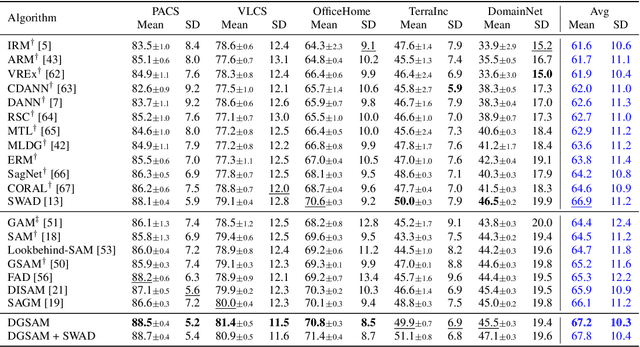


Domain generalization (DG) aims to learn models that can generalize well to unseen domains by training only on a set of source domains. Sharpness-Aware Minimization (SAM) has been a popular approach for this, aiming to find flat minima in the total loss landscape. However, we show that minimizing the total loss sharpness does not guarantee sharpness across individual domains. In particular, SAM can converge to fake flat minima, where the total loss may exhibit flat minima, but sharp minima are present in individual domains. Moreover, the current perturbation update in gradient ascent steps is ineffective in directly updating the sharpness of individual domains. Motivated by these findings, we introduce a novel DG algorithm, Decreased-overhead Gradual Sharpness-Aware Minimization (DGSAM), that applies gradual domain-wise perturbation to reduce sharpness consistently across domains while maintaining computational efficiency. Our experiments demonstrate that DGSAM outperforms state-of-the-art DG methods, achieving improved robustness to domain shifts and better performance across various benchmarks, while reducing computational overhead compared to SAM.