 Add to Chrome
 Add to Firefox
 Add to Edge
CDP
Papers and Code
GenCAMO: Scene-Graph Contextual Decoupling for Environment-aware and Mask-free Camouflage Image-Dense Annotation Generation
Jan 03, 2026
Conceal dense prediction (CDP), especially RGB-D camouflage object detection and open-vocabulary camouflage object segmentation, plays a crucial role in advancing the understanding and reasoning of complex camouflage scenes. However, high-quality and large-scale camouflage datasets with dense annotation remain scarce due to expensive data collection and labeling costs. To address this challenge, we explore leveraging generative models to synthesize realistic camouflage image-dense data for training CDP models with fine-grained representations, prior knowledge, and auxiliary reasoning. Concretely, our contributions are threefold: (i) we introduce GenCAMO-DB, a large-scale camouflage dataset with multi-modal annotations, including depth maps, scene graphs, attribute descriptions, and text prompts; (ii) we present GenCAMO, an environment-aware and mask-free generative framework that produces high-fidelity camouflage image-dense annotations; (iii) extensive experiments across multiple modalities demonstrate that GenCAMO significantly improves dense prediction performance on complex camouflage scenes by providing high-quality synthetic data. The code and datasets will be released after paper acceptance.

Robust Uncertainty Quantification for Self-Evolving Large Language Models via Continual Domain Pretraining
Oct 27, 2025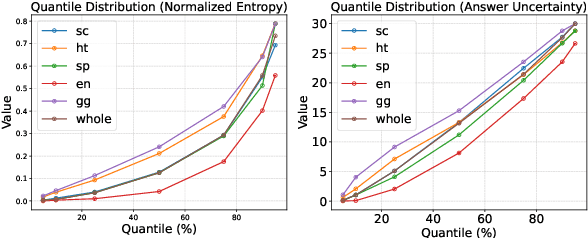
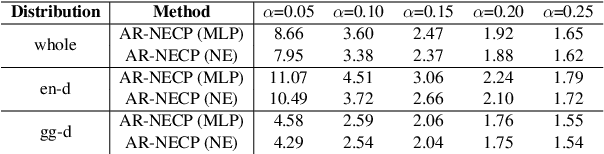
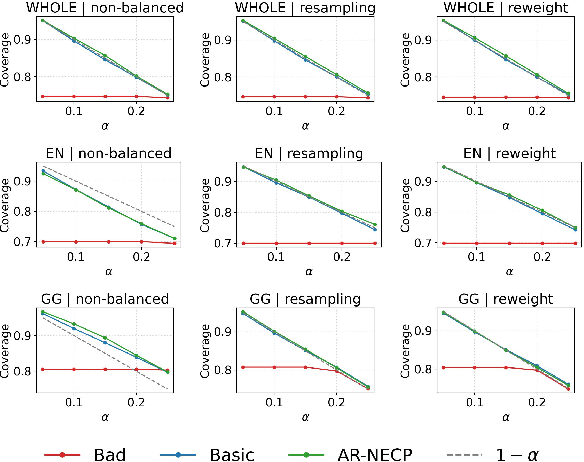
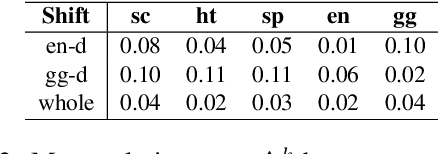
Continual Learning (CL) is essential for enabling self-evolving large language models (LLMs) to adapt and remain effective amid rapid knowledge growth. Yet, despite its importance, little attention has been given to establishing statistical reliability guarantees for LLMs under CL, particularly in the setting of continual domain pretraining (CDP). Conformal Prediction (CP) has shown promise in offering correctness guarantees for LLMs, but it faces major challenges in CDP: testing data often stems from unknown or shifting domain distributions, under which CP may no longer provide valid guarantees. Moreover, when high coverage is required, CP can yield excessively large prediction sets for unanswerable queries, reducing informativeness. To address these challenges, we introduce an adaptive rejection and non-exchangeable CP framework. Our method first estimates the distribution of questions across domains in the test set using transformer-based clustering, then reweights or resamples the calibration data accordingly. Building on this, adaptive rejection CP allows the LLM to selectively abstain from answering when its confidence or competence shifts significantly. Extensive experiments demonstrate that our framework enhances both the effectiveness and reliability of CP under CDP scenarios. Our code is available at: https://anonymous.4open.science/r/CPCL-8C12/
Convexity-Driven Projection for Point Cloud Dimensionality Reduction
Sep 26, 2025We propose Convexity-Driven Projection (CDP), a boundary-free linear method for dimensionality reduction of point clouds that targets preserving detour-induced local non-convexity. CDP builds a $k$-NN graph, identifies admissible pairs whose Euclidean-to-shortest-path ratios are below a threshold, and aggregates their normalized directions to form a positive semidefinite non-convexity structure matrix. The projection uses the top-$k$ eigenvectors of the structure matrix. We give two verifiable guarantees. A pairwise a-posteriori certificate that bounds the post-projection distortion for each admissible pair, and an average-case spectral bound that links expected captured direction energy to the spectrum of the structure matrix, yielding quantile statements for typical distortion. Our evaluation protocol reports fixed- and reselected-pairs detour errors and certificate quantiles, enabling practitioners to check guarantees on their data.
CDP: Towards Robust Autoregressive Visuomotor Policy Learning via Causal Diffusion
Jun 17, 2025Diffusion Policy (DP) enables robots to learn complex behaviors by imitating expert demonstrations through action diffusion. However, in practical applications, hardware limitations often degrade data quality, while real-time constraints restrict model inference to instantaneous state and scene observations. These limitations seriously reduce the efficacy of learning from expert demonstrations, resulting in failures in object localization, grasp planning, and long-horizon task execution. To address these challenges, we propose Causal Diffusion Policy (CDP), a novel transformer-based diffusion model that enhances action prediction by conditioning on historical action sequences, thereby enabling more coherent and context-aware visuomotor policy learning. To further mitigate the computational cost associated with autoregressive inference, a caching mechanism is also introduced to store attention key-value pairs from previous timesteps, substantially reducing redundant computations during execution. Extensive experiments in both simulated and real-world environments, spanning diverse 2D and 3D manipulation tasks, demonstrate that CDP uniquely leverages historical action sequences to achieve significantly higher accuracy than existing methods. Moreover, even when faced with degraded input observation quality, CDP maintains remarkable precision by reasoning through temporal continuity, which highlights its practical robustness for robotic control under realistic, imperfect conditions.
Deep Learning in Concealed Dense Prediction
Apr 15, 2025Deep learning is developing rapidly and handling common computer vision tasks well. It is time to pay attention to more complex vision tasks, as model size, knowledge, and reasoning capabilities continue to improve. In this paper, we introduce and review a family of complex tasks, termed Concealed Dense Prediction (CDP), which has great value in agriculture, industry, etc. CDP's intrinsic trait is that the targets are concealed in their surroundings, thus fully perceiving them requires fine-grained representations, prior knowledge, auxiliary reasoning, etc. The contributions of this review are three-fold: (i) We introduce the scope, characteristics, and challenges specific to CDP tasks and emphasize their essential differences from generic vision tasks. (ii) We develop a taxonomy based on concealment counteracting to summarize deep learning efforts in CDP through experiments on three tasks. We compare 25 state-of-the-art methods across 12 widely used concealed datasets. (iii) We discuss the potential applications of CDP in the large model era and summarize 6 potential research directions. We offer perspectives for the future development of CDP by constructing a large-scale multimodal instruction fine-tuning dataset, CvpINST, and a concealed visual perception agent, CvpAgent.
Carbon-Efficient 3D DNN Acceleration: Optimizing Performance and Sustainability
Apr 14, 2025As Deep Neural Networks (DNNs) continue to drive advancements in artificial intelligence, the design of hardware accelerators faces growing concerns over embodied carbon footprint due to complex fabrication processes. 3D integration improves performance but introduces sustainability challenges, making carbon-aware optimization essential. In this work, we propose a carbon-efficient design methodology for 3D DNN accelerators, leveraging approximate computing and genetic algorithm-based design space exploration to optimize Carbon Delay Product (CDP). By integrating area-efficient approximate multipliers into Multiply-Accumulate (MAC) units, our approach effectively reduces silicon area and fabrication overhead while maintaining high computational accuracy. Experimental evaluations across three technology nodes (45nm, 14nm, and 7nm) show that our method reduces embodied carbon by up to 30% with negligible accuracy drop.
Ecomap: Sustainability-Driven Optimization of Multi-Tenant DNN Execution on Edge Servers
Mar 06, 2025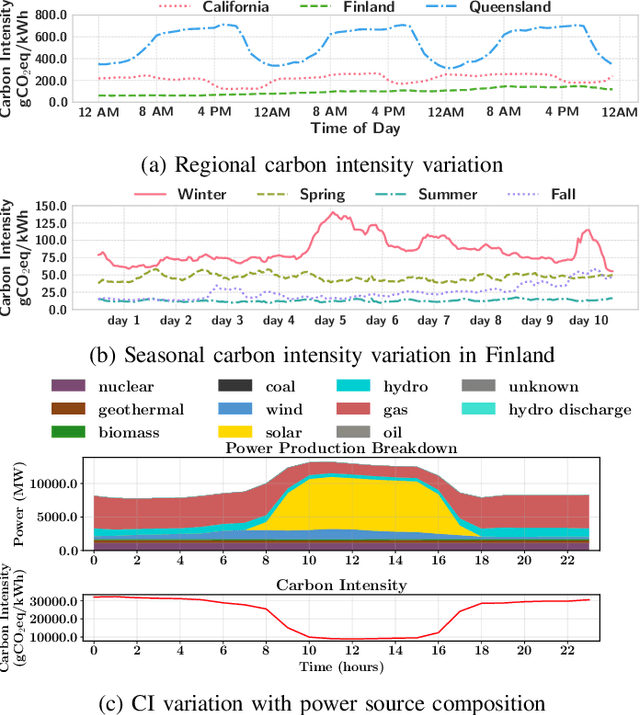
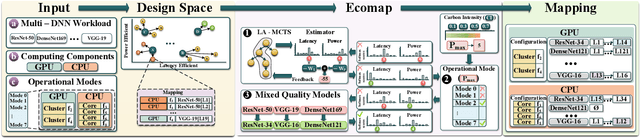
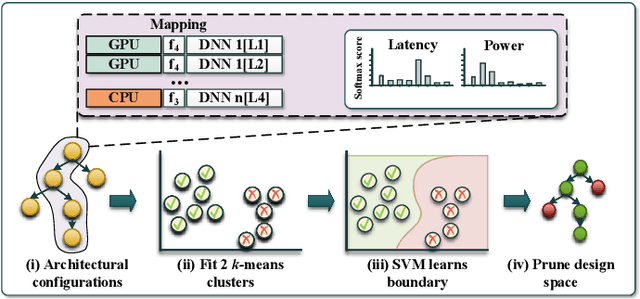
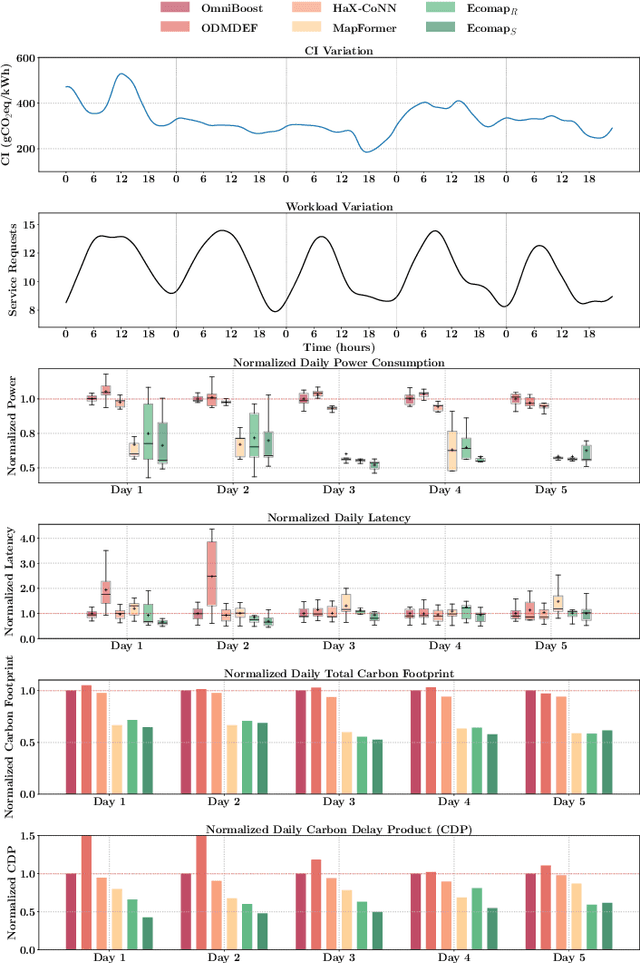
Edge computing systems struggle to efficiently manage multiple concurrent deep neural network (DNN) workloads while meeting strict latency requirements, minimizing power consumption, and maintaining environmental sustainability. This paper introduces Ecomap, a sustainability-driven framework that dynamically adjusts the maximum power threshold of edge devices based on real-time carbon intensity. Ecomap incorporates the innovative use of mixed-quality models, allowing it to dynamically replace computationally heavy DNNs with lighter alternatives when latency constraints are violated, ensuring service responsiveness with minimal accuracy loss. Additionally, it employs a transformer-based estimator to guide efficient workload mappings. Experimental results using NVIDIA Jetson AGX Xavier demonstrate that Ecomap reduces carbon emissions by an average of 30% and achieves a 25% lower carbon delay product (CDP) compared to state-of-the-art methods, while maintaining comparable or better latency and power efficiency.
LiteWebAgent: The Open-Source Suite for VLM-Based Web-Agent Applications
Mar 04, 2025We introduce LiteWebAgent, an open-source suite for VLM-based web agent applications. Our framework addresses a critical gap in the web agent ecosystem with a production-ready solution that combines minimal serverless backend configuration, intuitive user and browser interfaces, and extensible research capabilities in agent planning, memory, and tree search. For the core LiteWebAgent agent framework, we implemented a simple yet effective baseline using recursive function calling, providing with decoupled action generation and action grounding. In addition, we integrate advanced research components such as agent planning, agent workflow memory, and tree search in a modular and extensible manner. We then integrate the LiteWebAgent agent framework with frontend and backend as deployed systems in two formats: (1) a production Vercel-based web application, which provides users with an agent-controlled remote browser, (2) a Chrome extension leveraging LiteWebAgent's API to control an existing Chrome browser via CDP (Chrome DevTools Protocol). The LiteWebAgent framework is available at https://github.com/PathOnAI/LiteWebAgent, with deployed frontend at https://lite-web-agent.vercel.app/.
On Theoretical Limits of Learning with Label Differential Privacy
Feb 20, 2025Label differential privacy (DP) is designed for learning problems involving private labels and public features. While various methods have been proposed for learning under label DP, the theoretical limits remain largely unexplored. In this paper, we investigate the fundamental limits of learning with label DP in both local and central models for both classification and regression tasks, characterized by minimax convergence rates. We establish lower bounds by converting each task into a multiple hypothesis testing problem and bounding the test error. Additionally, we develop algorithms that yield matching upper bounds. Our results demonstrate that under label local DP (LDP), the risk has a significantly faster convergence rate than that under full LDP, i.e. protecting both features and labels, indicating the advantages of relaxing the DP definition to focus solely on labels. In contrast, under the label central DP (CDP), the risk is only reduced by a constant factor compared to full DP, indicating that the relaxation of CDP only has limited benefits on the performance.
Whisper D-SGD: Correlated Noise Across Agents for Differentially Private Decentralized Learning
Jan 24, 2025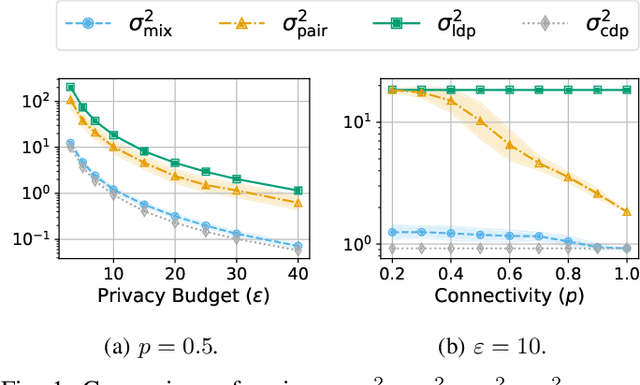
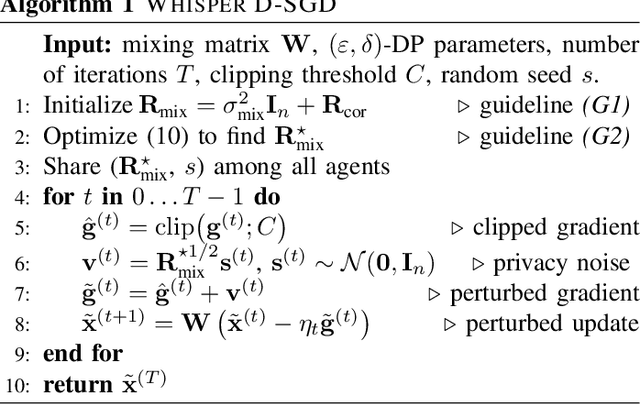
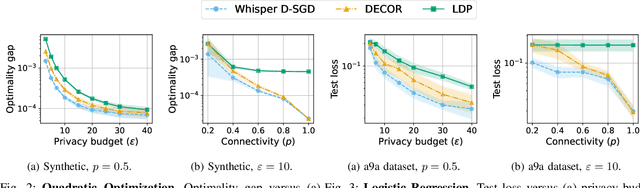
Decentralized learning enables distributed agents to train a shared machine learning model through local computation and peer-to-peer communication. Although each agent retains its dataset locally, the communication of local models can still expose private information to adversaries. To mitigate these threats, local differential privacy (LDP) injects independent noise per agent, but it suffers a larger utility gap than central differential privacy (CDP). We introduce Whisper D-SGD, a novel covariance-based approach that generates correlated privacy noise across agents, unifying several state-of-the-art methods as special cases. By leveraging network topology and mixing weights, Whisper D-SGD optimizes the noise covariance to achieve network-wide noise cancellation. Experimental results show that Whisper D-SGD cancels more noise than existing pairwise-correlation schemes, substantially narrowing the CDP-LDP gap and improving model performance under the same privacy guarantees.