 Add to Chrome
 Add to Firefox
 Add to Edge
6D Pose Estimation
Papers and Code
IndustryShapes: An RGB-D Benchmark dataset for 6D object pose estimation of industrial assembly components and tools
Feb 05, 2026
We introduce IndustryShapes, a new RGB-D benchmark dataset of industrial tools and components, designed for both instance-level and novel object 6D pose estimation approaches. The dataset provides a realistic and application-relevant testbed for benchmarking these methods in the context of industrial robotics bridging the gap between lab-based research and deployment in real-world manufacturing scenarios. Unlike many previous datasets that focus on household or consumer products or use synthetic, clean tabletop datasets, or objects captured solely in controlled lab environments, IndustryShapes introduces five new object types with challenging properties, also captured in realistic industrial assembly settings. The dataset has diverse complexity, from simple to more challenging scenes, with single and multiple objects, including scenes with multiple instances of the same object and it is organized in two parts: the classic set and the extended set. The classic set includes a total of 4,6k images and 6k annotated poses. The extended set introduces additional data modalities to support the evaluation of model-free and sequence-based approaches. To the best of our knowledge, IndustryShapes is the first dataset to offer RGB-D static onboarding sequences. We further evaluate the dataset on a representative set of state-of-the art methods for instance-based and novel object 6D pose estimation, including also object detection, segmentation, showing that there is room for improvement in this domain. The dataset page can be found in https://pose-lab.github.io/IndustryShapes.

RFM-Pose:Reinforcement-Guided Flow Matching for Fast Category-Level 6D Pose Estimation
Feb 05, 2026Object pose estimation is a fundamental problem in computer vision and plays a critical role in virtual reality and embodied intelligence, where agents must understand and interact with objects in 3D space. Recently, score based generative models have to some extent solved the rotational symmetry ambiguity problem in category level pose estimation, but their efficiency remains limited by the high sampling cost of score-based diffusion. In this work, we propose a new framework, RFM-Pose, that accelerates category-level 6D object pose generation while actively evaluating sampled hypotheses. To improve sampling efficiency, we adopt a flow-matching generative model and generate pose candidates along an optimal transport path from a simple prior to the pose distribution. To further refine these candidates, we cast the flow-matching sampling process as a Markov decision process and apply proximal policy optimization to fine-tune the sampling policy. In particular, we interpret the flow field as a learnable policy and map an estimator to a value network, enabling joint optimization of pose generation and hypothesis scoring within a reinforcement learning framework. Experiments on the REAL275 benchmark demonstrate that RFM-Pose achieves favorable performance while significantly reducing computational cost. Moreover, similar to prior work, our approach can be readily adapted to object pose tracking and attains competitive results in this setting.
Differentiable Inverse Graphics for Zero-shot Scene Reconstruction and Robot Grasping
Feb 04, 2026Operating effectively in novel real-world environments requires robotic systems to estimate and interact with previously unseen objects. Current state-of-the-art models address this challenge by using large amounts of training data and test-time samples to build black-box scene representations. In this work, we introduce a differentiable neuro-graphics model that combines neural foundation models with physics-based differentiable rendering to perform zero-shot scene reconstruction and robot grasping without relying on any additional 3D data or test-time samples. Our model solves a series of constrained optimization problems to estimate physically consistent scene parameters, such as meshes, lighting conditions, material properties, and 6D poses of previously unseen objects from a single RGBD image and bounding boxes. We evaluated our approach on standard model-free few-shot benchmarks and demonstrated that it outperforms existing algorithms for model-free few-shot pose estimation. Furthermore, we validated the accuracy of our scene reconstructions by applying our algorithm to a zero-shot grasping task. By enabling zero-shot, physically-consistent scene reconstruction and grasping without reliance on extensive datasets or test-time sampling, our approach offers a pathway towards more data efficient, interpretable and generalizable robot autonomy in novel environments.
Learning Fine-Grained Correspondence with Cross-Perspective Perception for Open-Vocabulary 6D Object Pose Estimation
Jan 20, 2026Open-vocabulary 6D object pose estimation empowers robots to manipulate arbitrary unseen objects guided solely by natural language. However, a critical limitation of existing approaches is their reliance on unconstrained global matching strategies. In open-world scenarios, trying to match anchor features against the entire query image space introduces excessive ambiguity, as target features are easily confused with background distractors. To resolve this, we propose Fine-grained Correspondence Pose Estimation (FiCoP), a framework that transitions from noise-prone global matching to spatially-constrained patch-level correspondence. Our core innovation lies in leveraging a patch-to-patch correlation matrix as a structural prior to narrowing the matching scope, effectively filtering out irrelevant clutter to prevent it from degrading pose estimation. Firstly, we introduce an object-centric disentanglement preprocessing to isolate the semantic target from environmental noise. Secondly, a Cross-Perspective Global Perception (CPGP) module is proposed to fuse dual-view features, establishing structural consensus through explicit context reasoning. Finally, we design a Patch Correlation Predictor (PCP) that generates a precise block-wise association map, acting as a spatial filter to enforce fine-grained, noise-resilient matching. Experiments on the REAL275 and Toyota-Light datasets demonstrate that FiCoP improves Average Recall by 8.0% and 6.1%, respectively, compared to the state-of-the-art method, highlighting its capability to deliver robust and generalized perception for robotic agents operating in complex, unconstrained open-world environments. The source code will be made publicly available at https://github.com/zjjqinyu/FiCoP.
Fiducial Exoskeletons: Image-Centric Robot State Estimation
Jan 12, 2026We introduce Fiducial Exoskeletons, an image-based reformulation of 3D robot state estimation that replaces cumbersome procedures and motor-centric pipelines with single-image inference. Traditional approaches - especially robot-camera extrinsic estimation - often rely on high-precision actuators and require time-consuming routines such as hand-eye calibration. In contrast, modern learning-based robot control is increasingly trained and deployed from RGB observations on lower-cost hardware. Our key insight is twofold. First, we cast robot state estimation as 6D pose estimation of each link from a single RGB image: the robot-camera base transform is obtained directly as the estimated base-link pose, and the joint state is recovered via a lightweight global optimization that enforces kinematic consistency with the observed link poses (optionally warm-started with encoder readings). Second, we make per-link 6D pose estimation robust and simple - even without learning - by introducing the fiducial exoskeleton: a lightweight 3D-printed mount with a fiducial marker on each link and known marker-link geometry. This design yields robust camera-robot extrinsics, per-link SE(3) poses, and joint-angle state from a single image, enabling robust state estimation even on unplugged robots. Demonstrated on a low-cost robot arm, fiducial exoskeletons substantially simplify setup while improving calibration, state accuracy, and downstream 3D control performance. We release code and printable hardware designs to enable further algorithm-hardware co-design.
OSCAR: Open-Set CAD Retrieval from a Language Prompt and a Single Image
Jan 12, 20266D object pose estimation plays a crucial role in scene understanding for applications such as robotics and augmented reality. To support the needs of ever-changing object sets in such context, modern zero-shot object pose estimators were developed to not require object-specific training but only rely on CAD models. Such models are hard to obtain once deployed, and a continuously changing and growing set of objects makes it harder to reliably identify the instance model of interest. To address this challenge, we introduce an Open-Set CAD Retrieval from a Language Prompt and a Single Image (OSCAR), a novel training-free method that retrieves a matching object model from an unlabeled 3D object database. During onboarding, OSCAR generates multi-view renderings of database models and annotates them with descriptive captions using an image captioning model. At inference, GroundedSAM detects the queried object in the input image, and multi-modal embeddings are computed for both the Region-of-Interest and the database captions. OSCAR employs a two-stage retrieval: text-based filtering using CLIP identifies candidate models, followed by image-based refinement using DINOv2 to select the most visually similar object. In our experiments we demonstrate that OSCAR outperforms all state-of-the-art methods on the cross-domain 3D model retrieval benchmark MI3DOR. Furthermore, we demonstrate OSCAR's direct applicability in automating object model sourcing for 6D object pose estimation. We propose using the most similar object model for pose estimation if the exact instance is not available and show that OSCAR achieves an average precision of 90.48\% during object retrieval on the YCB-V object dataset. Moreover, we demonstrate that the most similar object model can be utilized for pose estimation using Megapose achieving better results than a reconstruction-based approach.
VisuoTactile 6D Pose Estimation of an In-Hand Object using Vision and Tactile Sensor Data
Jan 04, 2026Knowledge of the 6D pose of an object can benefit in-hand object manipulation. In-hand 6D object pose estimation is challenging because of heavy occlusion produced by the robot's grippers, which can have an adverse effect on methods that rely on vision data only. Many robots are equipped with tactile sensors at their fingertips that could be used to complement vision data. In this paper, we present a method that uses both tactile and vision data to estimate the pose of an object grasped in a robot's hand. To address challenges like lack of standard representation for tactile data and sensor fusion, we propose the use of point clouds to represent object surfaces in contact with the tactile sensor and present a network architecture based on pixel-wise dense fusion. We also extend NVIDIA's Deep Learning Dataset Synthesizer to produce synthetic photo-realistic vision data and corresponding tactile point clouds. Results suggest that using tactile data in addition to vision data improves the 6D pose estimate, and our network generalizes successfully from synthetic training to real physical robots.
* Accepted for publication in IEEE Robotics and Automation Letters (RA-L), January 2022. Presented at ICRA 2022. This is the author's version of the manuscript
AlignPose: Generalizable 6D Pose Estimation via Multi-view Feature-metric Alignment
Dec 23, 2025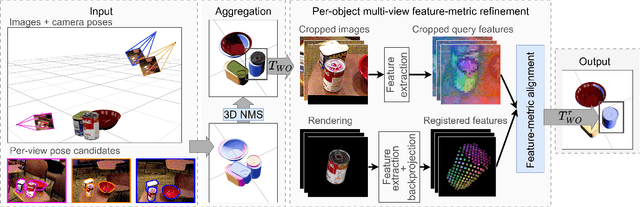
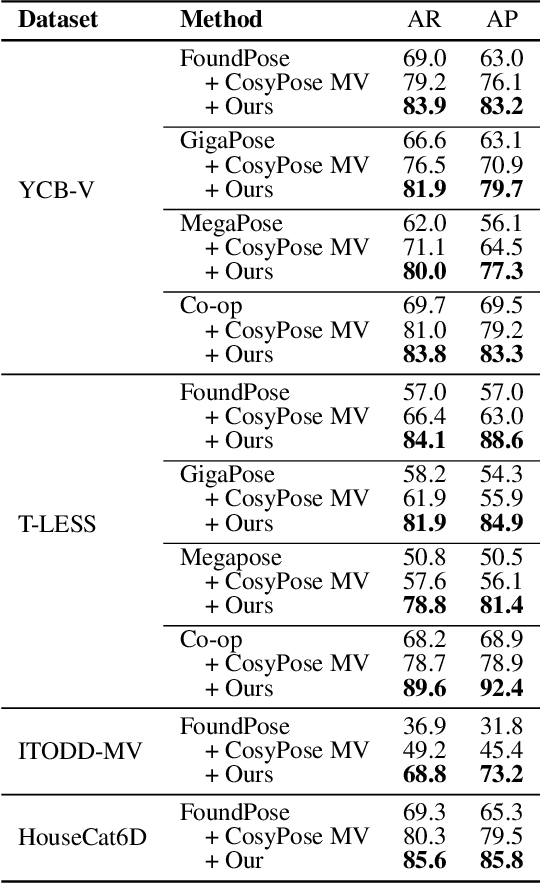
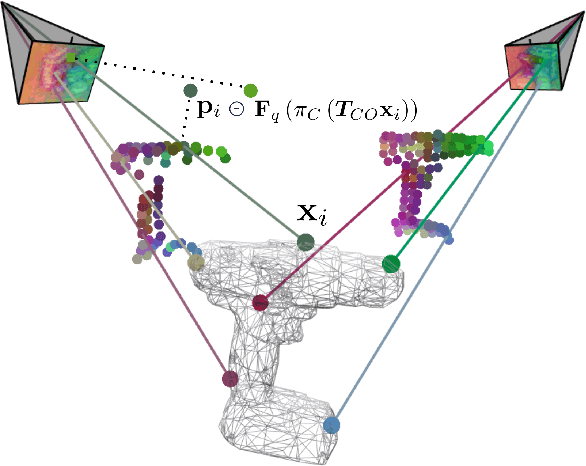
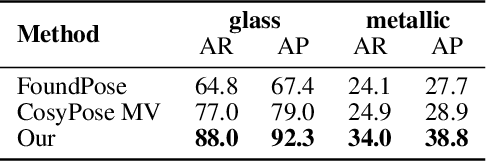
Single-view RGB model-based object pose estimation methods achieve strong generalization but are fundamentally limited by depth ambiguity, clutter, and occlusions. Multi-view pose estimation methods have the potential to solve these issues, but existing works rely on precise single-view pose estimates or lack generalization to unseen objects. We address these challenges via the following three contributions. First, we introduce AlignPose, a 6D object pose estimation method that aggregates information from multiple extrinsically calibrated RGB views and does not require any object-specific training or symmetry annotation. Second, the key component of this approach is a new multi-view feature-metric refinement specifically designed for object pose. It optimizes a single, consistent world-frame object pose minimizing the feature discrepancy between on-the-fly rendered object features and observed image features across all views simultaneously. Third, we report extensive experiments on four datasets (YCB-V, T-LESS, ITODD-MV, HouseCat6D) using the BOP benchmark evaluation and show that AlignPose outperforms other published methods, especially on challenging industrial datasets where multiple views are readily available in practice.
Geo6DPose: Fast Zero-Shot 6D Object Pose Estimation via Geometry-Filtered Feature Matching
Dec 11, 2025Recent progress in zero-shot 6D object pose estimation has been driven largely by large-scale models and cloud-based inference. However, these approaches often introduce high latency, elevated energy consumption, and deployment risks related to connectivity, cost, and data governance; factors that conflict with the practical constraints of real-world robotics, where compute is limited and on-device inference is frequently required. We introduce Geo6DPose, a lightweight, fully local, and training-free pipeline for zero-shot 6D pose estimation that trades model scale for geometric reliability. Our method combines foundation model visual features with a geometric filtering strategy: Similarity maps are computed between onboarded template DINO descriptors and scene patches, and mutual correspondences are established by projecting scene patch centers to 3D and template descriptors to the object model coordinate system. Final poses are recovered via correspondence-driven RANSAC and ranked using a weighted geometric alignment metric that jointly accounts for reprojection consistency and spatial support, improving robustness to noise, clutter, and partial visibility. Geo6DPose achieves sub-second inference on a single commodity GPU while matching the average recall of significantly larger zero-shot baselines (53.7 AR, 1.08 FPS). It requires no training, fine-tuning, or network access, and remains compatible with evolving foundation backbones, advancing practical, fully local 6D perception for robotic deployment.
THE-Pose: Topological Prior with Hybrid Graph Fusion for Estimating Category-Level 6D Object Pose
Dec 11, 2025Category-level object pose estimation requires both global context and local structure to ensure robustness against intra-class variations. However, 3D graph convolution (3D-GC) methods only focus on local geometry and depth information, making them vulnerable to complex objects and visual ambiguities. To address this, we present THE-Pose, a novel category-level 6D pose estimation framework that leverages a topological prior via surface embedding and hybrid graph fusion. Specifically, we extract consistent and invariant topological features from the image domain, effectively overcoming the limitations inherent in existing 3D-GC based methods. Our Hybrid Graph Fusion (HGF) module adaptively integrates the topological features with point-cloud features, seamlessly bridging 2D image context and 3D geometric structure. These fused features ensure stability for unseen or complicated objects, even under significant occlusions. Extensive experiments on the REAL275 dataset show that THE-Pose achieves a 35.8% improvement over the 3D-GC baseline (HS-Pose) and surpasses the previous state-of-the-art by 7.2% across all key metrics. The code is avaialbe on https://github.com/EHxxx/THE-Pose