 Add to Chrome
 Add to Firefox
 Add to Edge
A censoring-aware target interface for tabular foundation models in survival prediction
Jul 10, 2026
Time-to-event prediction from tabular patient data is central to prognosis and biomedical decision support, but right-censored follow-up prevents direct use of ordinary regression labels. Tabular foundation models offer reusable prediction machinery for modest heterogeneous datasets, yet they generally assume fully observed outcomes. We introduce SurvFM-RMST, a censoring-aware target-interface framework that converts survival outcomes into jackknife pseudo-observation targets for restricted mean survival time, enabling multiple tabular backbones to perform horizon-specific RMST regression without survival-specific fine-tuning. In controlled simulations with known conditional RMST, SurvFM-RMST recovered restricted event-free time accurately, and pseudo-RMST targets outperformed naive restricted observed-time and event-only targets. Across 36 eligible static SurvSet datasets, SurvFM backbones were competitive with established survival and RMST-regression comparators, though relative performance varied by endpoint, horizon and practical constraints. Predicted RMST further stratified held-out patients into groups with ordered observed event-free time and event enrichment. Overall, the results support pseudo-RMST target construction as a portable interface between censored survival data and tabular foundation-model prediction.

Tell2Adapt: A Unified Framework for Source Free Unsupervised Domain Adaptation via Vision Foundation Model
Mar 05, 2026Source Free Unsupervised Domain Adaptation (SFUDA) is critical for deploying deep learning models across diverse clinical settings. However, existing methods are typically designed for low-gap, specific domain shifts and cannot generalize into a unified, multi-modalities, and multi-target framework, which presents a major barrier to real-world application. To overcome this issue, we introduce Tell2Adapt, a novel SFUDA framework that harnesses the vast, generalizable knowledge of the Vision Foundation Model (VFM). Our approach ensures high-fidelity VFM prompts through Context-Aware Prompts Regularization (CAPR), which robustly translates varied text prompts into canonical instructions. This enables the generation of high-quality pseudo-labels for efficiently adapting the lightweight student model to target domain. To guarantee clinical reliability, the framework incorporates Visual Plausibility Refinement (VPR), which leverages the VFM's anatomical knowledge to re-ground the adapted model's predictions in target image's low-level visual features, effectively removing noise and false positives. We conduct one of the most extensive SFUDA evaluations to date, validating our framework across 10 domain adaptation directions and 22 anatomical targets, including brain, cardiac, polyp, and abdominal targets. Our results demonstrate that Tell2Adapt consistently outperforms existing approaches, achieving SOTA for a unified SFUDA framework in medical image segmentation. Code are avaliable at https://github.com/derekshiii/Tell2Adapt.
GraFSTNet: Graph-based Frequency SpatioTemporal Network for Cellular Traffic Prediction
Feb 06, 2026With rapid expansion of cellular networks and the proliferation of mobile devices, cellular traffic data exhibits complex temporal dynamics and spatial correlations, posing challenges to accurate traffic prediction. Previous methods often focus predominantly on temporal modeling or depend on predefined spatial topologies, which limits their ability to jointly model spatio-temporal dependencies and effectively capture periodic patterns in cellular traffic. To address these issues, we propose a cellular traffic prediction framework that integrates spatio-temporal modeling with time-frequency analysis. First, we construct a spatial modeling branch to capture inter-cell dependencies through an attention mechanism, minimizing the reliance on predefined topological structures. Second, we build a time-frequency modeling branch to enhance the representation of periodic patterns. Furthermore, we introduce an adaptive-scale LogCosh loss function, which adjusts the error penalty based on traffic magnitude, preventing large errors from dominating the training process and helping the model maintain relatively stable prediction accuracy across different traffic intensities. Experiments on three open-sourced datasets demonstrate that the proposed method achieves prediction performance superior to state-of-the-art approaches.
Boosting Neural Video Representation via Online Structural Reparameterization
Nov 14, 2025Neural Video Representation~(NVR) is a promising paradigm for video compression, showing great potential in improving video storage and transmission efficiency. While recent advances have made efforts in architectural refinements to improve representational capability, these methods typically involve complex designs, which may incur increased computational overhead and lack the flexibility to integrate into other frameworks. Moreover, the inherent limitation in model capacity restricts the expressiveness of NVR networks, resulting in a performance bottleneck. To overcome these limitations, we propose Online-RepNeRV, a NVR framework based on online structural reparameterization. Specifically, we propose a universal reparameterization block named ERB, which incorporates multiple parallel convolutional paths to enhance the model capacity. To mitigate the overhead, an online reparameterization strategy is adopted to dynamically fuse the parameters during training, and the multi-branch structure is equivalently converted into a single-branch structure after training. As a result, the additional computational and parameter complexity is confined to the encoding stage, without affecting the decoding efficiency. Extensive experiments on mainstream video datasets demonstrate that our method achieves an average PSNR gain of 0.37-2.7 dB over baseline methods, while maintaining comparable training time and decoding speed.
* 15 pages, 7 figures
CFNet: Cascade Fusion Network for Dense Prediction
Feb 13, 2023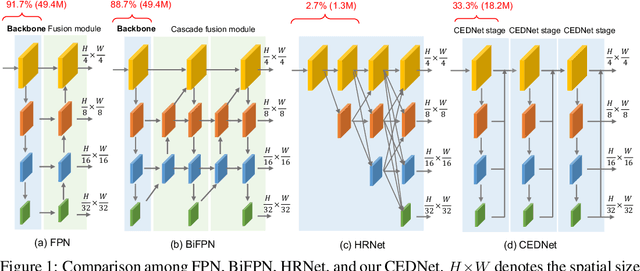

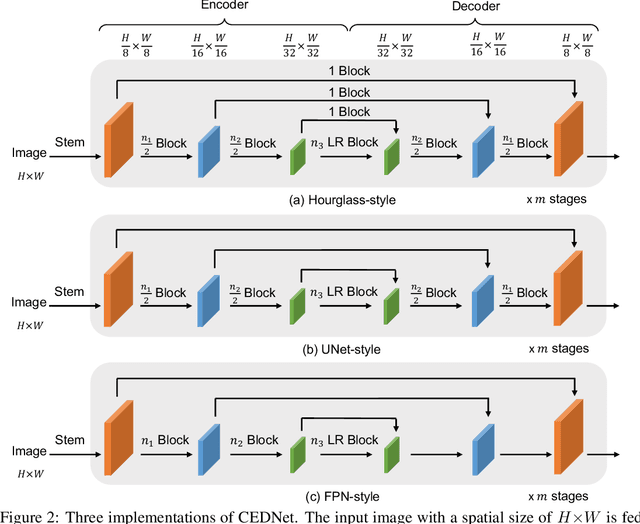
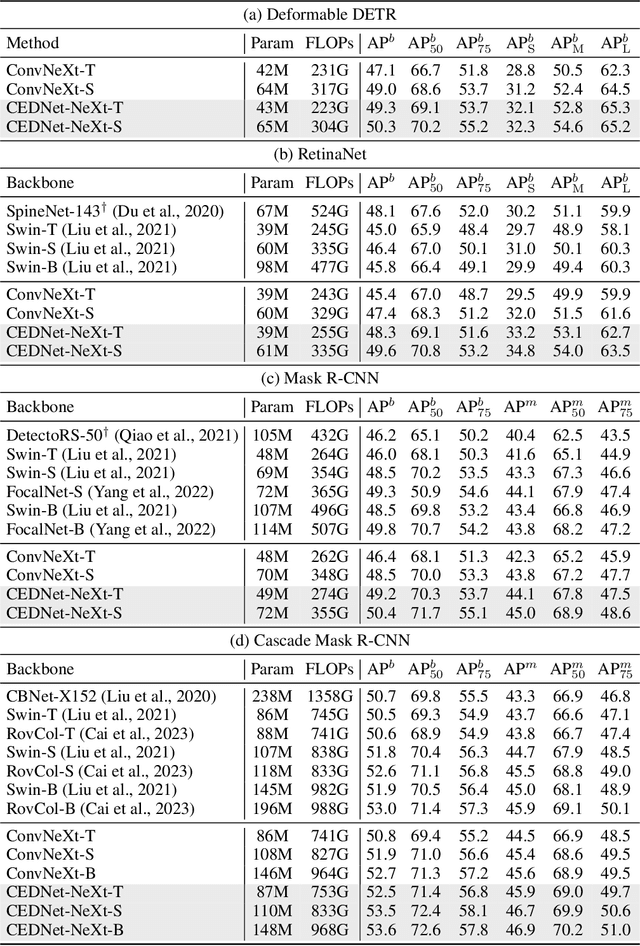
Multi-scale features are essential for dense prediction tasks, including object detection, instance segmentation, and semantic segmentation. Existing state-of-the-art methods usually first extract multi-scale features by a classification backbone and then fuse these features by a lightweight module (e.g. the fusion module in FPN). However, we argue that it may not be sufficient to fuse the multi-scale features through such a paradigm, because the parameters allocated for feature fusion are limited compared with the heavy classification backbone. In order to address this issue, we propose a new architecture named Cascade Fusion Network (CFNet) for dense prediction. Besides the stem and several blocks used to extract initial high-resolution features, we introduce several cascaded stages to generate multi-scale features in CFNet. Each stage includes a sub-backbone for feature extraction and an extremely lightweight transition block for feature integration. This design makes it possible to fuse features more deeply and effectively with a large proportion of parameters of the whole backbone. Extensive experiments on object detection, instance segmentation, and semantic segmentation validated the effectiveness of the proposed CFNet. Codes will be available at https://github.com/zhanggang001/CFNet.
Guiding Text-to-Image Diffusion Model Towards Grounded Generation
Jan 12, 2023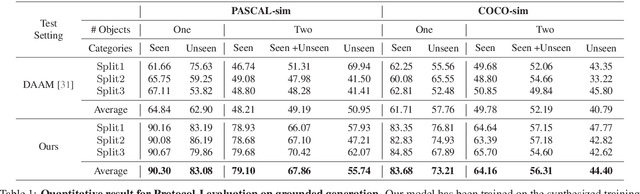
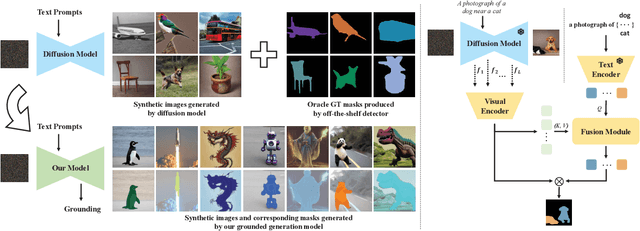
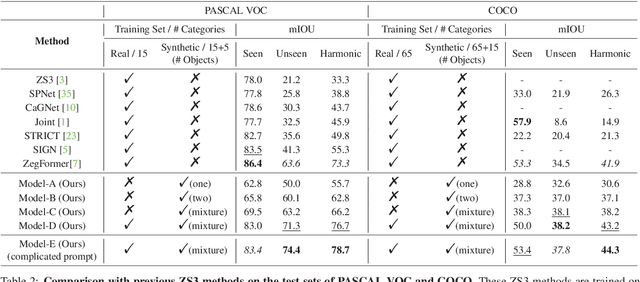
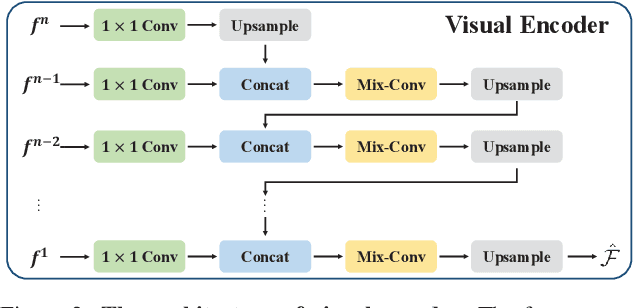
The goal of this paper is to augment a pre-trained text-to-image diffusion model with the ability of open-vocabulary objects grounding, i.e., simultaneously generating images and segmentation masks for the corresponding visual entities described in the text prompt. We make the following contributions: (i) we insert a grounding module into the existing diffusion model, that can be trained to align the visual and textual embedding space of the diffusion model with only a small number of object categories; (ii) we propose an automatic pipeline for constructing a dataset, that consists of {image, segmentation mask, text prompt} triplets, to train the proposed grounding module; (iii) we evaluate the performance of open-vocabulary grounding on images generated from the text-to-image diffusion model and show that the module can well segment the objects of categories beyond seen ones at training time; (iv) we adopt the guided diffusion model to build a synthetic semantic segmentation dataset, and show that training a standard segmentation model on such dataset demonstrates competitive performance on zero-shot segmentation(ZS3) benchmark, which opens up new opportunities for adopting the powerful diffusion model for discriminative tasks.
A Simple Plugin for Transforming Images to Arbitrary Scales
Oct 07, 2022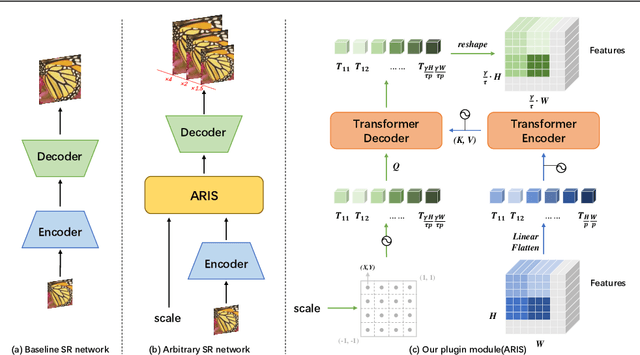
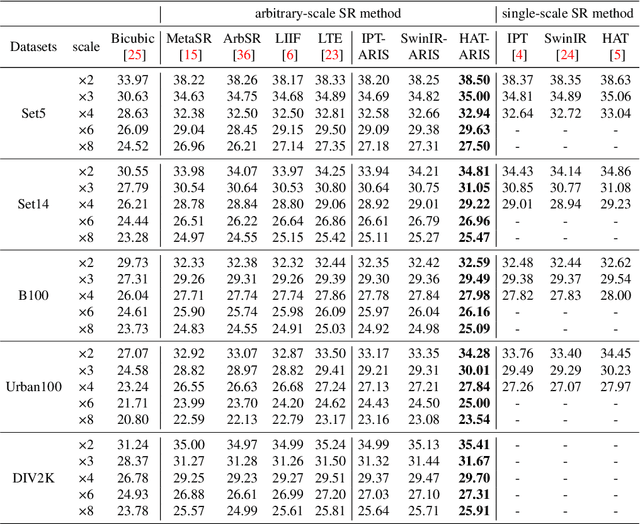
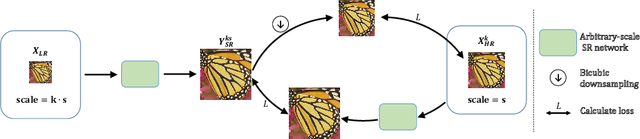
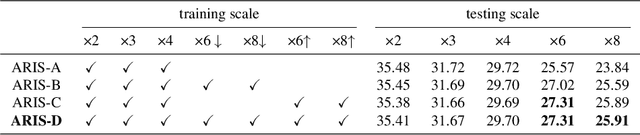
Existing models on super-resolution often specialized for one scale, fundamentally limiting their use in practical scenarios. In this paper, we aim to develop a general plugin that can be inserted into existing super-resolution models, conveniently augmenting their ability towards Arbitrary Resolution Image Scaling, thus termed ARIS. We make the following contributions: (i) we propose a transformer-based plugin module, which uses spatial coordinates as query, iteratively attend the low-resolution image feature through cross-attention, and output visual feature for the queried spatial location, resembling an implicit representation for images; (ii) we introduce a novel self-supervised training scheme, that exploits consistency constraints to effectively augment the model's ability for upsampling images towards unseen scales, i.e. ground-truth high-resolution images are not available; (iii) without loss of generality, we inject the proposed ARIS plugin module into several existing models, namely, IPT, SwinIR, and HAT, showing that the resulting models can not only maintain their original performance on fixed scale factor but also extrapolate to unseen scales, substantially outperforming existing any-scale super-resolution models on standard benchmarks, e.g. Urban100, DIV2K, etc.