 Add to Chrome
 Add to Firefox
 Add to Edge
GPT-Image-2 in the Wild: A Twitter Dataset of Self-Reported AI-Generated Images from the First Week of Deployment
Apr 28, 2026
The release of GPT-image-2 by OpenAI marks a watershed moment in AI-generated imagery: the boundary between photographic reality and synthetic content has never been more difficult to discern. We introduce the GPT-Image-2 Twitter Dataset, the first published dataset of GPT-image-2 generated images, sourced from publicly available Twitter/X posts in the immediate aftermath of the model's April 21, 2026 release. Leveraging the Twitter API v2 and a multi-stage curation pipeline spanning multilingual text heuristics (English, Japanese, and Chinese), browser-automated Twitter "Made with AI" badge verification, and model name variant matching, we curate 10,217 confirmed GPT-image-2 images from 27,662 collected records over a six-day window. We characterize the dataset across four analyses: CLIP-based zero-shot subject taxonomy, OCR text legibility (82.0% of images contain detectable text), face detection (59.2% of images, 22,583 total faces), and semantic clustering (137 CLIP ViT-L/14 clusters). A key negative result is that C2PA content credentials are systematically stripped by Twitter's CDN on upload, rendering cryptographic provenance verification infeasible for social-media-sourced AI images. The dataset and all curation code are released publicly.

CubeBench: Diagnosing Interactive, Long-Horizon Spatial Reasoning Under Partial Observations
Dec 30, 2025Large Language Model (LLM) agents, while proficient in the digital realm, face a significant gap in physical-world deployment due to the challenge of forming and maintaining a robust spatial mental model. We identify three core cognitive challenges hindering this transition: spatial reasoning, long-horizon state tracking via mental simulation, and active exploration under partial observation. To isolate and evaluate these faculties, we introduce CubeBench, a novel generative benchmark centered on the Rubik's Cube. CubeBench uses a three-tiered diagnostic framework that progressively assesses agent capabilities, from foundational state tracking with full symbolic information to active exploration with only partial visual data. Our experiments on leading LLMs reveal critical limitations, including a uniform 0.00% pass rate on all long-horizon tasks, exposing a fundamental failure in long-term planning. We also propose a diagnostic framework to isolate these cognitive bottlenecks by providing external solver tools. By analyzing the failure modes, we provide key insights to guide the development of more physically-grounded intelligent agents.
OpenBA-V2: Reaching 77.3% High Compression Ratio with Fast Multi-Stage Pruning
May 09, 2024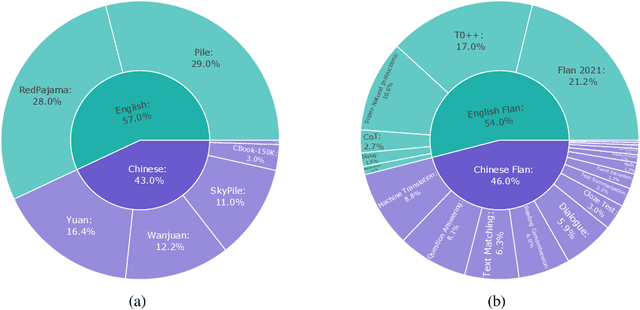
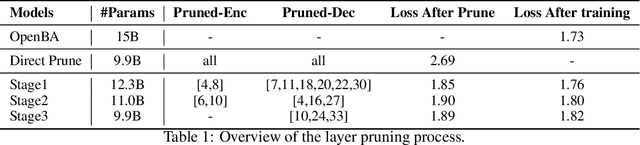


Large Language Models (LLMs) have played an important role in many fields due to their powerful capabilities.However, their massive number of parameters leads to high deployment requirements and incurs significant inference costs, which impedes their practical applications. Training smaller models is an effective way to address this problem. Therefore, we introduce OpenBA-V2, a 3.4B model derived from multi-stage compression and continual pre-training from the original 15B OpenBA model. OpenBA-V2 utilizes more data, more flexible training objectives, and techniques such as layer pruning, neural pruning, and vocabulary pruning to achieve a compression rate of 77.3\% with minimal performance loss. OpenBA-V2 demonstrates competitive performance compared to other open-source models of similar size, achieving results close to or on par with the 15B OpenBA model in downstream tasks such as common sense reasoning and Named Entity Recognition (NER). OpenBA-V2 illustrates that LLMs can be compressed into smaller ones with minimal performance loss by employing advanced training objectives and data strategies, which may help deploy LLMs in resource-limited scenarios.
A large-scale multimodal dataset of human speech recognition
Mar 15, 2023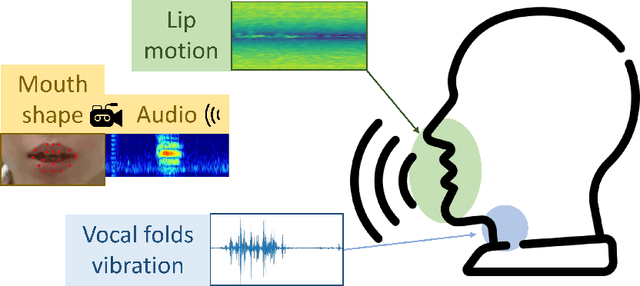
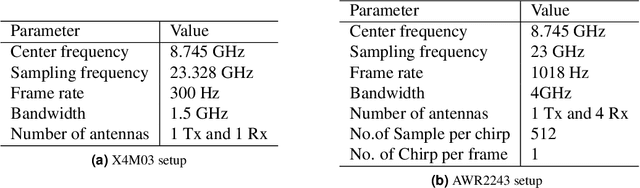
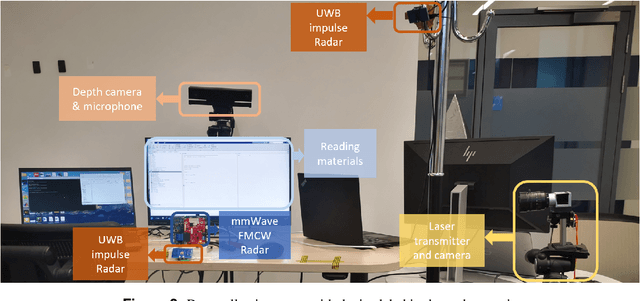
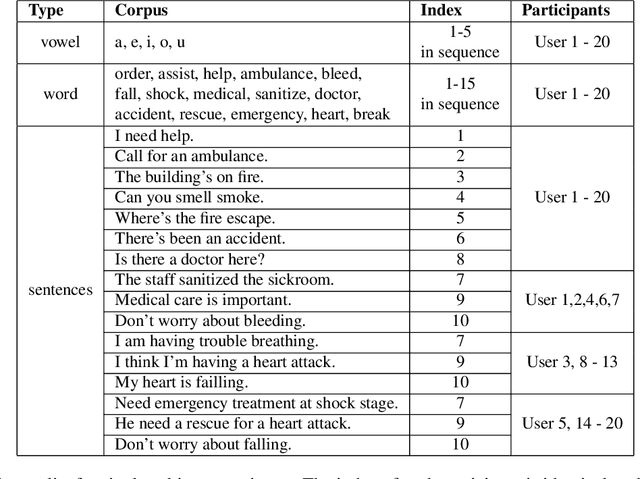
Nowadays, non-privacy small-scale motion detection has attracted an increasing amount of research in remote sensing in speech recognition. These new modalities are employed to enhance and restore speech information from speakers of multiple types of data. In this paper, we propose a dataset contains 7.5 GHz Channel Impulse Response (CIR) data from ultra-wideband (UWB) radars, 77-GHz frequency modulated continuous wave (FMCW) data from millimetre wave (mmWave) radar, and laser data. Meanwhile, a depth camera is adopted to record the landmarks of the subject's lip and voice. Approximately 400 minutes of annotated speech profiles are provided, which are collected from 20 participants speaking 5 vowels, 15 words and 16 sentences. The dataset has been validated and has potential for the research of lip reading and multimodal speech recognition.