 Add to Chrome
 Add to Firefox
 Add to Edge
Can We Defend Against AI-Generated Video Attacks on Real-World Crisis Events? A Systematic Evaluation of Detectors, Generators and Social Dissemination
Aug 14, 2026
Recent video generators can fabricate realistic depictions of wars, disasters, public emergencies, and other real-world crises, creating substantial risks of misinformation. Existing benchmarks, however, provide limited evidence on detector and generator behavior in such settings, including how detectability varies with generation conditions, how people perceive generated videos, and whether detectors remain reliable during social dissemination. To address this gap, we introduce RA-Bench, a benchmark for AI-generated video detection that uses Real videos as Anchors. RA-Bench contains 17,886 videos, comprising 1,830 real-video anchors across 10 social-risk categories and 16,056 generated clips from four open-source and five closed-source generators. Based on RA-Bench, we organize our evaluation along three dimensions. We first assess detector generalization across seven traditional detectors, ten zero-shot multimodal models under three review settings, and two MLLMs specifically fine-tuned on AI-generated video detection. Across these methods, none of the three detector families generalizes consistently across RA-Bench instances. We then examine how detectability varies with generation quality, conditioning information, and sampling seeds. These analyses show that generation properties affect detector families differently, while source-level detection patterns remain stable across seeds. Finally, we study human authenticity judgments and detector reliability during social dissemination. We find that videos that mislead people are also difficult for current detectors, and that social dissemination makes detection harder. Together, these findings show that current methods struggle to detect realistic AI-generated videos, highlighting the need for detectors robust to evolving video generators.

GroupToM-Bench: Benchmarking Group Theory of Mind and Nonlinear Social Emergence in MLLMs
Jun 02, 2026True general intelligence requires not only a model of the physical world but also a social world model: the capacity to infer how individual mental states interact and crystallize into group-level outcomes. Despite notable progress in individual-level Theory of Mind (ToM) reasoning, existing multimodal large language models fail at this broader task. Collective behavior emerges non-linearly from social tensions, conformity dynamics, and structural constraints, meaning it cannot be recovered by merely summing individual intentions. We present GroupToM-Bench, the first multimodal benchmark for group-level ToM, built around a causal chain spanning micro-level BDI states (belief, desire, intention), meso-level group tension and structural constraints, and macro-level outcome prediction and mechanistic attribution. To probe this full arc, we develop a seven-level cognitive audit framework. Experiments reveal a gap between current models and human baselines, highlighting a failure to process social structures and non-linear collective dynamics.
Multi-Attribute Attention Network for Interpretable Diagnosis of Thyroid Nodules in Ultrasound Images
Jul 09, 2022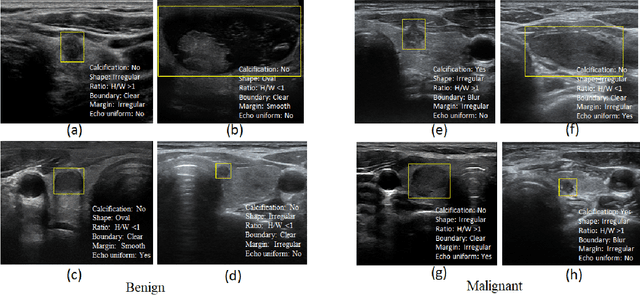
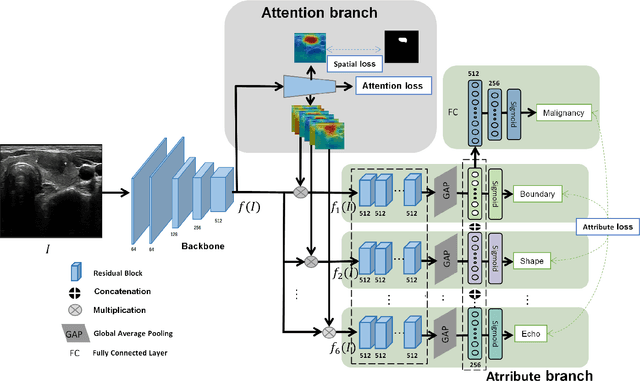
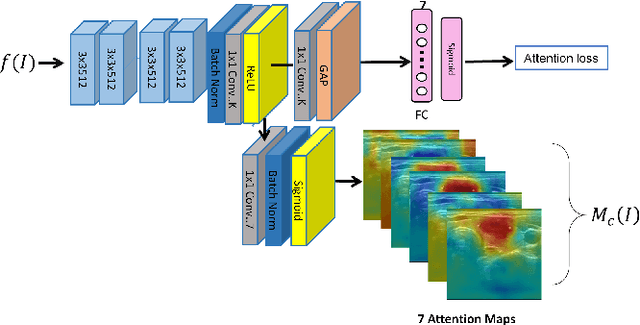
Ultrasound (US) is the primary imaging technique for the diagnosis of thyroid cancer. However, accurate identification of nodule malignancy is a challenging task that can elude less-experienced clinicians. Recently, many computer-aided diagnosis (CAD) systems have been proposed to assist this process. However, most of them do not provide the reasoning of their classification process, which may jeopardize their credibility in practical use. To overcome this, we propose a novel deep learning framework called multi-attribute attention network (MAA-Net) that is designed to mimic the clinical diagnosis process. The proposed model learns to predict nodular attributes and infer their malignancy based on these clinically-relevant features. A multi-attention scheme is adopted to generate customized attention to improve each task and malignancy diagnosis. Furthermore, MAA-Net utilizes nodule delineations as nodules spatial prior guidance for the training rather than cropping the nodules with additional models or human interventions to prevent losing the context information. Validation experiments were performed on a large and challenging dataset containing 4554 patients. Results show that the proposed method outperformed other state-of-the-art methods and provides interpretable predictions that may better suit clinical needs.