 Add to Chrome
 Add to Firefox
 Add to Edge
AirFlow: Context Preserving and Multi-Rate State Modeling for Air Quality Forecasting
Aug 10, 2026
Accurate air quality forecasting is essential for public health and urban environmental management, but remains challenging because pollutant channels differ in periodicity and distribution drift, while their concentration trajectories contain both multi-scale dependencies and rapid changes. Recent methods have improved spatial dependency learning and meteorological covariate modeling. However, pollutant channels are still passed through the same normalization rule and temporal backbone, using a shared latent representation for channel-specific distributions and changes at different rates. To address this limitation, we propose AirFlow, a pollutant-aware dual-stream framework that operates on station multivariate observations without additional graph propagation or predefined signal decomposition. Specifically, AirFlow designs two novel blocks: (1) a statistic-guided normalization routing mechanism that selects a normalization path for each pollutant according to its 24-hour autocorrelation and distribution drift; and (2) a hierarchical dual-stream state model that combines multi-scale state space propagation with learnable response coefficients, where gated bidirectional cross-attention exchanges information and adaptively fuses the resulting representations. Experiments on real-world data from multiple cities show that AirFlow achieves the best performance in 34 of 36 metrics comparisons, with reductions of up to 11.11% root mean square error over the state-of-the-art baseline. AirFlow also requires only 0.0483M parameters and 0.0215G FLOPs, achieving high forecasting accuracy with low computational overhead.

Multi-Attribute Attention Network for Interpretable Diagnosis of Thyroid Nodules in Ultrasound Images
Jul 09, 2022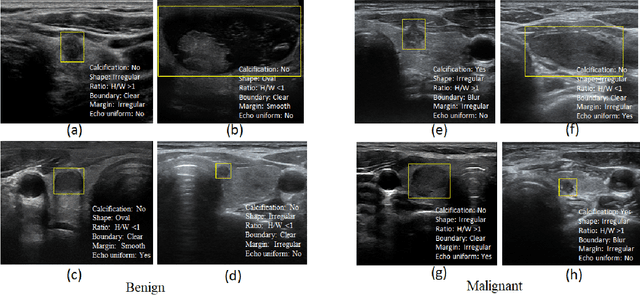
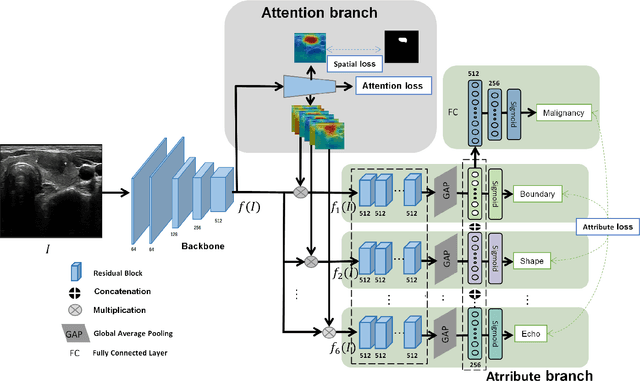
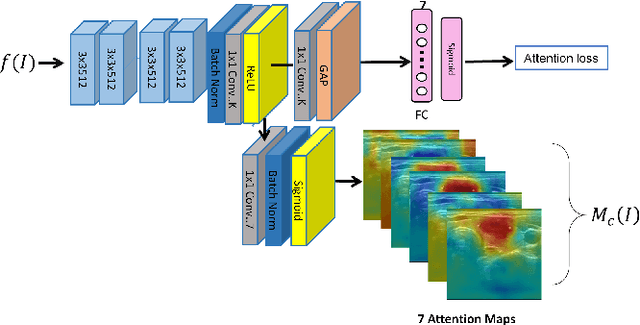
Ultrasound (US) is the primary imaging technique for the diagnosis of thyroid cancer. However, accurate identification of nodule malignancy is a challenging task that can elude less-experienced clinicians. Recently, many computer-aided diagnosis (CAD) systems have been proposed to assist this process. However, most of them do not provide the reasoning of their classification process, which may jeopardize their credibility in practical use. To overcome this, we propose a novel deep learning framework called multi-attribute attention network (MAA-Net) that is designed to mimic the clinical diagnosis process. The proposed model learns to predict nodular attributes and infer their malignancy based on these clinically-relevant features. A multi-attention scheme is adopted to generate customized attention to improve each task and malignancy diagnosis. Furthermore, MAA-Net utilizes nodule delineations as nodules spatial prior guidance for the training rather than cropping the nodules with additional models or human interventions to prevent losing the context information. Validation experiments were performed on a large and challenging dataset containing 4554 patients. Results show that the proposed method outperformed other state-of-the-art methods and provides interpretable predictions that may better suit clinical needs.
Personalized Diagnostic Tool for Thyroid Cancer Classification using Multi-view Ultrasound
Jul 01, 2022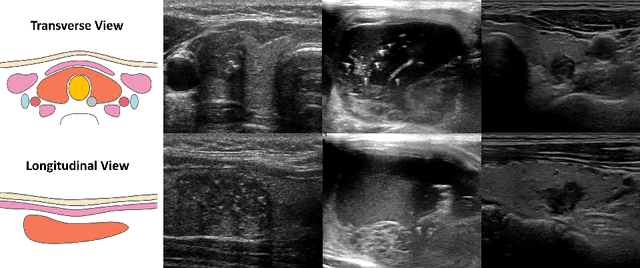
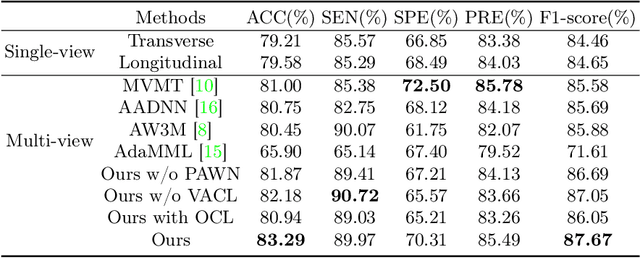
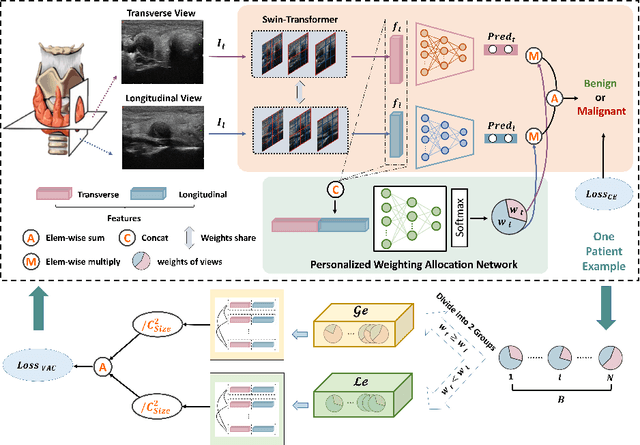
Over the past decades, the incidence of thyroid cancer has been increasing globally. Accurate and early diagnosis allows timely treatment and helps to avoid over-diagnosis. Clinically, a nodule is commonly evaluated from both transverse and longitudinal views using thyroid ultrasound. However, the appearance of the thyroid gland and lesions can vary dramatically across individuals. Identifying key diagnostic information from both views requires specialized expertise. Furthermore, finding an optimal way to integrate multi-view information also relies on the experience of clinicians and adds further difficulty to accurate diagnosis. To address these, we propose a personalized diagnostic tool that can customize its decision-making process for different patients. It consists of a multi-view classification module for feature extraction and a personalized weighting allocation network that generates optimal weighting for different views. It is also equipped with a self-supervised view-aware contrastive loss to further improve the model robustness towards different patient groups. Experimental results show that the proposed framework can better utilize multi-view information and outperform the competing methods.