 Add to Chrome
 Add to Firefox
 Add to Edge
Patch Policy: Efficient Embodied Control via Dense Visual Representations
Jul 20, 2026
Pretrained dense visual features from Vision Transformers (ViTs) are powerful yet have been underutilized in robot learning. Modern robot policies either compress each observation into a single global token, or rely on visual backbones trained from scratch, sacrificing both fine-grained spatial detail and the benefits of large-scale visual pre-training. While there exist policies that do operate on dense patch features like large vision-language-action models (VLAs), they tend to be heavy and slow, inheriting the full cost of a billion-parameter vision-language model (VLM) backbone. We close this gap with Patch Policy, a minimal architectural extension that enables transformer-based policies to consume dense pre-trained patch tokens directly without the computational overhead of a full VLM. At its core is a block-causal attention mask that preserves the temporal causality of standard policies while letting the model attend over many patch tokens per observation, alongside other state information. Patch Policy is lightweight, fast, and highly effective. Across four simulated and three real-world environment suites, our method achieves a 40% relative improvement over policies using state-of-the-art global-pooled representations. Furthermore, it surpasses fine-tuned OpenVLA-OFT by 18% while using roughly 0.7% of the parameters. We believe Patch Policy provides a pipeline for the robotics community to readily leverage continuing progress in visual representation learning, without sacrificing the training efficiency or inference speed required for high-frequency, reactive control. Videos can be viewed at https://patch-policy.github.io

YOR: Your Own Mobile Manipulator for Generalizable Robotics
Feb 11, 2026Recent advances in robot learning have generated significant interest in capable platforms that may eventually approach human-level competence. This interest, combined with the commoditization of actuators, has propelled growth in low-cost robotic platforms. However, the optimal form factor for mobile manipulation, especially on a budget, remains an open question. We introduce YOR, an open-source, low-cost mobile manipulator that integrates an omnidirectional base, a telescopic vertical lift, and two arms with grippers to achieve whole-body mobility and manipulation. Our design emphasizes modularity, ease of assembly using off-the-shelf components, and affordability, with a bill-of-materials cost under 10,000 USD. We demonstrate YOR's capability by completing tasks that require coordinated whole-body control, bimanual manipulation, and autonomous navigation. Overall, YOR offers competitive functionality for mobile manipulation research at a fraction of the cost of existing platforms. Project website: https://www.yourownrobot.ai/
Contact-Anchored Policies: Contact Conditioning Creates Strong Robot Utility Models
Feb 09, 2026The prevalent paradigm in robot learning attempts to generalize across environments, embodiments, and tasks with language prompts at runtime. A fundamental tension limits this approach: language is often too abstract to guide the concrete physical understanding required for robust manipulation. In this work, we introduce Contact-Anchored Policies (CAP), which replace language conditioning with points of physical contact in space. Simultaneously, we structure CAP as a library of modular utility models rather than a monolithic generalist policy. This factorization allows us to implement a real-to-sim iteration cycle: we build EgoGym, a lightweight simulation benchmark, to rapidly identify failure modes and refine our models and datasets prior to real-world deployment. We show that by conditioning on contact and iterating via simulation, CAP generalizes to novel environments and embodiments out of the box on three fundamental manipulation skills while using only 23 hours of demonstration data, and outperforms large, state-of-the-art VLAs in zero-shot evaluations by 56%. All model checkpoints, codebase, hardware, simulation, and datasets will be open-sourced. Project page: https://cap-policy.github.io/
DynaMo: In-Domain Dynamics Pretraining for Visuo-Motor Control
Sep 18, 2024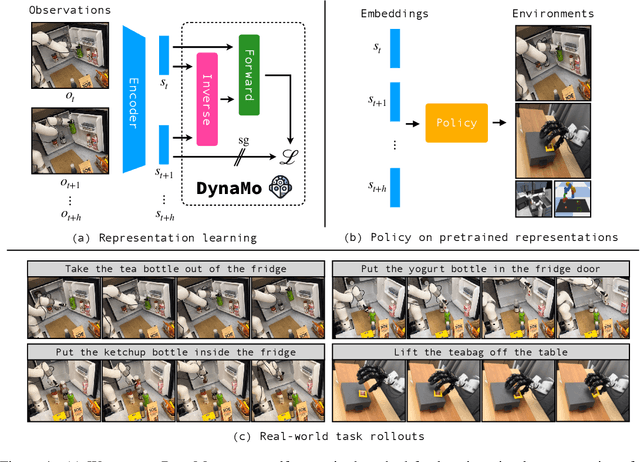
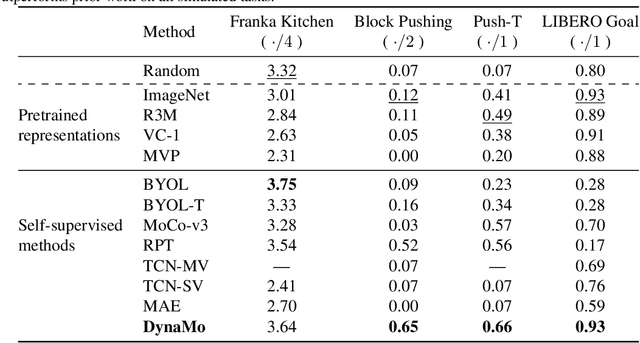
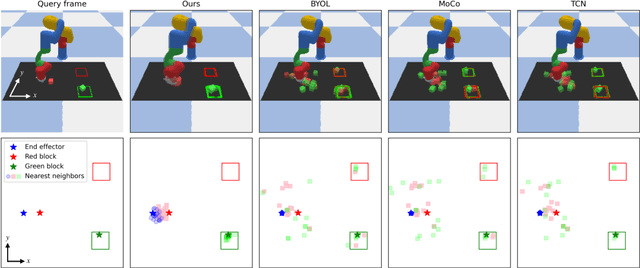
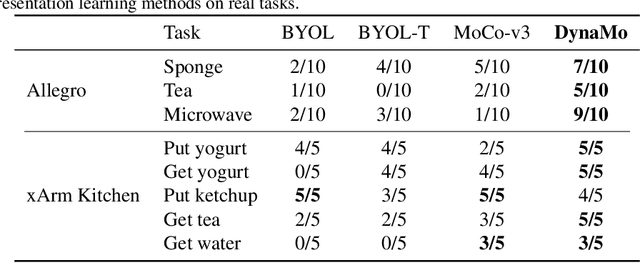
Imitation learning has proven to be a powerful tool for training complex visuomotor policies. However, current methods often require hundreds to thousands of expert demonstrations to handle high-dimensional visual observations. A key reason for this poor data efficiency is that visual representations are predominantly either pretrained on out-of-domain data or trained directly through a behavior cloning objective. In this work, we present DynaMo, a new in-domain, self-supervised method for learning visual representations. Given a set of expert demonstrations, we jointly learn a latent inverse dynamics model and a forward dynamics model over a sequence of image embeddings, predicting the next frame in latent space, without augmentations, contrastive sampling, or access to ground truth actions. Importantly, DynaMo does not require any out-of-domain data such as Internet datasets or cross-embodied datasets. On a suite of six simulated and real environments, we show that representations learned with DynaMo significantly improve downstream imitation learning performance over prior self-supervised learning objectives, and pretrained representations. Gains from using DynaMo hold across policy classes such as Behavior Transformer, Diffusion Policy, MLP, and nearest neighbors. Finally, we ablate over key components of DynaMo and measure its impact on downstream policy performance. Robot videos are best viewed at https://dynamo-ssl.github.io
Open X-Embodiment: Robotic Learning Datasets and RT-X Models
Oct 17, 2023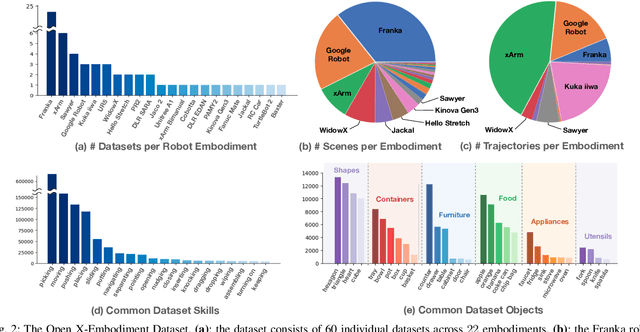
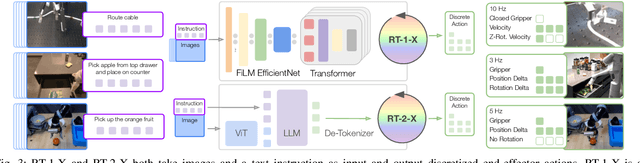


Large, high-capacity models trained on diverse datasets have shown remarkable successes on efficiently tackling downstream applications. In domains from NLP to Computer Vision, this has led to a consolidation of pretrained models, with general pretrained backbones serving as a starting point for many applications. Can such a consolidation happen in robotics? Conventionally, robotic learning methods train a separate model for every application, every robot, and even every environment. Can we instead train generalist X-robot policy that can be adapted efficiently to new robots, tasks, and environments? In this paper, we provide datasets in standardized data formats and models to make it possible to explore this possibility in the context of robotic manipulation, alongside experimental results that provide an example of effective X-robot policies. We assemble a dataset from 22 different robots collected through a collaboration between 21 institutions, demonstrating 527 skills (160266 tasks). We show that a high-capacity model trained on this data, which we call RT-X, exhibits positive transfer and improves the capabilities of multiple robots by leveraging experience from other platforms. More details can be found on the project website $\href{https://robotics-transformer-x.github.io}{\text{robotics-transformer-x.github.io}}$.
From Play to Policy: Conditional Behavior Generation from Uncurated Robot Data
Oct 19, 2022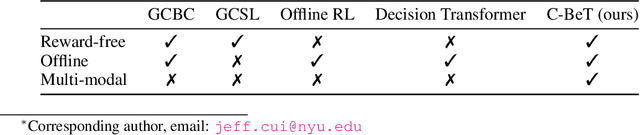
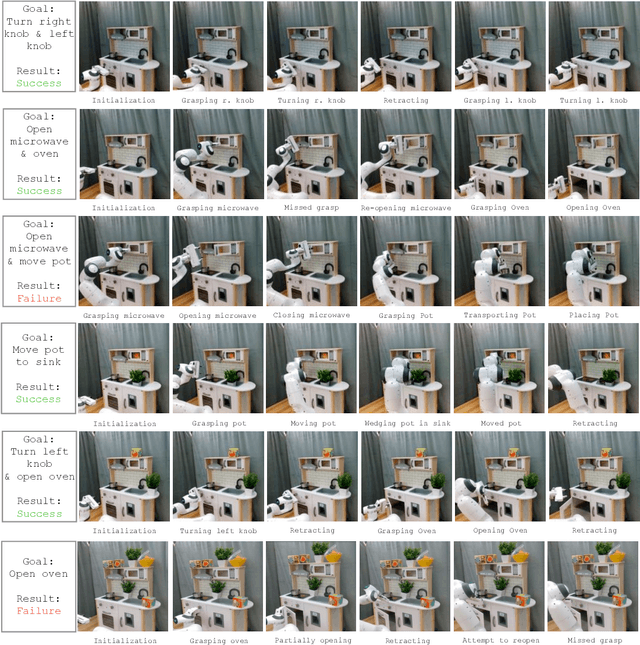
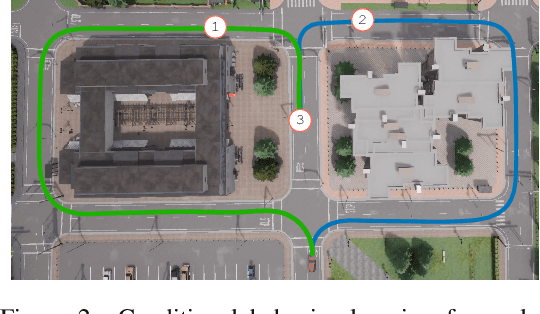

While large-scale sequence modeling from offline data has led to impressive performance gains in natural language and image generation, directly translating such ideas to robotics has been challenging. One critical reason for this is that uncurated robot demonstration data, i.e. play data, collected from non-expert human demonstrators are often noisy, diverse, and distributionally multi-modal. This makes extracting useful, task-centric behaviors from such data a difficult generative modeling problem. In this work, we present Conditional Behavior Transformers (C-BeT), a method that combines the multi-modal generation ability of Behavior Transformer with future-conditioned goal specification. On a suite of simulated benchmark tasks, we find that C-BeT improves upon prior state-of-the-art work in learning from play data by an average of 45.7%. Further, we demonstrate for the first time that useful task-centric behaviors can be learned on a real-world robot purely from play data without any task labels or reward information. Robot videos are best viewed on our project website: https://play-to-policy.github.io
Behavior Transformers: Cloning $k$ modes with one stone
Jun 22, 2022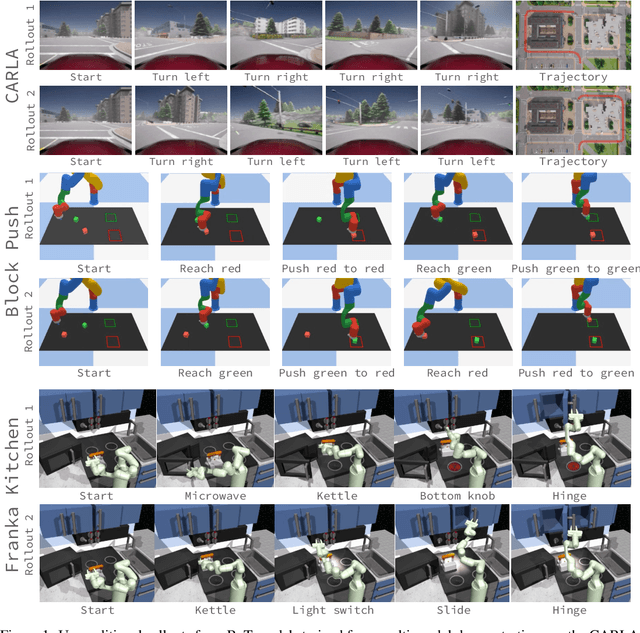
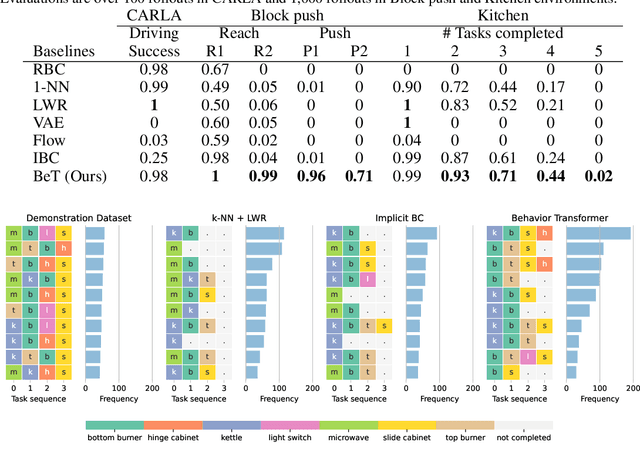
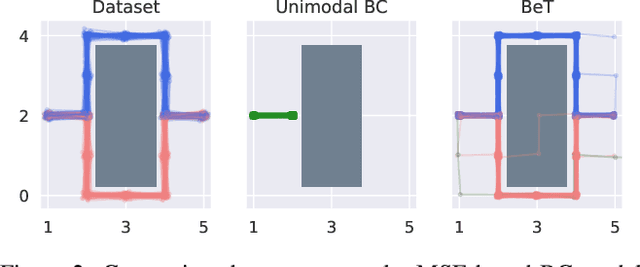
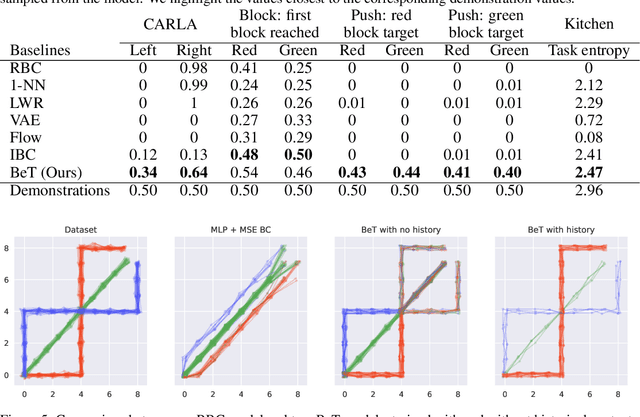
While behavior learning has made impressive progress in recent times, it lags behind computer vision and natural language processing due to its inability to leverage large, human-generated datasets. Human behaviors have wide variance, multiple modes, and human demonstrations typically do not come with reward labels. These properties limit the applicability of current methods in Offline RL and Behavioral Cloning to learn from large, pre-collected datasets. In this work, we present Behavior Transformer (BeT), a new technique to model unlabeled demonstration data with multiple modes. BeT retrofits standard transformer architectures with action discretization coupled with a multi-task action correction inspired by offset prediction in object detection. This allows us to leverage the multi-modal modeling ability of modern transformers to predict multi-modal continuous actions. We experimentally evaluate BeT on a variety of robotic manipulation and self-driving behavior datasets. We show that BeT significantly improves over prior state-of-the-art work on solving demonstrated tasks while capturing the major modes present in the pre-collected datasets. Finally, through an extensive ablation study, we analyze the importance of every crucial component in BeT. Videos of behavior generated by BeT are available at https://notmahi.github.io/bet