 Add to Chrome
 Add to Firefox
 Add to Edge
FetchMan: Learning Visual Humanoid Loco-Manipulation Policies from Simulated Experiences
Aug 17, 2026
Visual loco-manipulation policies that can generalize to novel scenes and objects have long been a goal of robotics research. However, today's data-hungry algorithms make collecting sufficient demonstrations a struggle for tabletop manipulation, and even more so for humanoids that must also walk and balance. Learning from simulated data and transferring that behavior to the real world, as is commonly done in locomotion, sidesteps this struggle, so we replicate that recipe for loco-manipulation. In doing so, we find that cloning synthetic demonstrations results in a low performance ceiling no matter the amount of training data. Reinforcement learning breaks through it, and refining the cloned policy with Flow-GRPO on a single sparse reward yields performance that synthetic behavior cloning cannot match. Together, these stages form our end-to-end sim-to-real pipeline spanning more than 150,000 scenes, which we use to train FetchMan. We evaluate it on FetchMan-Bench, a simulation benchmark we release, and deploy it zero-shot on a real Unitree G1, where our single-object reach-and-pick policy walks to and grasps a target across unseen scenes at 73.3% success. Finally, we extend this recipe to multi-object training, a first step toward loco-manipulation generalist policies at this data scale.

COBALT: Crowdsourcing Robot Learning via Cloud-Based Teleoperation with Smartphones
May 20, 2026The scarcity of large-scale, high-quality demonstration data remains a bottleneck in scaling imitation learning for robotic manipulation. We present COBALT, a teleoperation platform designed to democratize robot learning at scale both in simulation and in the real world. By leveraging vectorized environments, our scalable, load-balanced infrastructure supports concurrent teleoperation by multiple users on a single GPU, yielding a significant reduction in teleoperation cost. Operators can connect from nearly anywhere on Earth using commonly available devices, including single or dual smartphones, VR headsets, 3D mice, and keyboards. An inmemory data cache and efficient video streaming keep control and rendering synchronous, sustaining dozens of concurrent users at 20 Hz with sub-100 ms end-to-end latency for up to 8 concurrent users per GPU. We also demonstrate stable operation supporting 256 simulated clients across 8 GPUs, underscoring the system's ability to scale across hardware and within individual servers. We perform a comprehensive user study showing that phone-based teleoperation performs comparably to or better than specialized hardware, enabling faster, more ergonomic data collection. To ensure data quality, COBALT logs a suite of real-time metrics to automatically filter suboptimal demonstrations. We further demonstrate that a structured user training curriculum significantly improves data collection quality. Guided by insights from our user study, we crowdsource the collection of a large-scale, high-quality pilot dataset with 7500+ demonstrations (50+ hours) collected with smartphones across nine countries over five days. We validate the dataset's quality by training state-of-the-art imitation learning algorithms. Please visit https://cobalt-teleop.github.io/ for more details.
TeleDex: Accessible Dexterous Teleoperation
Mar 17, 2026Despite increasing dataset scale and model capacity, robot manipulation policies still struggle to generalize beyond their training distributions. As a result, deploying state-of-the-art policies in new environments, tasks, or robot embodiments often requires collecting additional demonstrations. Enabling this in real-world deployment settings requires tools that allow users to collect demonstrations quickly, affordably, and with minimal setup. We present TeleDex, an open-source system for intuitive teleoperation of dexterous hands and robotic manipulators using any readily available phone. The system streams low-latency 6-DoF wrist poses and articulated 21-DoF hand state estimates from the phone, which are retargeted to robot arms and multi-fingered hands without requiring external tracking infrastructure. TeleDex supports both a handheld phone-only mode and an optional 3D-printable hand-mounted interface for finger-level teleoperation. By lowering the hardware and setup barriers to dexterous teleoperation, TeleDex enables users to quickly collect demonstrations during deployment to support policy fine-tuning. We evaluate the system across simulation and real-world manipulation tasks, demonstrating its effectiveness as a unified scalable interface for robot teleoperation. All software and hardware designs, along with demonstration videos, are open-source and available at orayyan.com/teledex.
MolmoB0T: Large-Scale Simulation Enables Zero-Shot Manipulation
Mar 17, 2026A prevailing view in robot learning is that simulation alone is not enough; effective sim-to-real transfer is widely believed to require at least some real-world data collection or task-specific fine-tuning to bridge the gap between simulated and physical environments. We challenge that assumption. With sufficiently large-scale and diverse simulated synthetic training data, we show that zero-shot transfer to the real world is not only possible, but effective for both static and mobile manipulation. We introduce MolmoBot-Engine, a fully open-source pipeline for procedural data generation across robots, tasks, and diverse simulated environments in MolmoSpaces. With it, we release MolmoBot-Data, a dataset of 1.8 million expert trajectories for articulated object manipulation and pick-and-place tasks. We train three policy classes: MolmoBot, a Molmo2-based multi-frame vision-language model with a flow-matching action head; MolmoBot-Pi0, which replicates the $π_0$ architecture to enable direct comparison; and MolmoBot-SPOC, a lightweight policy suitable for edge deployment and amenable to RL fine-tuning. We evaluate on two robotic platforms: the Franka FR3 for tabletop manipulation tasks and the Rainbow Robotics RB-Y1 mobile manipulator for door opening, drawer manipulation, cabinet interaction, and mobile pick-and-place. Without any real-world fine-tuning, our policies achieve zero-shot transfer to unseen objects and environments. On tabletop pick-and-place, MolmoBot achieves a success rate of 79.2% in real world evaluations across 4 settings, outperforming $π_{0.5}$ at 39.2%. Our results demonstrate that procedural environment generation combined with diverse articulated assets can produce robust manipulation policies that generalize broadly to the real world. Technical Blog: https://allenai.org/blog/molmobot-robot-manipulation
MolmoSpaces: A Large-Scale Open Ecosystem for Robot Navigation and Manipulation
Feb 11, 2026Deploying robots at scale demands robustness to the long tail of everyday situations. The countless variations in scene layout, object geometry, and task specifications that characterize real environments are vast and underrepresented in existing robot benchmarks. Measuring this level of generalization requires infrastructure at a scale and diversity that physical evaluation alone cannot provide. We introduce MolmoSpaces, a fully open ecosystem to support large-scale benchmarking of robot policies. MolmoSpaces consists of over 230k diverse indoor environments, ranging from handcrafted household scenes to procedurally generated multiroom houses, populated with 130k richly annotated object assets, including 48k manipulable objects with 42M stable grasps. Crucially, these environments are simulator-agnostic, supporting popular options such as MuJoCo, Isaac, and ManiSkill. The ecosystem supports the full spectrum of embodied tasks: static and mobile manipulation, navigation, and multiroom long-horizon tasks requiring coordinated perception, planning, and interaction across entire indoor environments. We also design MolmoSpaces-Bench, a benchmark suite of 8 tasks in which robots interact with our diverse scenes and richly annotated objects. Our experiments show MolmoSpaces-Bench exhibits strong sim-to-real correlation (R = 0.96, \r{ho} = 0.98), confirm newer and stronger zero-shot policies outperform earlier versions in our benchmarks, and identify key sensitivities to prompt phrasing, initial joint positions, and camera occlusion. Through MolmoSpaces and its open-source assets and tooling, we provide a foundation for scalable data generation, policy training, and benchmark creation for robot learning research.
Contact-Anchored Policies: Contact Conditioning Creates Strong Robot Utility Models
Feb 09, 2026The prevalent paradigm in robot learning attempts to generalize across environments, embodiments, and tasks with language prompts at runtime. A fundamental tension limits this approach: language is often too abstract to guide the concrete physical understanding required for robust manipulation. In this work, we introduce Contact-Anchored Policies (CAP), which replace language conditioning with points of physical contact in space. Simultaneously, we structure CAP as a library of modular utility models rather than a monolithic generalist policy. This factorization allows us to implement a real-to-sim iteration cycle: we build EgoGym, a lightweight simulation benchmark, to rapidly identify failure modes and refine our models and datasets prior to real-world deployment. We show that by conditioning on contact and iterating via simulation, CAP generalizes to novel environments and embodiments out of the box on three fundamental manipulation skills while using only 23 hours of demonstration data, and outperforms large, state-of-the-art VLAs in zero-shot evaluations by 56%. All model checkpoints, codebase, hardware, simulation, and datasets will be open-sourced. Project page: https://cap-policy.github.io/
RCM-Constrained Manipulator Trajectory Tracking Using Differential Kinematics Control
Sep 09, 2024
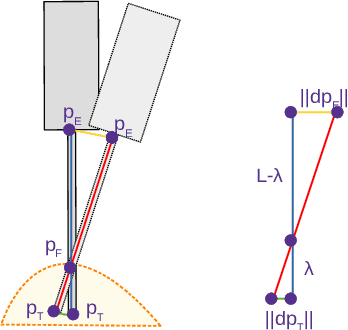

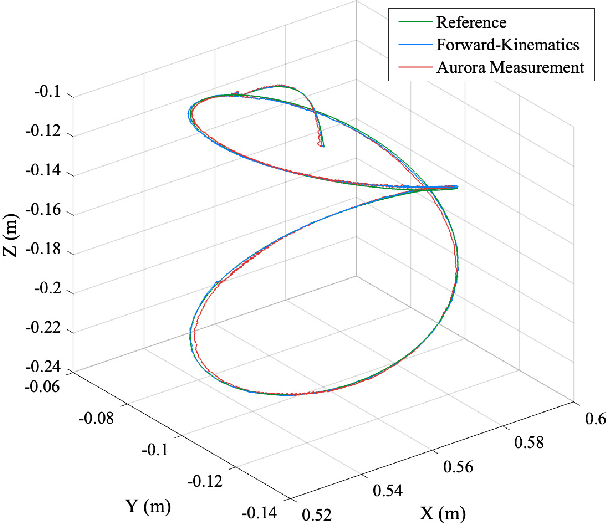
This paper proposes an approach for controlling surgical robotic systems, while complying with the Remote Center of Motion (RCM) constraint in Robot-Assisted Minimally Invasive Surgery (RA-MIS). In this approach, the RCM-constraint is upheld algorithmically, providing flexibility in the positioning of the insertion point and enabling compatibility with a wide range of general-purpose robots. The paper further investigates the impact of the tool's insertion ratio on the RCM-error, and introduces a manipulability index of the robot which considers the RCM-error that it is used to find a starting configuration. To accurately evaluate the proposed method's trajectory tracking within an RCM-constrained environment, an electromagnetic tracking system is employed. The results demonstrate the effectiveness of the proposed method in addressing the RCM constraint problem in RA-MIS.
* 6 pages, 7 figures. Published in the 21st International Conference on Advanced Robotics (ICAR 2023)