 Add to Chrome
 Add to Firefox
 Add to Edge
RiboSphere: Learning Unified and Efficient Representations of RNA Structures
Mar 20, 2026
Accurate RNA structure modeling remains difficult because RNA backbones are highly flexible, non-canonical interactions are prevalent, and experimentally determined 3D structures are comparatively scarce. We introduce \emph{RiboSphere}, a framework that learns \emph{discrete} geometric representations of RNA by combining vector quantization with flow matching. Our design is motivated by the modular organization of RNA architecture: complex folds are composed from recurring structural motifs. RiboSphere uses a geometric transformer encoder to produce SE(3)-invariant (rotation/translation-invariant) features, which are discretized with finite scalar quantization (FSQ) into a finite vocabulary of latent codes. Conditioned on these discrete codes, a flow-matching decoder reconstructs atomic coordinates, enabling high-fidelity structure generation. We find that the learned code indices are enriched for specific RNA motifs, suggesting that the model captures motif-level compositional structure rather than acting as a purely compressive bottleneck. Across benchmarks, RiboSphere achieves strong performance in structure reconstruction (RMSD 1.25\,Å, TM-score 0.84), and its pretrained discrete representations transfer effectively to inverse folding and RNA--ligand binding prediction, with robust generalization in data-scarce regimes.

EDM-ARS: A Domain-Specific Multi-Agent System for Automated Educational Data Mining Research
Mar 18, 2026In this technical report, we present the Educational Data Mining Automated Research System (EDM-ARS), a domain-specific multi-agent pipeline that automates end-to-end educational data mining (EDM) research. We conceptualize EDM-ARS as a general framework for domain-aware automated research pipelines, where educational expertise is embedded into each stage of the research lifecycle. As a first instantiation of this framework, we focus on predictive modeling tasks. Within this scope, EDM-ARS orchestrates five specialized LLM-powered agents (ProblemFormulator, DataEngineer, Analyst, Critic, and Writer) through a state-machine coordinator that supports revision loops, checkpoint-based recovery, and sandboxed code execution. Given a research prompt and a dataset, EDM-ARS produces a complete LaTeX manuscript with real Semantic Scholar citations, validated machine learning analyses, and automated methodological peer review. We also provide a detailed description of the system architecture, the three-tier data registry design that encodes educational domain expertise, the specification of each agent, the inter-agent communication protocol, and mechanisms for error-handling and self-correction. Finally, we discuss current limitations, including single-dataset scope and formulaic paper output, and outline a phased roadmap toward causal inference, transfer learning, psychometric, and multi-dataset generalization. EDM-ARS is released as an open-source project to support the educational research community.
An Efficient Additive Kolmogorov-Arnold Transformer for Point-Level Maize Localization in Unmanned Aerial Vehicle Imagery
Jan 12, 2026High-resolution UAV photogrammetry has become a key technology for precision agriculture, enabling centimeter-level crop monitoring and point-level plant localization. However, point-level maize localization in UAV imagery remains challenging due to (1) extremely small object-to-pixel ratios, typically less than 0.1%, (2) prohibitive computational costs of quadratic attention on ultra-high-resolution images larger than 3000 x 4000 pixels, and (3) agricultural scene-specific complexities such as sparse object distribution and environmental variability that are poorly handled by general-purpose vision models. To address these challenges, we propose the Additive Kolmogorov-Arnold Transformer (AKT), which replaces conventional multilayer perceptrons with Pade Kolmogorov-Arnold Network (PKAN) modules to enhance functional expressivity for small-object feature extraction, and introduces PKAN Additive Attention (PAA) to model multiscale spatial dependencies with reduced computational complexity. In addition, we present the Point-based Maize Localization (PML) dataset, consisting of 1,928 high-resolution UAV images with approximately 501,000 point annotations collected under real field conditions. Extensive experiments show that AKT achieves an average F1-score of 62.8%, outperforming state-of-the-art methods by 4.2%, while reducing FLOPs by 12.6% and improving inference throughput by 20.7%. For downstream tasks, AKT attains a mean absolute error of 7.1 in stand counting and a root mean square error of 1.95-1.97 cm in interplant spacing estimation. These results demonstrate that integrating Kolmogorov-Arnold representation theory with efficient attention mechanisms offers an effective framework for high-resolution agricultural remote sensing.
Joint Probing and Scheduling for Cache-Aided Hybrid Satellite-Terrestrial Networks
Oct 06, 2025Caching is crucial in hybrid satellite-terrestrial networks to reduce latency, optimize throughput, and improve data availability by storing frequently accessed content closer to users, especially in bandwidth-limited satellite systems, requiring strategic Medium Access Control (MAC) layer. This paper addresses throughput optimization in satellite-terrestrial integrated networks through opportunistic cooperative caching. We propose a joint probing and scheduling strategy to enhance content retrieval efficiency. The strategy leverages the LEO satellite to probe satellite-to-ground links and cache states of multiple cooperative terrestrial stations, enabling dynamic user scheduling for content delivery. Using an optimal stopping theoretic approach with two levels of incomplete information, we make real-time decisions on satellite-terrestrial hybrid links and caching probing. Our threshold-based strategy optimizes probing and scheduling, significantly improving average system throughput by exploiting cooperative caching, satellite-terrestrial link transmission, and time diversity from dynamic user requests. Simulation results validate the effectiveness and practicality of the proposed strategies.
From Supervision to Exploration: What Does Protein Language Model Learn During Reinforcement Learning?
Oct 02, 2025Protein language models (PLMs) have advanced computational protein science through large-scale pretraining and scalable architectures. In parallel, reinforcement learning (RL) has broadened exploration and enabled precise multi-objective optimization in protein design. Yet whether RL can push PLMs beyond their pretraining priors to uncover latent sequence-structure-function rules remains unclear. We address this by pairing RL with PLMs across four domains: antimicrobial peptide design, kinase variant optimization, antibody engineering, and inverse folding. Using diverse RL algorithms and model classes, we ask if RL improves sampling efficiency and, more importantly, if it reveals capabilities not captured by supervised learning. Across benchmarks, RL consistently boosts success rates and sample efficiency. Performance follows a three-factor interaction: task headroom, reward fidelity, and policy capacity jointly determine gains. When rewards are accurate and informative, policies have sufficient capacity, and tasks leave room beyond supervised baselines, improvements scale; when rewards are noisy or capacity is constrained, gains saturate despite exploration. This view yields practical guidance for RL in protein design: prioritize reward modeling and calibration before scaling policy size, match algorithm and regularization strength to task difficulty, and allocate capacity where marginal gains are largest. Implementation is available at https://github.com/chq1155/RL-PLM.
Knowledge-guided machine learning model with soil moisture for corn yield prediction under drought conditions
Mar 20, 2025Remote sensing (RS) techniques, by enabling non-contact acquisition of extensive ground observations, have become a valuable tool for corn yield prediction. Traditional process-based (PB) models are limited by fixed input features and struggle to incorporate large volumes of RS data. In contrast, machine learning (ML) models are often criticized for being ``black boxes'' with limited interpretability. To address these limitations, we used Knowledge-Guided Machine Learning (KGML), which combined the strengths of both approaches and fully used RS data. However, previous KGML methods overlooked the crucial role of soil moisture in plant growth. To bridge this gap, we proposed the Knowledge-Guided Machine Learning with Soil Moisture (KGML-SM) framework, using soil moisture as an intermediate variable to emphasize its key role in plant development. Additionally, based on the prior knowledge that the model may overestimate under drought conditions, we designed a drought-aware loss function that penalizes predicted yield in drought-affected areas. Our experiments showed that the KGML-SM model outperformed other ML models. Finally, we explored the relationships between drought, soil moisture, and corn yield prediction, assessing the importance of various features and analyzing how soil moisture impacts corn yield predictions across different regions and time periods.
Unleashing the Power of Emojis in Texts via Self-supervised Graph Pre-Training
Sep 26, 2024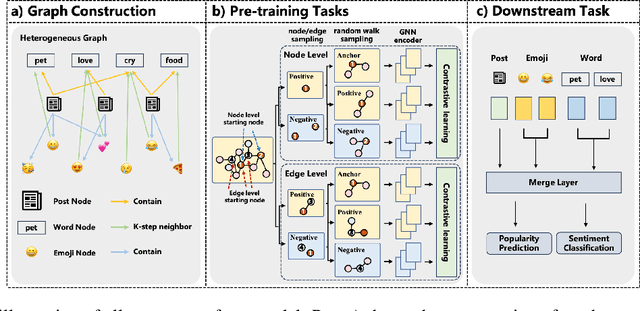
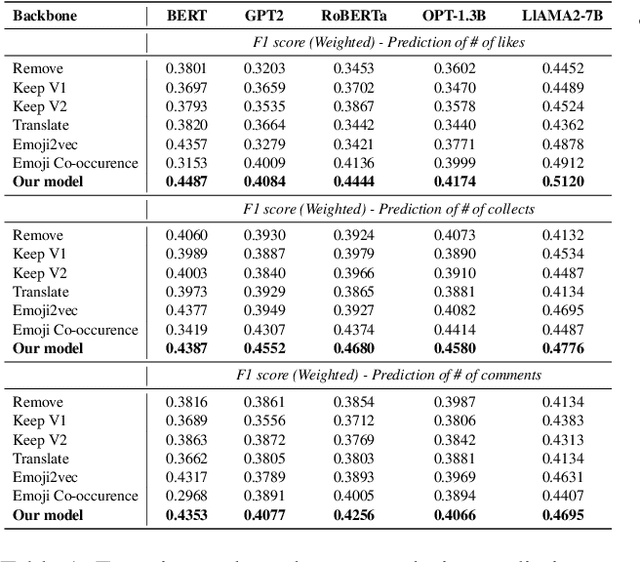
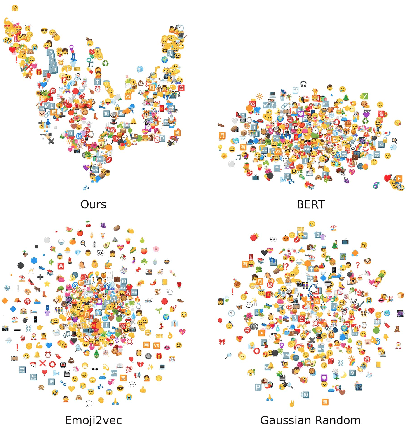
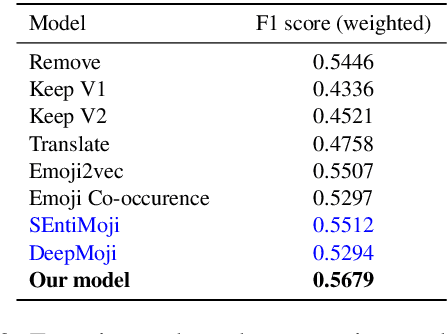
Emojis have gained immense popularity on social platforms, serving as a common means to supplement or replace text. However, existing data mining approaches generally either completely ignore or simply treat emojis as ordinary Unicode characters, which may limit the model's ability to grasp the rich semantic information in emojis and the interaction between emojis and texts. Thus, it is necessary to release the emoji's power in social media data mining. To this end, we first construct a heterogeneous graph consisting of three types of nodes, i.e. post, word and emoji nodes to improve the representation of different elements in posts. The edges are also well-defined to model how these three elements interact with each other. To facilitate the sharing of information among post, word and emoji nodes, we propose a graph pre-train framework for text and emoji co-modeling, which contains two graph pre-training tasks: node-level graph contrastive learning and edge-level link reconstruction learning. Extensive experiments on the Xiaohongshu and Twitter datasets with two types of downstream tasks demonstrate that our approach proves significant improvement over previous strong baseline methods.
Throughput Optimization in Cache-aided Networks: An Opportunistic Probing and Scheduling Approach
Sep 02, 2024

This paper addresses the challenges of throughput optimization in wireless cache-aided cooperative networks. We propose an opportunistic cooperative probing and scheduling strategy for efficient content delivery. The strategy involves the base station probing the relaying channels and cache states of multiple cooperative nodes, thereby enabling opportunistic user scheduling for content delivery. Leveraging the theory of Sequentially Planned Decision (SPD) optimization, we dynamically formulate decisions on cooperative probing and stopping time. Our proposed Reward Expected Thresholds (RET)-based strategy optimizes opportunistic probing and scheduling. This approach significantly enhances system throughput by exploiting gains from local caching, cooperative transmission and time diversity. Simulations confirm the effectiveness and practicality of the proposed Media Access Control (MAC) strategy.
Dynamic Cooperative MAC Optimization in RSU-Enhanced VANETs: A Distributed Approach
Feb 14, 2024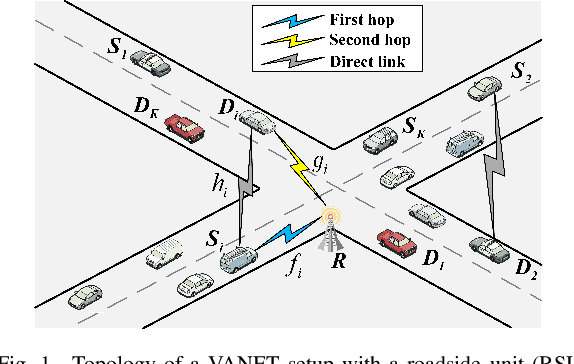
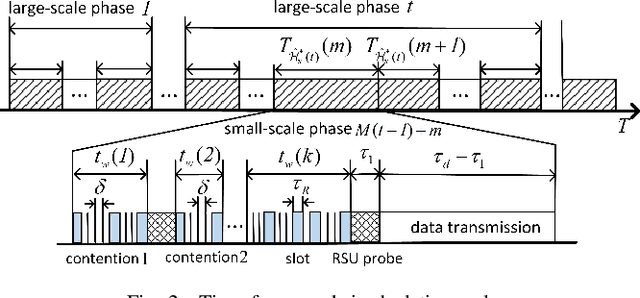
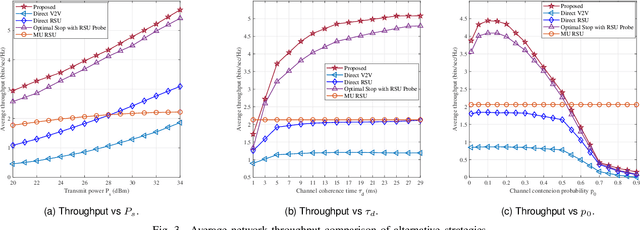
This paper presents an optimization approach for cooperative Medium Access Control (MAC) techniques in Vehicular Ad Hoc Networks (VANETs) equipped with Roadside Unit (RSU) to enhance network throughput. Our method employs a distributed cooperative MAC scheme based on Carrier Sense Multiple Access with Collision Avoidance (CSMA/CA) protocol, featuring selective RSU probing and adaptive transmission. It utilizes a dual timescale channel access framework, with a ``large-scale'' phase accounting for gradual changes in vehicle locations and a ``small-scale'' phase adapting to rapid channel fluctuations. We propose the RSU Probing and Cooperative Access (RPCA) strategy, a two-stage approach based on dynamic inter-vehicle distances from the RSU. Using optimal sequential planned decision theory, we rigorously prove its optimality in maximizing average system throughput per large-scale phase. For practical implementation in VANETs, we develop a distributed MAC algorithm with periodic location updates. It adjusts thresholds based on inter-vehicle and vehicle-RSU distances during the large-scale phase and accesses channels following the RPCA strategy with updated thresholds during the small-scale phase. Simulation results confirm the effectiveness and efficiency of our algorithm.
Learning county from pixels: Corn yield prediction with attention-weighted multiple instance learning
Dec 02, 2023Remote sensing technology has become a promising tool in yield prediction. Most prior work employs satellite imagery for county-level corn yield prediction by spatially aggregating all pixels within a county into a single value, potentially overlooking the detailed information and valuable insights offered by more granular data. To this end, this research examines each county at the pixel level and applies multiple instance learning to leverage detailed information within a county. In addition, our method addresses the "mixed pixel" issue caused by the inconsistent resolution between feature datasets and crop mask, which may introduce noise into the model and therefore hinder accurate yield prediction. Specifically, the attention mechanism is employed to automatically assign weights to different pixels, which can mitigate the influence of mixed pixels. The experimental results show that the developed model outperforms four other machine learning models over the past five years in the U.S. corn belt and demonstrates its best performance in 2022, achieving a coefficient of determination (R2) value of 0.84 and a root mean square error (RMSE) of 0.83. This paper demonstrates the advantages of our approach from both spatial and temporal perspectives. Furthermore, through an in-depth study of the relationship between mixed pixels and attention, it is verified that our approach can capture critical feature information while filtering out noise from mixed pixels.