 Add to Chrome
 Add to Firefox
 Add to Edge
ConceptM$^3$oE: Concept-Guided Multimodal Mixture of Experts for Interpretable Computational Pathology
May 27, 2026
Healthcare models are transitioning from unimodal prediction toward multimodal reasoning over heterogeneous diagnostic inputs. In computational pathology, for complex tumor subtypes where morphology alone can be challenging to distinguish, pathology reports and molecular measurements may provide additional diagnostic evidence alongside whole-slide images, yet existing models often fail to clarify how diverse signals assemble into recognizable diagnostic concepts. We propose ConceptM$^3$oE (Concept Multimodal MoE), which embeds concept formation directly within interaction-aware mixture-of-experts (MoE) pathways. The architecture decomposes evidence into modality-specific, redundant, and synergistic experts, which are then projected into structured concept bottlenecks mapping latent features to a hierarchy of morphology and biomarker concepts. To prevent the information loss typical of interpretable bottlenecks, we utilize residual pathways within each expert to allow task-relevant signals to flow both through the concepts and directly to the final task prediction, so that high performance is maintained alongside interpretability. Across an institutional pediatric brain tumor cohort and a public glioma cohort, the framework delivers competitive performance to unconstrained models while producing reasoning traces validated by an independent neuropathologist. In data-limited regimes, ConceptM$^3$oE improves limited-data performance, increasing macro-F1 from 56.41% to 66.70% at small training sizes compared to non-concept-informed baselines, while also showing faster training convergence consistent with the regularizing effect of concept learning. This work offers a scalable path toward high-performance medical AI that is inherently verifiable and better aligned with the complex decision-making of clinical practice.

SeqRoute: Global Budget-Aware Sequential LLM Routing via Offline Reinforcement Learning
May 25, 2026Existing LLM routing frameworks treat queries as independent events, neglecting the sequential nature of real-world user sessions constrained by global computational budgets. This mismatch inevitably leads to budget bankruptcy: myopic routing policies exhaust resources on early interactions, forcing subsequent and often more complex queries onto inadequate models. We introduce SeqRoute, a framework that formulates multi-turn routing as a finite-horizon Markov Decision Process and solves it via offline reinforcement learning. By incorporating the remaining budget into the state space and training with Conservative Q-Learning (CQL), SeqRoute learns delayed gratification to strategically preserve resources for high-stakes turns later in the session. To overcome data starvation, we propose Hindsight Budget Relabeling (HBR). This technique retrospectively simulates historical trajectories under diverse hypothetical budgets, expanding 10,000 raw sessions into 2.38 million transitions enriched with critical bankruptcy signals. At deployment, a dynamic $λ$-sweep mechanism enables zero-shot navigation of the cost-quality Pareto frontier without retraining. Extensive evaluations demonstrate that SeqRoute reduces operational costs by 6.0-73.5% while maintaining or improving quality, and suppresses bankruptcy rates to under 1%, strictly dominating behavior cloning, budget-aware heuristics, and static baselines across the entire Pareto frontier.
Non-destructive Degradation Pattern Decoupling for Ultra-early Battery Prototype Verification Using Physics-informed Machine Learning
Jun 01, 2024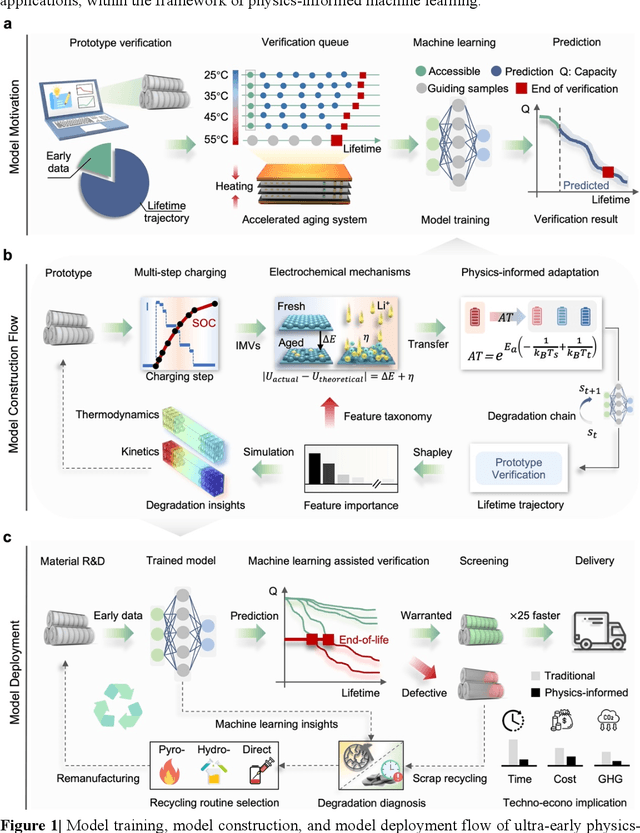
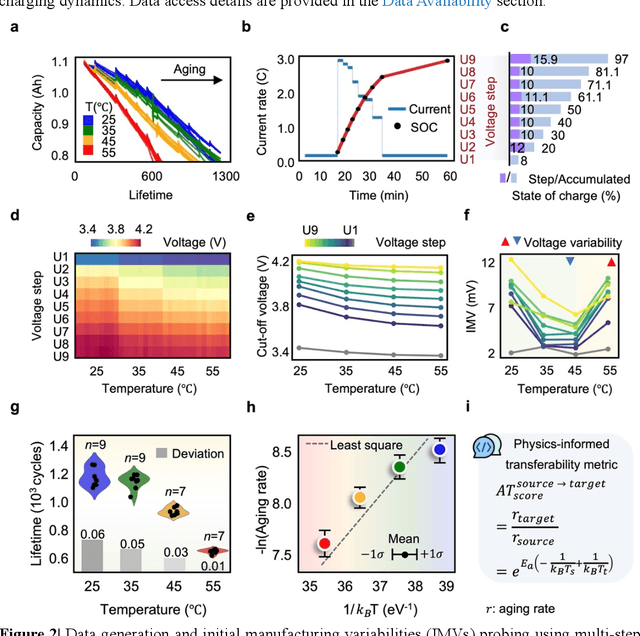
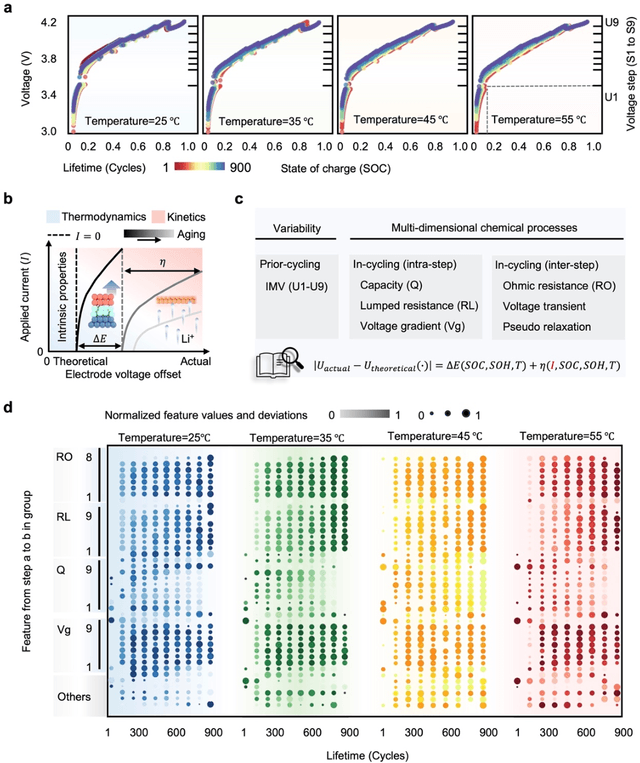
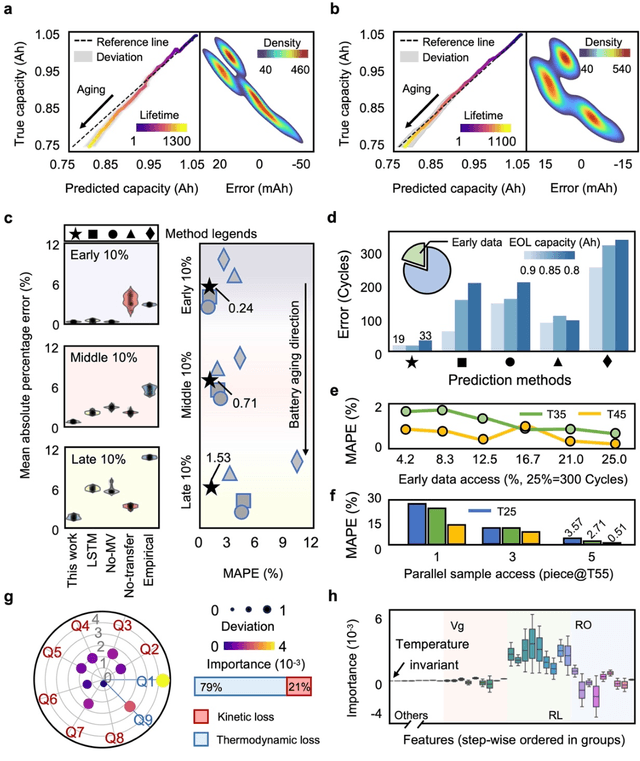
Manufacturing complexities and uncertainties have impeded the transition from material prototypes to commercial batteries, making prototype verification critical to quality assessment. A fundamental challenge involves deciphering intertwined chemical processes to characterize degradation patterns and their quantitative relationship with battery performance. Here we show that a physics-informed machine learning approach can quantify and visualize temporally resolved losses concerning thermodynamics and kinetics only using electric signals. Our method enables non-destructive degradation pattern characterization, expediting temperature-adaptable predictions of entire lifetime trajectories, rather than end-of-life points. The verification speed is 25 times faster yet maintaining 95.1% accuracy across temperatures. Such advances facilitate more sustainable management of defective prototypes before massive production, establishing a 19.76 billion USD scrap material recycling market by 2060 in China. By incorporating stepwise charge acceptance as a measure of the initial manufacturing variability of normally identical batteries, we can immediately identify long-term degradation variations. We attribute the predictive power to interpreting machine learning insights using material-agnostic featurization taxonomy for degradation pattern decoupling. Our findings offer new possibilities for dynamic system analysis, such as battery prototype degradation, demonstrating that complex pattern evolutions can be accurately predicted in a non-destructive and data-driven fashion by integrating physics-informed machine learning.