 Add to Chrome
 Add to Firefox
 Add to Edge
Battery-Sim-Agent: Leveraging LLM-Agent for Inverse Battery Parameter Estimation
May 28, 2026
Parameterizing high-fidelity "digital twins" of batteries is a critical yet challenging inverse problem that hinders the pace of battery innovation. Prevailing methods formulate this as a black-box optimization (BBO) task, employing algorithms that are sample-inefficient and blind to the underlying physics. In this work, we introduce a new paradigm that reframes the inverse problem as a reasoning task, and present Battery-Sim-Agent, the first framework to deploy a Large Language Model (LLM) agent in a closed loop with a high-fidelity battery simulator. The agent mimics a human scientist's workflow: it interprets rich, multi-modal feedback from the simulator, forms physically-grounded hypotheses to explain discrepancies, and proposes structured parameter updates. On a systematically constructed benchmark suite spanning diverse battery chemistries, operating conditions, and difficulty levels, our agent significantly outperforms strong BBO baselines like Bayesian optimization in identifying accurate parameters. We further demonstrate the framework's capability in complex long-horizon degradation fitting tasks and validate its practical applicability on real-world battery datasets. Our results highlight the promise of LLM-agents as reasoning-based optimizers for scientific discovery and battery parameter estimation.

Design Guidelines for Nonlinear Kalman Filters via Covariance Compensation
Mar 24, 2026Nonlinear extensions of the Kalman filter (KF), such as the extended Kalman filter (EKF) and the unscented Kalman filter (UKF), are indispensable for state estimation in complex dynamical systems, yet the conditions for a nonlinear KF to provide robust and accurate estimations remain poorly understood. This work proposes a theoretical framework that identifies the causes of failure and success in certain nonlinear KFs and establishes guidelines for their improvement. Central to our framework is the concept of covariance compensation: the deviation between the covariance predicted by a nonlinear KF and that of the EKF. With this definition and detailed theoretical analysis, we derive three design guidelines for nonlinear KFs: (i) invariance under orthogonal transformations, (ii) sufficient covariance compensation beyond the EKF baseline, and (iii) selection of compensation magnitude that favors underconfidence. Both theoretical analysis and empirical validation confirm that adherence to these principles significantly improves estimation accuracy, whereas fixed parameter choices commonly adopted in the literature are often suboptimal. The codes and the proofs for all the theorems in this paper are available at https://github.com/Shida-Jiang/Guidelines-for-Nonlinear-Kalman-Filters.
All-Mem: Agentic Lifelong Memory via Dynamic Topology Evolution
Mar 20, 2026Lifelong interactive agents are expected to assist users over months or years, which requires continually writing long term memories while retrieving the right evidence for each new query under fixed context and latency budgets. Existing memory systems often degrade as histories grow, yielding redundant, outdated, or noisy retrieved contexts. We present All-Mem, an online/offline lifelong memory framework that maintains a topology structured memory bank via explicit, non destructive consolidation, avoiding the irreversible information loss typical of summarization based compression. In online operation, it anchors retrieval on a bounded visible surface to keep coarse search cost bounded. Periodically offline, an LLM diagnoser proposes confidence scored topology edits executed with gating using three operators: SPLIT, MERGE, and UPDATE, while preserving immutable evidence for traceability. At query time, typed links enable hop bounded, budgeted expansion from active anchors to archived evidence when needed. Experiments on LOCOMO and LONGMEMEVAL show improved retrieval and QA over representative baselines.
CodeHacker: Automated Test Case Generation for Detecting Vulnerabilities in Competitive Programming Solutions
Feb 23, 2026The evaluation of Large Language Models (LLMs) for code generation relies heavily on the quality and robustness of test cases. However, existing benchmarks often lack coverage for subtle corner cases, allowing incorrect solutions to pass. To bridge this gap, we propose CodeHacker, an automated agent framework dedicated to generating targeted adversarial test cases that expose latent vulnerabilities in program submissions. Mimicking the hack mechanism in competitive programming, CodeHacker employs a multi-strategy approach, including stress testing, anti-hash attacks, and logic-specific targeting to break specific code submissions. To ensure the validity and reliability of these attacks, we introduce a Calibration Phase, where the agent iteratively refines its own Validator and Checker via self-generated adversarial probes before evaluating contestant code.Experiments demonstrate that CodeHacker significantly improves the True Negative Rate (TNR) of existing datasets, effectively filtering out incorrect solutions that were previously accepted. Furthermore, generated adversarial cases prove to be superior training data, boosting the performance of RL-trained models on benchmarks like LiveCodeBench.
PulseBat: A field-accessible dataset for second-life battery diagnostics from realistic histories using multidimensional rapid pulse test
Feb 24, 2025As electric vehicles (EVs) approach the end of their operational life, their batteries retain significant economic value and present promising opportunities for second-life use and material recycling. This is particularly compelling for Global South and other underdeveloped regions, where reliable energy storage is vital to addressing critical challenges posed by weak and even nonexistent power grid and energy infrastructures. However, despite this potential, widespread adoption has been hindered by critical uncertainties surrounding the technical performance, safety, and recertification of second-life batteries. In cases where they have been redeployed, mismatches between estimated and actual performance often render batteries technically unsuitable or hazardous, turning them into liabilities for communities they were intended to benefit. This considerable misalignment exacerbates energy access disparities and undermines the broader vision of energy justice, highlighting an urgent need for robust and scalable solutions to unlock the potential. In the PulseBat Dataset, the authors tested 464 retired lithium-ion batteries, covering 3 cathode material types, 6 historical usages, 3 physical formats, and 6 capacity designs. The pulse test experiments were performed repeatedly for each second-life battery with 10 pulse width, 10 pulse magnitude, multiple state-of-charge, and state-of-health conditions, e.g., from 0.37 to 1.03. The PulseBat Dataset recorded these test conditions and the voltage response as well as the temperature signals that were subject to the injected pulse current, which could be used as a valuable data resource for critical diagnostics tasks such as state-of-charge estimation, state-of-health estimation, cathode material type identification, open-circuit voltage reconstruction, thermal management, and beyond.
* Extended data descriptor of Nat Commun 15, 10154 (2024), https://doi.org/10.1038/s41467-024-54454-0
Non-destructive Degradation Pattern Decoupling for Ultra-early Battery Prototype Verification Using Physics-informed Machine Learning
Jun 01, 2024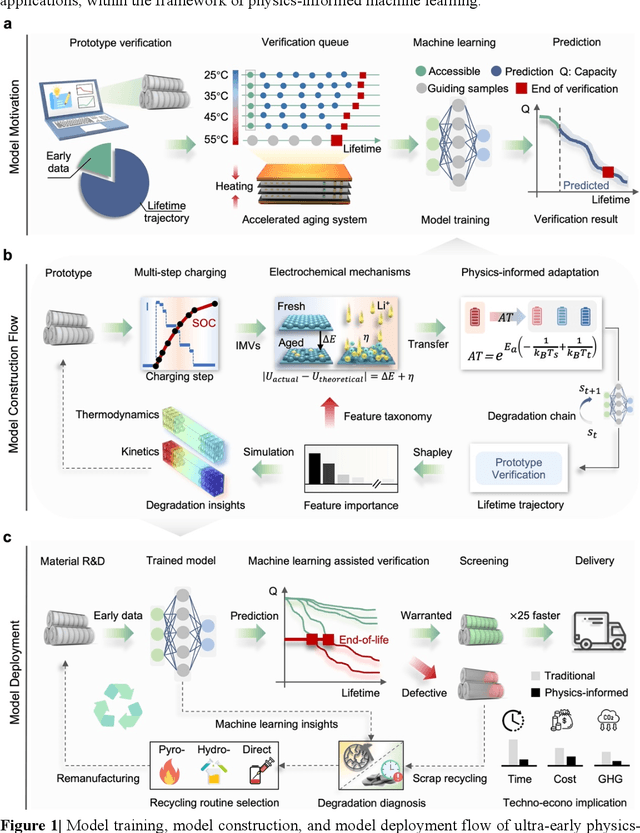
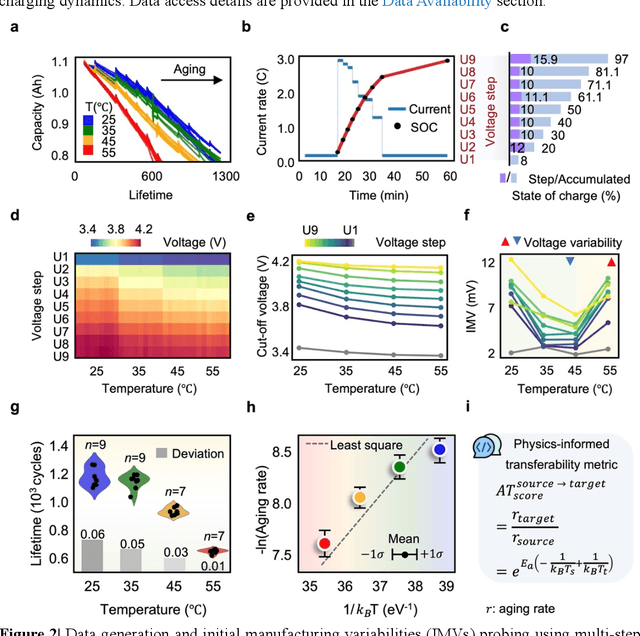
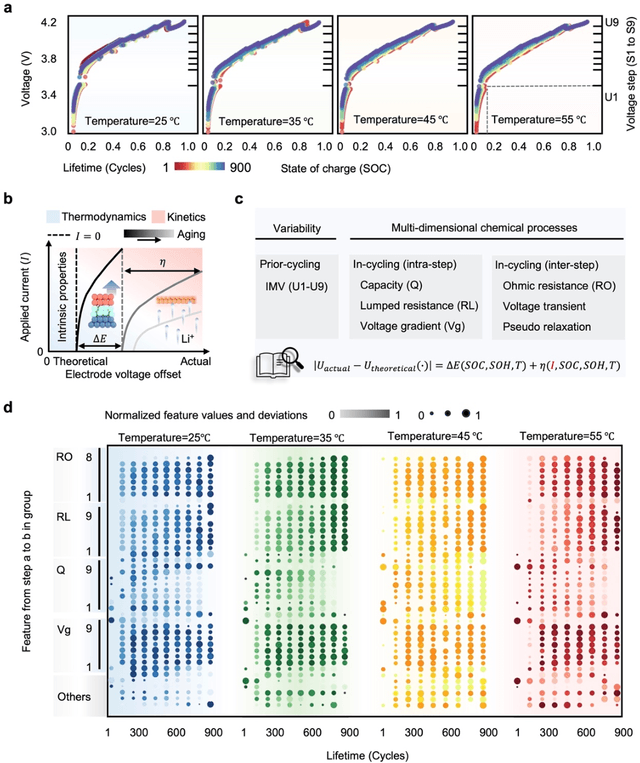
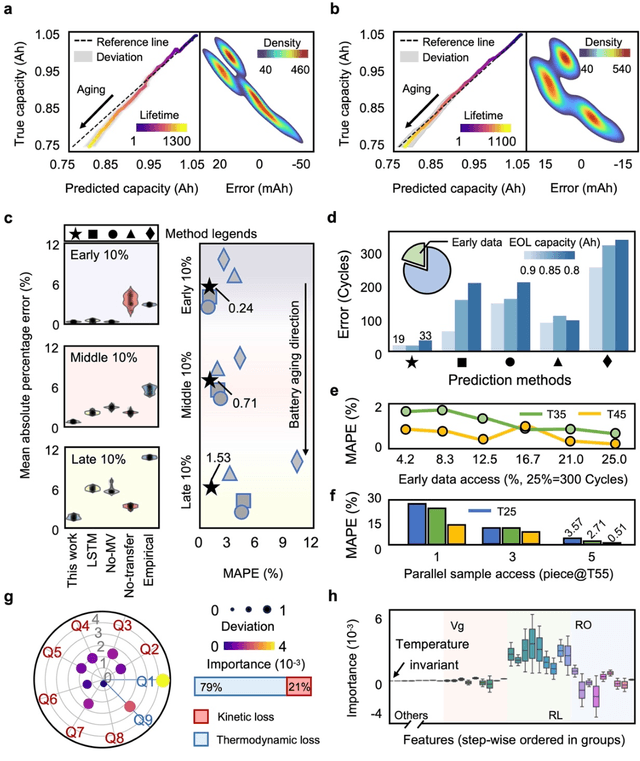
Manufacturing complexities and uncertainties have impeded the transition from material prototypes to commercial batteries, making prototype verification critical to quality assessment. A fundamental challenge involves deciphering intertwined chemical processes to characterize degradation patterns and their quantitative relationship with battery performance. Here we show that a physics-informed machine learning approach can quantify and visualize temporally resolved losses concerning thermodynamics and kinetics only using electric signals. Our method enables non-destructive degradation pattern characterization, expediting temperature-adaptable predictions of entire lifetime trajectories, rather than end-of-life points. The verification speed is 25 times faster yet maintaining 95.1% accuracy across temperatures. Such advances facilitate more sustainable management of defective prototypes before massive production, establishing a 19.76 billion USD scrap material recycling market by 2060 in China. By incorporating stepwise charge acceptance as a measure of the initial manufacturing variability of normally identical batteries, we can immediately identify long-term degradation variations. We attribute the predictive power to interpreting machine learning insights using material-agnostic featurization taxonomy for degradation pattern decoupling. Our findings offer new possibilities for dynamic system analysis, such as battery prototype degradation, demonstrating that complex pattern evolutions can be accurately predicted in a non-destructive and data-driven fashion by integrating physics-informed machine learning.