 Add to Chrome
 Add to Firefox
 Add to Edge
ConceptM$^3$oE: Concept-Guided Multimodal Mixture of Experts for Interpretable Computational Pathology
May 27, 2026
Healthcare models are transitioning from unimodal prediction toward multimodal reasoning over heterogeneous diagnostic inputs. In computational pathology, for complex tumor subtypes where morphology alone can be challenging to distinguish, pathology reports and molecular measurements may provide additional diagnostic evidence alongside whole-slide images, yet existing models often fail to clarify how diverse signals assemble into recognizable diagnostic concepts. We propose ConceptM$^3$oE (Concept Multimodal MoE), which embeds concept formation directly within interaction-aware mixture-of-experts (MoE) pathways. The architecture decomposes evidence into modality-specific, redundant, and synergistic experts, which are then projected into structured concept bottlenecks mapping latent features to a hierarchy of morphology and biomarker concepts. To prevent the information loss typical of interpretable bottlenecks, we utilize residual pathways within each expert to allow task-relevant signals to flow both through the concepts and directly to the final task prediction, so that high performance is maintained alongside interpretability. Across an institutional pediatric brain tumor cohort and a public glioma cohort, the framework delivers competitive performance to unconstrained models while producing reasoning traces validated by an independent neuropathologist. In data-limited regimes, ConceptM$^3$oE improves limited-data performance, increasing macro-F1 from 56.41% to 66.70% at small training sizes compared to non-concept-informed baselines, while also showing faster training convergence consistent with the regularizing effect of concept learning. This work offers a scalable path toward high-performance medical AI that is inherently verifiable and better aligned with the complex decision-making of clinical practice.

PathMoE: Interpretable Multimodal Interaction Experts for Pediatric Brain Tumor Classification
Mar 02, 2026Accurate classification of pediatric central nervous system tumors remains challenging due to histological complexity and limited training data. While pathology foundation models have advanced whole-slide image (WSI) analysis, they often fail to leverage the rich, complementary information found in clinical text and tissue microarchitecture. To this end, we propose PathMoE, an interpretable multimodal framework that integrates H\&E slides, pathology reports, and nuclei-level cell graphs via an interaction-aware mixture-of-experts architecture built on state-of-the-art foundation models for each modality. By training specialized experts to capture modality uniqueness, redundancy, and synergy, PathMoE employs an input-dependent gating mechanism that dynamically weights these interactions, providing sample-level interpretability. We evaluate our framework on two dataset-specific classification tasks on an internal pediatric brain tumor dataset (PBT) and external TCGA datasets. PathMoE improves macro-F1 from 0.762 to 0.799 (+0.037) on PBT when integrating WSI, text, and graph modalities; on TCGA, augmenting WSI with graph knowledge improves macro-F1 from 0.668 to 0.709 (+0.041). These results demonstrate significant performance gains over state-of-the-art image-only baselines while revealing the specific modality interactions driving individual predictions. This interpretability is particularly critical for rare tumor subtypes, where transparent model reasoning is essential for clinical trust and diagnostic validation.
Path-RAG: Knowledge-Guided Key Region Retrieval for Open-ended Pathology Visual Question Answering
Nov 26, 2024
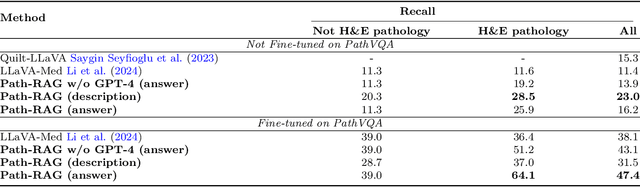

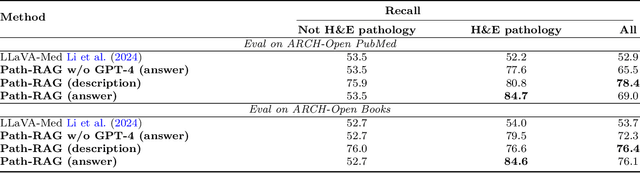
Accurate diagnosis and prognosis assisted by pathology images are essential for cancer treatment selection and planning. Despite the recent trend of adopting deep-learning approaches for analyzing complex pathology images, they fall short as they often overlook the domain-expert understanding of tissue structure and cell composition. In this work, we focus on a challenging Open-ended Pathology VQA (PathVQA-Open) task and propose a novel framework named Path-RAG, which leverages HistoCartography to retrieve relevant domain knowledge from pathology images and significantly improves performance on PathVQA-Open. Admitting the complexity of pathology image analysis, Path-RAG adopts a human-centered AI approach by retrieving domain knowledge using HistoCartography to select the relevant patches from pathology images. Our experiments suggest that domain guidance can significantly boost the accuracy of LLaVA-Med from 38% to 47%, with a notable gain of 28% for H&E-stained pathology images in the PathVQA-Open dataset. For longer-form question and answer pairs, our model consistently achieves significant improvements of 32.5% in ARCH-Open PubMed and 30.6% in ARCH-Open Books on H\&E images. Our code and dataset is available here (https://github.com/embedded-robotics/path-rag).