 Add to Chrome
 Add to Firefox
 Add to Edge
Agents' Last Exam
Jun 03, 2026
Recent AI systems have achieved strong results on a wide range of benchmarks, yet these gains have not translated into economically meaningful deployment across many professional domains. We argue that this gap is largely an evaluation problem: widely used benchmarks lack sustained performance measurement on real and economically valuable workflows. This paper introduces Agents' Last Exam (ALE), a benchmark designed to evaluate AI agents on long-horizon, economically valuable, real-world tasks with verifiable outcomes. Developed in collaboration with 250+ industry experts, ALE covers non-physical industries defined with reference to O*NET / SOC 2018 (the U.S. federal occupational taxonomy). It is organized around a task taxonomy with 55 subfields grouped into 13 industry clusters covering 1K+ tasks. Current results show that the hardest tier remains far from saturated: across mainstream harness and backbone configurations, the average full pass rate is 2.6%. ALE is designed as a living benchmark: its task pool grows continuously as new workflows and industries are onboarded. More broadly, ALE is intended not merely as another leaderboard, but as an instrument for closing the gap between benchmark success and GDP-relevant impact.

StepAudio 2.5 Technical Report
May 22, 2026Unified audio-language modeling has emerged as a prominent trend in modern speech systems, promising to bring the reasoning capabilities of large language models to auditory tasks. However, existing unified foundations often struggle to match the depth of specialized systems across automatic speech recognition (ASR), text-to-speech synthesis (TTS), and realtime spoken interaction. Bridging this gap remains an open challenge. This report presents StepAudio 2.5, a unified audio-language foundation model that matches or exceeds specialized systems across all three capabilities. Rather than treating these tasks as architecturally distinct, we operate on the premise that once text and audio share a multimodal representational space, task specialization becomes a matter of operational regimes: data construction, optimization targets, and decoding constraints. Guided by this insight, we advance the post-training paradigm from standard supervised learning to task-tailored Reinforcement Learning from Human Feedback (RLHF), using it as the primary mechanism to define complex optimization targets. We leverage this RLHF-centric alignment, alongside specialized decoding, to shape a shared backbone into three distinct operational modes. Concretely, the ASR branch advances transcription efficiency via verifiable multi-token decoding; the TTS branch achieves controllable, expressive synthesis through preference-based RLHF and context-rich supervision; and the Realtime branch realizes low-latency, persona-consistent dialogue via generative reward modeling within an RLHF framework. On standard benchmarks, StepAudio 2.5 achieves state-of-the-art results across ASR, TTS, and Realtime, demonstrating that a singular audio-language foundation can successfully internalize the distinct deployment objectives of speech understanding, generation, and live interaction.
Back to Ear: Perceptually Driven High Fidelity Music Reconstruction
Sep 18, 2025Variational Autoencoders (VAEs) are essential for large-scale audio tasks like diffusion-based generation. However, existing open-source models often neglect auditory perceptual aspects during training, leading to weaknesses in phase accuracy and stereophonic spatial representation. To address these challenges, we propose {\epsilon}ar-VAE, an open-source music signal reconstruction model that rethinks and optimizes the VAE training paradigm. Our contributions are threefold: (i) A K-weighting perceptual filter applied prior to loss calculation to align the objective with auditory perception. (ii) Two novel phase losses: a Correlation Loss for stereo coherence, and a Phase Loss using its derivatives--Instantaneous Frequency and Group Delay--for precision. (iii) A new spectral supervision paradigm where magnitude is supervised by all four Mid/Side/Left/Right components, while phase is supervised only by the LR components. Experiments show {\epsilon}ar-VAE at 44.1kHz substantially outperforms leading open-source models across diverse metrics, showing particular strength in reconstructing high-frequency harmonics and the spatial characteristics.
Can LLMs "Reason" in Music? An Evaluation of LLMs' Capability of Music Understanding and Generation
Jul 31, 2024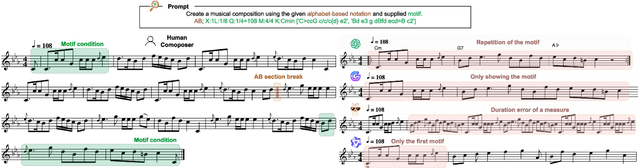
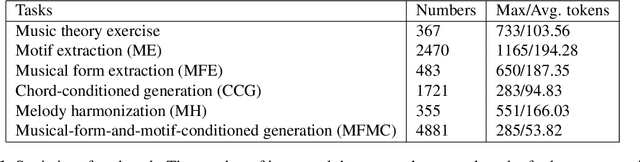
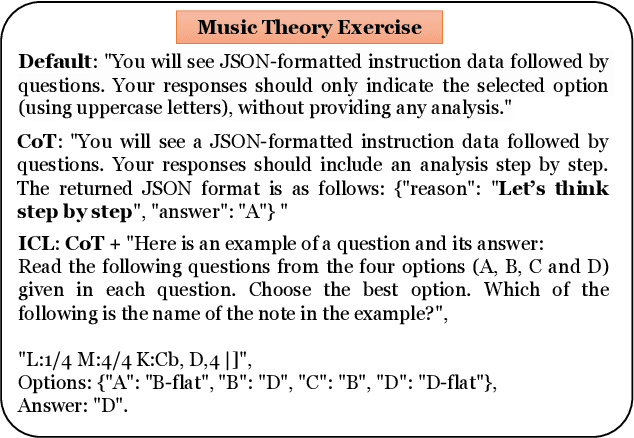
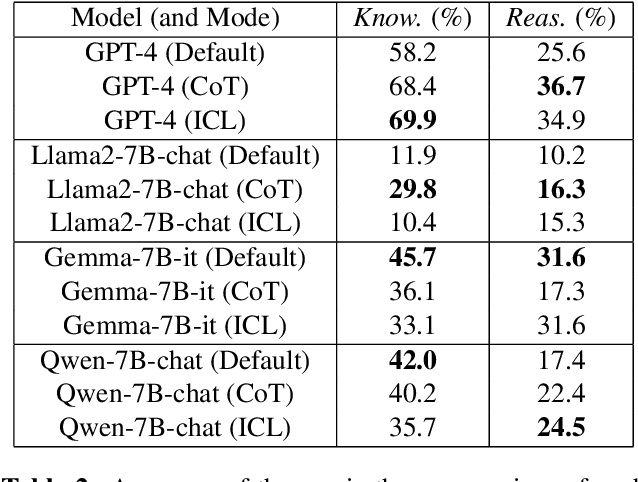
Symbolic Music, akin to language, can be encoded in discrete symbols. Recent research has extended the application of large language models (LLMs) such as GPT-4 and Llama2 to the symbolic music domain including understanding and generation. Yet scant research explores the details of how these LLMs perform on advanced music understanding and conditioned generation, especially from the multi-step reasoning perspective, which is a critical aspect in the conditioned, editable, and interactive human-computer co-creation process. This study conducts a thorough investigation of LLMs' capability and limitations in symbolic music processing. We identify that current LLMs exhibit poor performance in song-level multi-step music reasoning, and typically fail to leverage learned music knowledge when addressing complex musical tasks. An analysis of LLMs' responses highlights distinctly their pros and cons. Our findings suggest achieving advanced musical capability is not intrinsically obtained by LLMs, and future research should focus more on bridging the gap between music knowledge and reasoning, to improve the co-creation experience for musicians.
DRAM Failure Prediction in AIOps: Empirical Evaluation, Challenges and Opportunities
May 04, 2021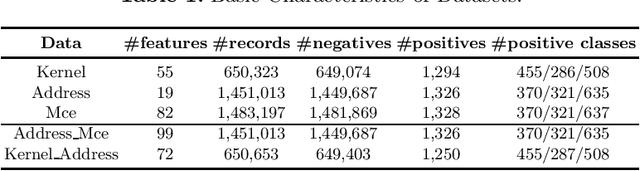
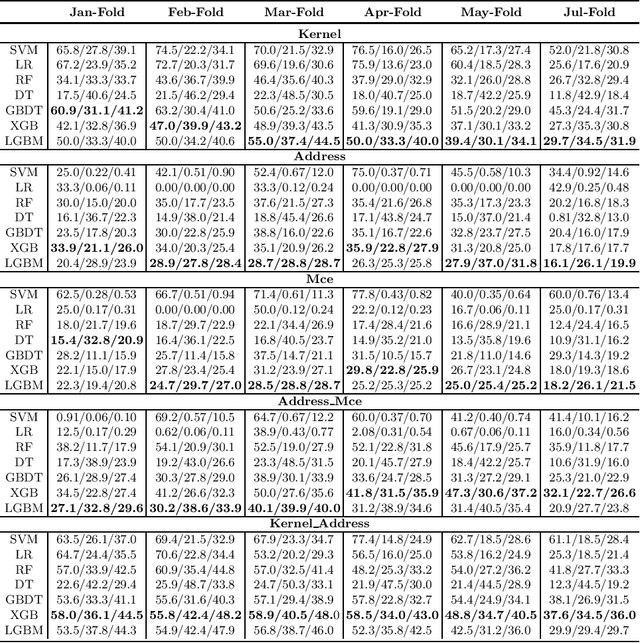
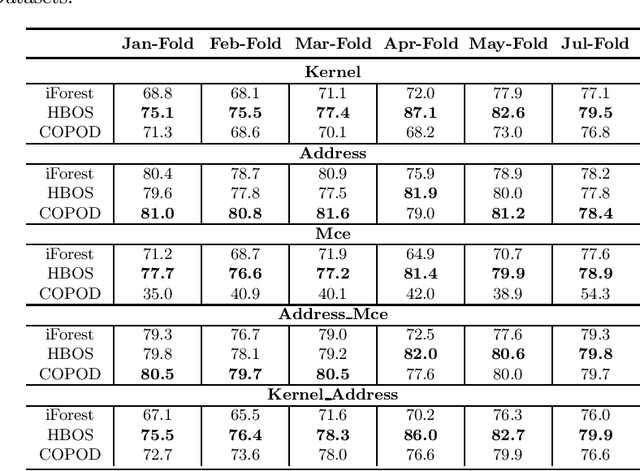
DRAM failure prediction is a vital task in AIOps, which is crucial to maintain the reliability and sustainable service of large-scale data centers. However, limited work has been done on DRAM failure prediction mainly due to the lack of public available datasets. This paper presents a comprehensive empirical evaluation of diverse machine learning techniques for DRAM failure prediction using a large-scale multi-source dataset, including more than three millions of records of kernel, address, and mcelog data, provided by Alibaba Cloud through PAKDD 2021 competition. Particularly, we first formulate the problem as a multi-class classification task and exhaustively evaluate seven popular/state-of-the-art classifiers on both the individual and multiple data sources. We then formulate the problem as an unsupervised anomaly detection task and evaluate three state-of-the-art anomaly detectors. Further, based on the empirical results and our experience of attending this competition, we discuss major challenges and present future research opportunities in this task.