 Add to Chrome
 Add to Firefox
 Add to Edge
Deployed trusted-node quantum key distribution over 300 km with a multi-core fiber access link
Jun 04, 2026
Quantum key distribution (QKD) is increasingly considered for deployment in realistic communication networks, where long distances, heterogeneous fiber infrastructure, and coexistence with classical traffic present substantial challenges. Here, we demonstrate trusted-node QKD between Linköping University and the Stockholm hub of the Swedish national quantum communication infrastructure over 270 km of deployed single-mode fiber, extended by a 33 km multi-core fiber (MCF) segment emulating a metropolitan access link, for a total distance of 303 km. The two sub-links use commercial QKD systems whose receivers are interfaced with external superconducting nanowire single-photon detectors, enabling operation at losses beyond those supported by standard internal gated-mode detectors. We operate the link while actively switching the QKD channel between two MCF cores, with co-propagating Ethernet traffic and injected broadband optical noise in the other cores. The results demonstrate the integration of commercial QKD into demanding, dynamically reconfigurable fiber infrastructure relevant to future hybrid quantum-classical networks. Finally, using the generated secret keys, we illustrate how limited and time-varying QKD throughput affects one-time-pad-protected image transmission: image fidelity depends strongly on the available QKD-generated key budget and the choice of compression algorithm, highlighting application-level challenges for QKD-based encryption in realistic scenarios.

VidPrism: Heterogeneous Mixture of Experts for Image-to-Video Transfer
May 27, 2026With the rapid development of pre-training technologies, adapting large-scale Vision-Language Models (VLMs) for video understanding \emph{\ie} image-to-video transfer learning has become a dominant paradigm. To achieve superior performance, it raises as an effective strategy among recent advances to employ Mixture-of-Experts (MoE) to enhance VLMs' temporal modeling capabilities. However, conventional MoE designs suffer from expert homogenization, where all experts act as identical generalists, inefficiently learning spatio-temporal features from undifferentiated video streams. To overcome this problem, we propose VidPrism, a novel heterogeneous temporal Mixture-of-Experts framework. VidPrism pioneers a division of labor by deploying functionally specialized experts, each assuming a role ranging from spatial understanding to temporal modeling. To feed these specialists appropriately, we introduce a content-aware, multi-rate sampling module that dynamically generates streams ranging from semantically rich to motion-focused representations, providing specialized inputs for experts. Furthermore, a dynamic, bidirectional fusion mechanism enables synergistic information exchange between these pathways, leading to a comprehensive video representation. Extensive experiments on various video recognition benchmarks demonstrate that VidPrism achieves state-of-the-art performance and effectively fosters expert specialization. Our source code is available at \href{https://github.com/Lrrrr549/VidPrism.git}{https://github.com/Lrrrr549/VidPrism.git}.
Tracing the Thought of a Grandmaster-level Chess-Playing Transformer
Apr 11, 2026While modern transformer neural networks achieve grandmaster-level performance in chess and other reasoning tasks, their internal computation process remains largely opaque. Focusing on Leela Chess Zero (LC0), we introduce a sparse decomposition framework to interpret its internal computation by decomposing its MLP and attention modules with sparse replacement layers, which capture the primary computation process of LC0. We conduct a detailed case study showing that these pathways expose rich, interpretable tactical considerations that are empirically verifiable. We further introduce three quantitative metrics and show that LC0 exhibits parallel reasoning behavior consistent with the inductive bias of its policy head architecture. To the best of our knowledge, this is the first work to decompose the internal computation of a transformer on both MLP and attention modules for interpretability. Combining sparse replacement layers and causal interventions in LC0 provides a comprehensive understanding of advanced tactical reasoning, offering critical insights into the underlying mechanisms of superhuman systems. Our code is available at https://github.com/JacklE0niden/Leela-SAEs.
JARVIS: An Evidence-Grounded Retrieval System for Interpretable Deceptive Reviews Adjudication
Feb 13, 2026Deceptive reviews, refer to fabricated feedback designed to artificially manipulate the perceived quality of products. Within modern e-commerce ecosystems, these reviews remain a critical governance challenge. Despite advances in review-level and graph-based detection methods, two pivotal limitations remain: inadequate generalization and lack of interpretability. To address these challenges, we propose JARVIS, a framework providing Judgment via Augmented Retrieval and eVIdence graph Structures. Starting from the review to be evaluated, it retrieves semantically similar evidence via hybrid dense-sparse multimodal retrieval, expands relational signals through shared entities, and constructs a heterogeneous evidence graph. Large language model then performs evidence-grounded adjudication to produce interpretable risk assessments. Offline experiments demonstrate that JARVIS enhances performance on our constructed review dataset, achieving a precision increase from 0.953 to 0.988 and a recall boost from 0.830 to 0.901. In the production environment, our framework achieves a 27% increase in the recall volume and reduces manual inspection time by 75%. Furthermore, the adoption rate of the model-generated analysis reaches 96.4%.
VULCAN: Tool-Augmented Multi Agents for Iterative 3D Object Arrangement
Dec 26, 2025Despite the remarkable progress of Multimodal Large Language Models (MLLMs) in 2D vision-language tasks, their application to complex 3D scene manipulation remains underexplored. In this paper, we bridge this critical gap by tackling three key challenges in 3D object arrangement task using MLLMs. First, to address the weak visual grounding of MLLMs, which struggle to link programmatic edits with precise 3D outcomes, we introduce an MCP-based API. This shifts the interaction from brittle raw code manipulation to more robust, function-level updates. Second, we augment the MLLM's 3D scene understanding with a suite of specialized visual tools to analyze scene state, gather spatial information, and validate action outcomes. This perceptual feedback loop is critical for closing the gap between language-based updates and precise 3D-aware manipulation. Third, to manage the iterative, error-prone updates, we propose a collaborative multi-agent framework with designated roles for planning, execution, and verification. This decomposition allows the system to robustly handle multi-step instructions and recover from intermediate errors. We demonstrate the effectiveness of our approach on a diverse set of 25 complex object arrangement tasks, where it significantly outperforms existing baselines. Website: vulcan-3d.github.io
Back to Ear: Perceptually Driven High Fidelity Music Reconstruction
Sep 18, 2025Variational Autoencoders (VAEs) are essential for large-scale audio tasks like diffusion-based generation. However, existing open-source models often neglect auditory perceptual aspects during training, leading to weaknesses in phase accuracy and stereophonic spatial representation. To address these challenges, we propose {\epsilon}ar-VAE, an open-source music signal reconstruction model that rethinks and optimizes the VAE training paradigm. Our contributions are threefold: (i) A K-weighting perceptual filter applied prior to loss calculation to align the objective with auditory perception. (ii) Two novel phase losses: a Correlation Loss for stereo coherence, and a Phase Loss using its derivatives--Instantaneous Frequency and Group Delay--for precision. (iii) A new spectral supervision paradigm where magnitude is supervised by all four Mid/Side/Left/Right components, while phase is supervised only by the LR components. Experiments show {\epsilon}ar-VAE at 44.1kHz substantially outperforms leading open-source models across diverse metrics, showing particular strength in reconstructing high-frequency harmonics and the spatial characteristics.
Towards Understanding the Nature of Attention with Low-Rank Sparse Decomposition
Apr 29, 2025We propose Low-Rank Sparse Attention (Lorsa), a sparse replacement model of Transformer attention layers to disentangle original Multi Head Self Attention (MHSA) into individually comprehensible components. Lorsa is designed to address the challenge of attention superposition to understand attention-mediated interaction between features in different token positions. We show that Lorsa heads find cleaner and finer-grained versions of previously discovered MHSA behaviors like induction heads, successor heads and attention sink behavior (i.e., heavily attending to the first token). Lorsa and Sparse Autoencoder (SAE) are both sparse dictionary learning methods applied to different Transformer components, and lead to consistent findings in many ways. For instance, we discover a comprehensive family of arithmetic-specific Lorsa heads, each corresponding to an atomic operation in Llama-3.1-8B. Automated interpretability analysis indicates that Lorsa achieves parity with SAE in interpretability while Lorsa exhibits superior circuit discovery properties, especially for features computed collectively by multiple MHSA heads. We also conduct extensive experiments on architectural design ablation, Lorsa scaling law and error analysis.
A Unifying Tensor View for Lightweight CNNs
Dec 15, 2023Despite the decomposition of convolutional kernels for lightweight CNNs being well studied, existing works that rely on tensor network diagrams or hyperdimensional abstraction lack geometry intuition. This work devises a new perspective by linking a 3D-reshaped kernel tensor to its various slice-wise and rank-1 decompositions, permitting a straightforward connection between various tensor approximations and efficient CNN modules. Specifically, it is discovered that a pointwise-depthwise-pointwise (PDP) configuration constitutes a viable construct for lightweight CNNs. Moreover, a novel link to the latest ShiftNet is established, inspiring a first-ever shift layer pruning that achieves nearly 50% compression with < 1% drop in accuracy for ShiftResNet.
Lite it fly: An All-Deformable-Butterfly Network
Nov 14, 2023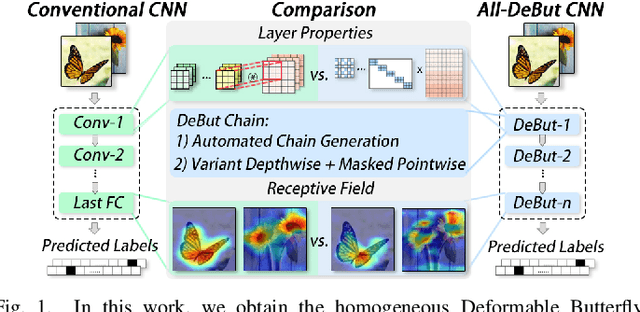
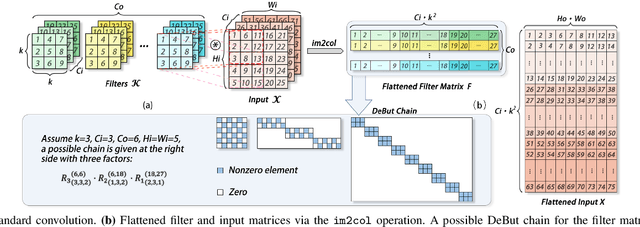
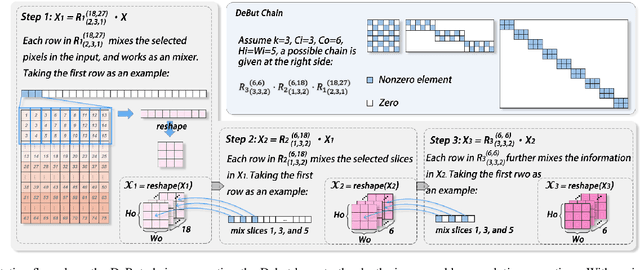
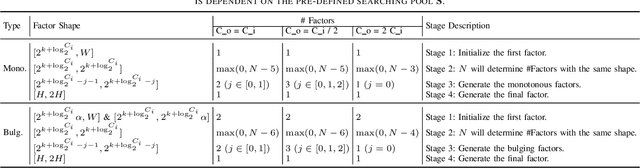
Most deep neural networks (DNNs) consist fundamentally of convolutional and/or fully connected layers, wherein the linear transform can be cast as the product between a filter matrix and a data matrix obtained by arranging feature tensors into columns. The lately proposed deformable butterfly (DeBut) decomposes the filter matrix into generalized, butterflylike factors, thus achieving network compression orthogonal to the traditional ways of pruning or low-rank decomposition. This work reveals an intimate link between DeBut and a systematic hierarchy of depthwise and pointwise convolutions, which explains the empirically good performance of DeBut layers. By developing an automated DeBut chain generator, we show for the first time the viability of homogenizing a DNN into all DeBut layers, thus achieving an extreme sparsity and compression. Various examples and hardware benchmarks verify the advantages of All-DeBut networks. In particular, we show it is possible to compress a PointNet to < 5% parameters with < 5% accuracy drop, a record not achievable by other compression schemes.
Cluster-based Method for Eavesdropping Identification and Localization in Optical Links
Sep 25, 2023


We propose a cluster-based method to detect and locate eavesdropping events in optical line systems characterized by small power losses. Our findings indicate that detecting such subtle losses from eavesdropping can be accomplished solely through optical performance monitoring (OPM) data collected at the receiver. On the other hand, the localization of such events can be effectively achieved by leveraging in-line OPM data.