 Add to Chrome
 Add to Firefox
 Add to Edge
Orbit-Planner: Towards Latent World Models for On-Orbit Obstacle Avoidance of Satellite Agents
Aug 17, 2026
Satellite agents for on-orbit navigation tasks need to predict collision risks using limited onboard observations. However, conventional planners often rely on predefined maps and fixed environmental assumptions, limiting their adaptability in dynamic on-orbit scenarios. In this paper, we propose Orbit-Planner, a two-stage latent world model for on-orbit obstacle avoidance. Orbit-Planner learns action-conditioned spacecraft dynamics to perform future-state rollouts in latent space, and introduces a Physics Probe to decode physical state changes from imagined latent trajectories. Experiments demonstrate that Orbit-Planner can perform long-horizon latent rollouts and recover physical states from imagined trajectories. In closed-loop obstacle-avoidance navigation in Isaac Sim, it attains a success rate of 91.7%. Code is available at https://github.com/ZhijianLi2003/Orbit_Planner.

CoEvo-Mem: Co-Evolving Retrieval Policy and Memory Bank for LLM Agents
Aug 03, 2026As memories accumulate across tasks and sessions, the performance of long-term LLM agents depends jointly on query-specific retrieval and continual memory refinement. However, existing methods typically optimize either memory access, through iterative query refinement or adaptive retrieval policies, or memory evolution such as structural update. This separation overlooks a fundamental feedback loop: retrieval determines which memories receive usage signals, while updated memory bank reshape future retrieval. We propose \textbf{CoEvo-Mem}, a closed-loop framework for co-evolving the retrieval policy and memory bank. For each query, a frozen LLM generates route-specific query rewrites and a routing prior, which a lightweight residual router corrects online. The retrieved context serves as the coupling interface between the two learning processes: task outcomes assign credit to routing decisions, while trajectory-conditioned feedback updates memory values and graph relations. These updates alter how memories are ranked and selected for subsequent queries, thereby closing the feedback loop. To mitigate coupling induced non-stationarity, CoEvo-Mem alternates between updating the router with the memory bank fixed and evolving the memory bank with the retrieval policy fixed. Across seven diverse benchmarks, \textbf{CoEvo-Mem} achieves state-of-the-art performance, demonstrating the importance of retrieval-memory coevolution.
ReasonSTL: Bridging Natural Language and Signal Temporal Logic via Tool-Augmented Process-Rewarded Learning
May 07, 2026Signal Temporal Logic (STL) is an expressive formal language for specifying spatio-temporal requirements over real-valued, real-time signals. It has been widely used for the verification and synthesis of autonomous systems and cyber-physical systems. In practice, however, users often express their requirements in natural language rather than in structured STL formulas, making natural-language-to-STL translation a critical yet challenging task. Manual specification requires temporal-logic expertise and cannot scale, while prompting commercial LLM APIs incurs substantial token costs and may expose sensitive system requirements to third-party services, raising privacy concerns for industrial deployment. To address these challenges, we present \textsc{ReasonSTL}, a tool-augmented framework that adapts local open-source language models for natural-language-to-STL generation. \textsc{ReasonSTL} decomposes the translation process into explicit reasoning, deterministic tool calls, and structured formula construction. We further introduce process-rewarded training to supervise both tool-use trajectories and final formulas, together with \textsc{STL-Bench}, a bilingual, computation-aware benchmark grounded in real-world signals. Experiments show that a 4B model trained with \textsc{ReasonSTL} achieves state-of-the-art performance in both automatic metrics and human evaluations, demonstrating that \textsc{ReasonSTL} provides a transparent, low-cost, and privacy-preserving alternative for formal specification drafting.
Kernel-Based Enhanced Oversampling Method for Imbalanced Classification
Apr 12, 2025This paper introduces a novel oversampling technique designed to improve classification performance on imbalanced datasets. The proposed method enhances the traditional SMOTE algorithm by incorporating convex combination and kernel-based weighting to generate synthetic samples that better represent the minority class. Through experiments on multiple real-world datasets, we demonstrate that the new technique outperforms existing methods in terms of F1-score, G-mean, and AUC, providing a robust solution for handling imbalanced datasets in classification tasks.
Document Type Classification using File Names
Oct 02, 2024Rapid document classification is critical in several time-sensitive applications like digital forensics and large-scale media classification. Traditional approaches that rely on heavy-duty deep learning models fall short due to high inference times over vast input datasets and computational resources associated with analyzing whole documents. In this paper, we present a method using lightweight supervised learning models, combined with a TF-IDF feature extraction-based tokenization method, to accurately and efficiently classify documents based solely on file names that substantially reduces inference time. This approach can distinguish ambiguous file names from the indicative file names through confidence scores and through using a negative class representing ambiguous file names. Our results indicate that file name classifiers can process more than 80% of the in-scope data with 96.7% accuracy when tested on a dataset with a large portion of out-of-scope data with respect to the training dataset while being 442.43x faster than more complex models such as DiT. Our method offers a crucial solution for efficiently processing vast datasets in critical scenarios, enabling fast, more reliable document classification.
DeliLaw: A Chinese Legal Counselling System Based on a Large Language Model
Aug 01, 2024
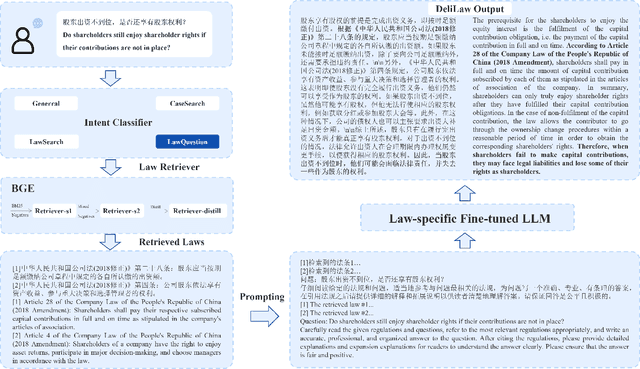
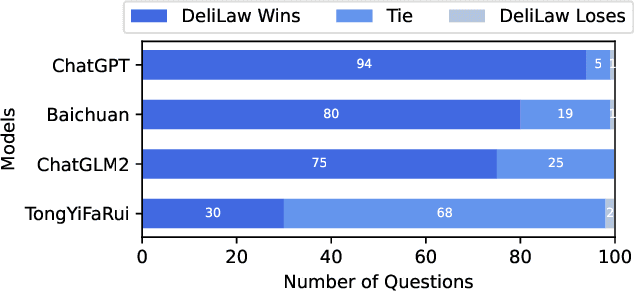
Traditional legal retrieval systems designed to retrieve legal documents, statutes, precedents, and other legal information are unable to give satisfactory answers due to lack of semantic understanding of specific questions. Large Language Models (LLMs) have achieved excellent results in a variety of natural language processing tasks, which inspired us that we train a LLM in the legal domain to help legal retrieval. However, in the Chinese legal domain, due to the complexity of legal questions and the rigour of legal articles, there is no legal large model with satisfactory practical application yet. In this paper, we present DeliLaw, a Chinese legal counselling system based on a large language model. DeliLaw integrates a legal retrieval module and a case retrieval module to overcome the model hallucination. Users can consult professional legal questions, search for legal articles and relevant judgement cases, etc. on the DeliLaw system in a dialogue mode. In addition, DeliLaw supports the use of English for counseling. we provide the address of the system: https://data.delilegal.com/lawQuestion.
Generating Hard-Negative Out-of-Scope Data with ChatGPT for Intent Classification
Mar 08, 2024
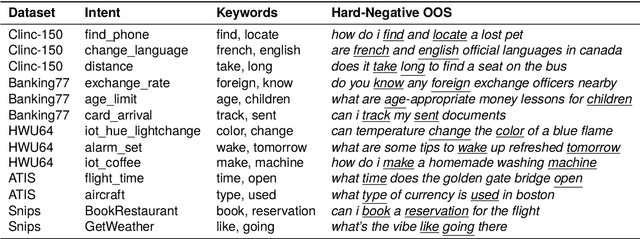
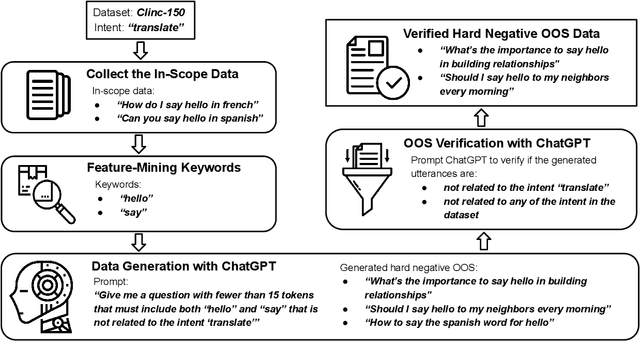
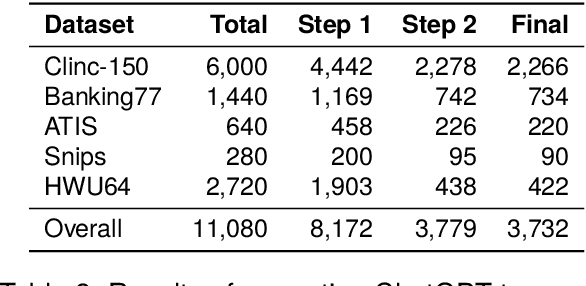
Intent classifiers must be able to distinguish when a user's utterance does not belong to any supported intent to avoid producing incorrect and unrelated system responses. Although out-of-scope (OOS) detection for intent classifiers has been studied, previous work has not yet studied changes in classifier performance against hard-negative out-of-scope utterances (i.e., inputs that share common features with in-scope data, but are actually out-of-scope). We present an automated technique to generate hard-negative OOS data using ChatGPT. We use our technique to build five new hard-negative OOS datasets, and evaluate each against three benchmark intent classifiers. We show that classifiers struggle to correctly identify hard-negative OOS utterances more than general OOS utterances. Finally, we show that incorporating hard-negative OOS data for training improves model robustness when detecting hard-negative OOS data and general OOS data. Our technique, datasets, and evaluation address an important void in the field, offering a straightforward and inexpensive way to collect hard-negative OOS data and improve intent classifiers' robustness.
Feature Affinity Assisted Knowledge Distillation and Quantization of Deep Neural Networks on Label-Free Data
Feb 10, 2023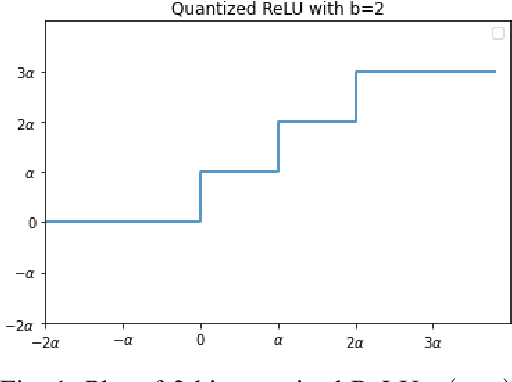
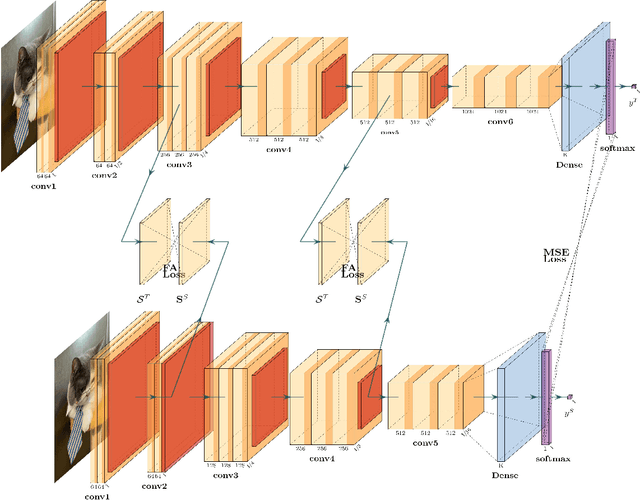
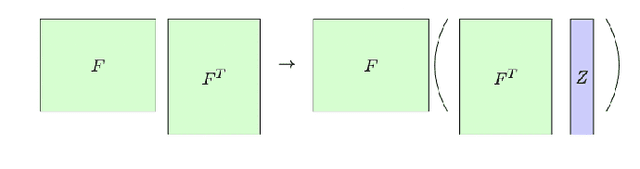
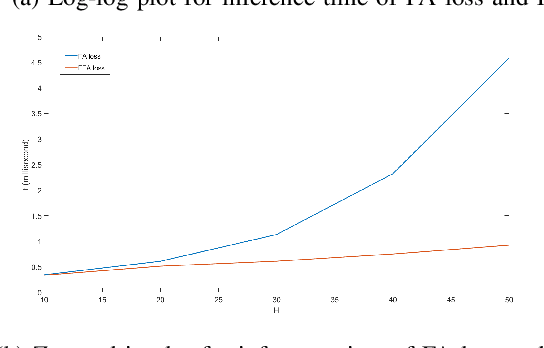
In this paper, we propose a feature affinity (FA) assisted knowledge distillation (KD) method to improve quantization-aware training of deep neural networks (DNN). The FA loss on intermediate feature maps of DNNs plays the role of teaching middle steps of a solution to a student instead of only giving final answers in the conventional KD where the loss acts on the network logits at the output level. Combining logit loss and FA loss, we found that the quantized student network receives stronger supervision than from the labeled ground-truth data. The resulting FAQD is capable of compressing model on label-free data, which brings immediate practical benefits as pre-trained teacher models are readily available and unlabeled data are abundant. In contrast, data labeling is often laborious and expensive. Finally, we propose a fast feature affinity (FFA) loss that accurately approximates FA loss with a lower order of computational complexity, which helps speed up training for high resolution image input.
Channel Pruning In Quantization-aware Training: An Adaptive Projection-gradient Descent-shrinkage-splitting Method
Apr 09, 2022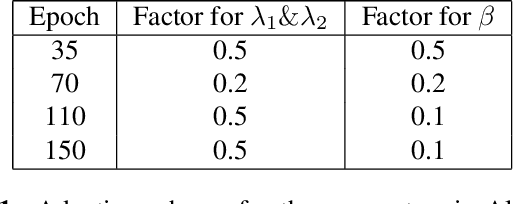
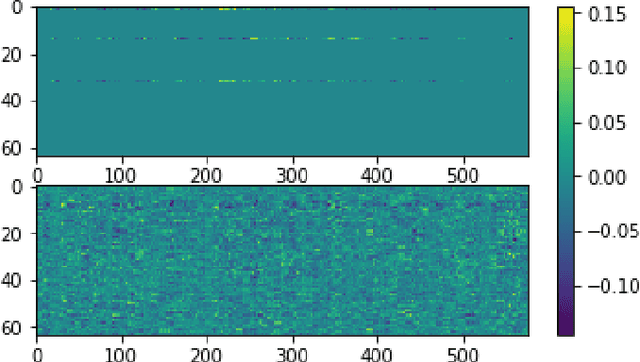
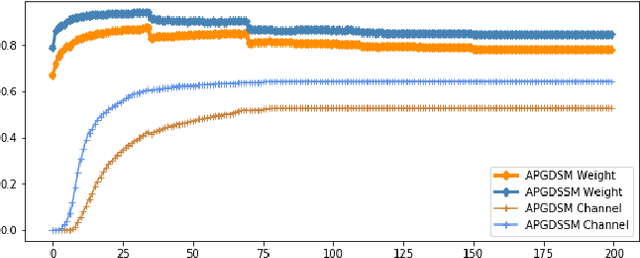
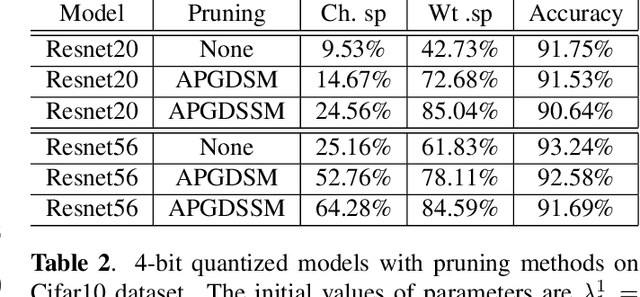
We propose an adaptive projection-gradient descent-shrinkage-splitting method (APGDSSM) to integrate penalty based channel pruning into quantization-aware training (QAT). APGDSSM concurrently searches weights in both the quantized subspace and the sparse subspace. APGDSSM uses shrinkage operator and a splitting technique to create sparse weights, as well as the Group Lasso penalty to push the weight sparsity into channel sparsity. In addition, we propose a novel complementary transformed l1 penalty to stabilize the training for extreme compression.
An integrated recurrent neural network and regression model with spatial and climatic couplings for vector-borne disease dynamics
Jan 23, 2022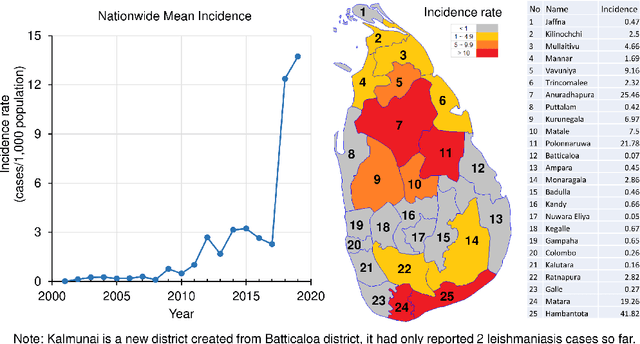
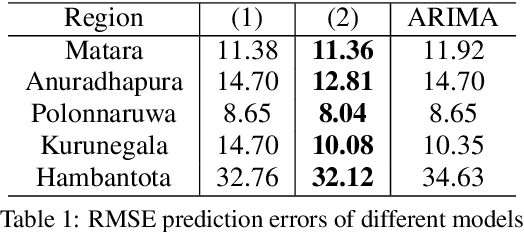
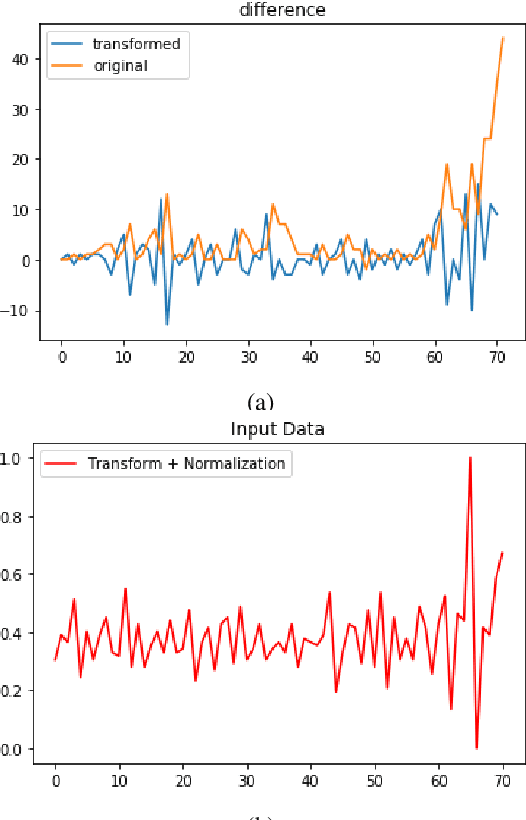
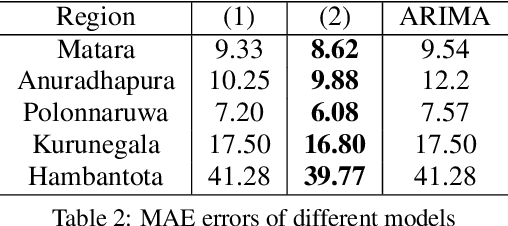
We developed an integrated recurrent neural network and nonlinear regression spatio-temporal model for vector-borne disease evolution. We take into account climate data and seasonality as external factors that correlate with disease transmitting insects (e.g. flies), also spill-over infections from neighboring regions surrounding a region of interest. The climate data is encoded to the model through a quadratic embedding scheme motivated by recommendation systems. The neighboring regions' influence is modeled by a long short-term memory neural network. The integrated model is trained by stochastic gradient descent and tested on leish-maniasis data in Sri Lanka from 2013-2018 where infection outbreaks occurred. Our model outperformed ARIMA models across a number of regions with high infections, and an associated ablation study renders support to our modeling hypothesis and ideas.