 Add to Chrome
 Add to Firefox
 Add to Edge
RoutePack: Expert Placement and Attention-Aware Data Packing for MoE Reinforcement Learning
Aug 12, 2026
Training Mixture-of-Experts (MoE) models for reinforcement learning (RL) couples two load-balancing problems: sequence composition determines dense attention work in each data-parallel microbatch, while token routing determines sparse expert work on expert-parallel ranks. Optimizing either alone can shift the bottleneck to the other. In MoE RL, rollout-time routing replay exposes every sample's sequence length and layer-wise expert demand before its training step. We present RoutePack, a hierarchical planner that coordinates state-consistent, layer-wise expert rerouting with joint attention- and expert-aware data packing over an optimizer-step window. RoutePack first places experts independently at each MoE layer using aggregate routing demand. It then packs samples into the smallest certified, or best-known feasible, number of token-capped execution rows and optimizes their DP layout with a projected EDP-shard-aware objective. The objective combines a window-normalized linear-quadratic attention proxy with per-layer physical EP-rank peaks and minimizes the accumulated cost of the slowest EDP shard. Parallel population annealing searches fixed-row feasible layouts while preserving sample coverage, capacity, nonempty cells, equal microbatch counts, and communicator topology. State-consistent materialization preserves logical top-k routing and existing MoE kernels without microbatch-level expert replication. Across Ling-3.0-Tiny and Ling-3.0-Flash, expert rerouting improves mean trainer-measured token throughput by 3.80% and 10.50%, while routing-aware packing adds another 4.86% and 3.98%, respectively. Overall, RoutePack improves throughput by 8.85% and 14.89% over the baseline.

Ling and Ring 2.6 Technical Report: Efficient and Instant Agentic Intelligence at Trillion-Parameter Scale
Jun 13, 2026Efficient and scalable agentic intelligence requires models that can deliver both low-latency responses and strong reasoning capabilities while remaining practical to train, serve, and deploy. In this report, we present Ling-2.6 and Ring-2.6, a family of models designed to address this challenge at scale. Ling-2.6 is optimized for instant response generation and high capability per output token, whereas Ring-2.6 is tailored for deeper reasoning and more advanced agentic workflows. Instead of training from scratch, we upgrade the Ling-2.0 base model through architectural migration pre-training and large-scale post-training. This upgrade is guided by a unified co-design of model architecture, optimization objectives, serving systems, and agent training environments, enabling improvements in both model capability and deployment efficiency. At the architectural level, we introduce a hybrid linear attention design that integrates Lightning Attention with MLA, improving the efficiency of long-context training and decoding. To further enhance token efficiency, we optimize capability per output token through Evolutionary Chain-of-Thought, Linguistic Unit Policy Optimization, bidirectional preference alignment, and shortest-correct-response distillation. For agentic capabilities, we propose KPop, a reinforcement learning framework designed to support stable training of Ring-2.6-1T on large-scale environment-grounded data. KPop improves training efficiency through asynchronous scheduling across coding, search, tool use, and workflow execution, enabling scalable learning from complex agent-environment interactions. Together, Ling-2.6 and Ring-2.6 provide a practical pathway toward efficient, scalable, and open agentic systems. We open-source all checkpoints in the 2.6 family to support further research and development in practical agentic intelligence.
TAD: Temporal-Aware Trajectory Self-Distillation for Fast and Accurate Diffusion LLM
May 10, 2026Diffusion large language models (dLLMs) offer a promising paradigm for parallel text generation, but in practice they face an accuracy-parallelism trade-off, where increasing tokens per forward (TPF) often degrades generation quality. Existing acceleration methods often gain speed at the cost of accuracy. To address this limitation, we propose TAD, a Temporal-Aware trajectory self-Distillation framework. During data construction, we condition a teacher model on both the prompt and the ground-truth response to generate decoding trajectories, recording the intermediate masked states throughout the process. Based on how many decoding steps remain before each masked token is revealed, we partition masked positions into near and distant subsets. For near tokens, we train the student with a hard cross-entropy loss using the teacher trajectory tokens as labels, encouraging confident predictions for tokens that are about to be decoded. For distant tokens, we apply a soft KL divergence loss between the teacher and student token distributions, providing softer supervision and preserving future planning knowledge. This temporal-aware partition naturally gives rise to two deployment configurations: a Quality model that prioritizes accuracy and a Speed model that favors more aggressive acceleration. Experiments show that TAD consistently improves the accuracy-parallelism trade-off. On LLaDA, it raises average accuracy from 46.2\% to 51.6\% with the Quality model and average AUP from 46.2 to 257.1 with the Speed model. Our code is available at: https://github.com/BHmingyang/TAD
LLaDA2.1: Speeding Up Text Diffusion via Token Editing
Feb 09, 2026While LLaDA2.0 showcased the scaling potential of 100B-level block-diffusion models and their inherent parallelization, the delicate equilibrium between decoding speed and generation quality has remained an elusive frontier. Today, we unveil LLaDA2.1, a paradigm shift designed to transcend this trade-off. By seamlessly weaving Token-to-Token (T2T) editing into the conventional Mask-to-Token (M2T) scheme, we introduce a joint, configurable threshold-decoding scheme. This structural innovation gives rise to two distinct personas: the Speedy Mode (S Mode), which audaciously lowers the M2T threshold to bypass traditional constraints while relying on T2T to refine the output; and the Quality Mode (Q Mode), which leans into conservative thresholds to secure superior benchmark performances with manageable efficiency degrade. Furthering this evolution, underpinned by an expansive context window, we implement the first large-scale Reinforcement Learning (RL) framework specifically tailored for dLLMs, anchored by specialized techniques for stable gradient estimation. This alignment not only sharpens reasoning precision but also elevates instruction-following fidelity, bridging the chasm between diffusion dynamics and complex human intent. We culminate this work by releasing LLaDA2.1-Mini (16B) and LLaDA2.1-Flash (100B). Across 33 rigorous benchmarks, LLaDA2.1 delivers strong task performance and lightning-fast decoding speed. Despite its 100B volume, on coding tasks it attains an astounding 892 TPS on HumanEval+, 801 TPS on BigCodeBench, and 663 TPS on LiveCodeBench.
Every Step Evolves: Scaling Reinforcement Learning for Trillion-Scale Thinking Model
Oct 21, 2025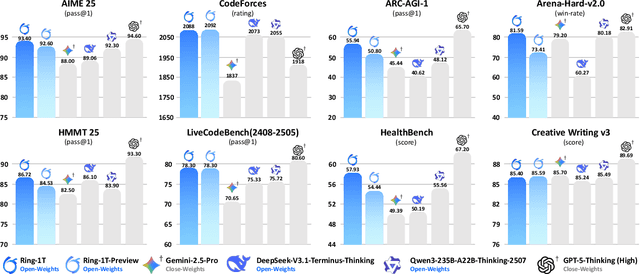
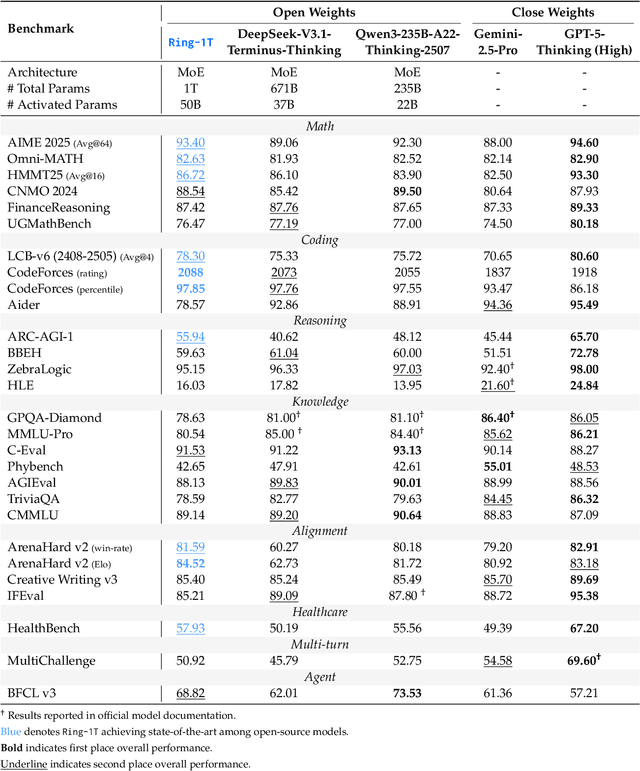
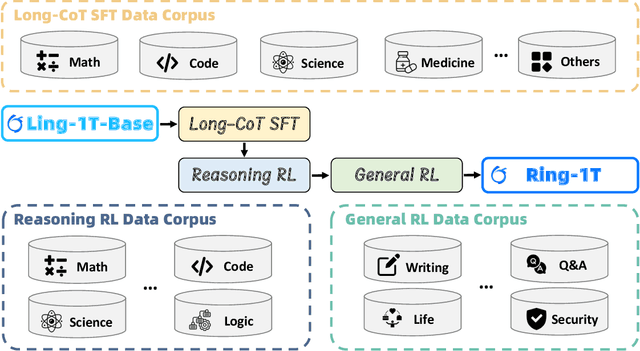
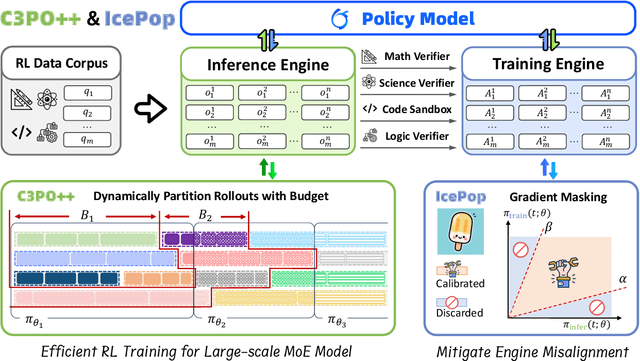
We present Ring-1T, the first open-source, state-of-the-art thinking model with a trillion-scale parameter. It features 1 trillion total parameters and activates approximately 50 billion per token. Training such models at a trillion-parameter scale introduces unprecedented challenges, including train-inference misalignment, inefficiencies in rollout processing, and bottlenecks in the RL system. To address these, we pioneer three interconnected innovations: (1) IcePop stabilizes RL training via token-level discrepancy masking and clipping, resolving instability from training-inference mismatches; (2) C3PO++ improves resource utilization for long rollouts under a token budget by dynamically partitioning them, thereby obtaining high time efficiency; and (3) ASystem, a high-performance RL framework designed to overcome the systemic bottlenecks that impede trillion-parameter model training. Ring-1T delivers breakthrough results across critical benchmarks: 93.4 on AIME-2025, 86.72 on HMMT-2025, 2088 on CodeForces, and 55.94 on ARC-AGI-v1. Notably, it attains a silver medal-level result on the IMO-2025, underscoring its exceptional reasoning capabilities. By releasing the complete 1T parameter MoE model to the community, we provide the research community with direct access to cutting-edge reasoning capabilities. This contribution marks a significant milestone in democratizing large-scale reasoning intelligence and establishes a new baseline for open-source model performance.
LayerKV: Optimizing Large Language Model Serving with Layer-wise KV Cache Management
Oct 01, 2024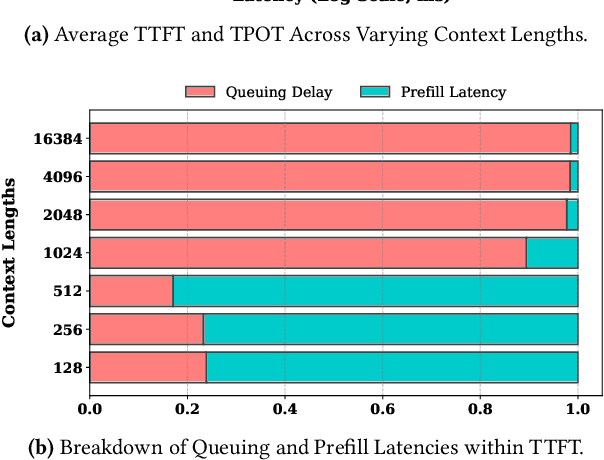

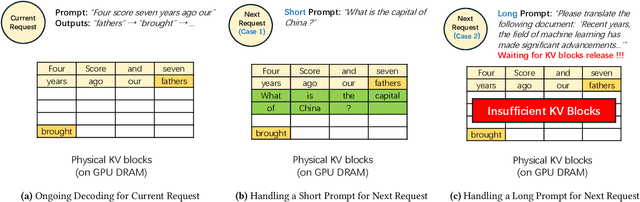
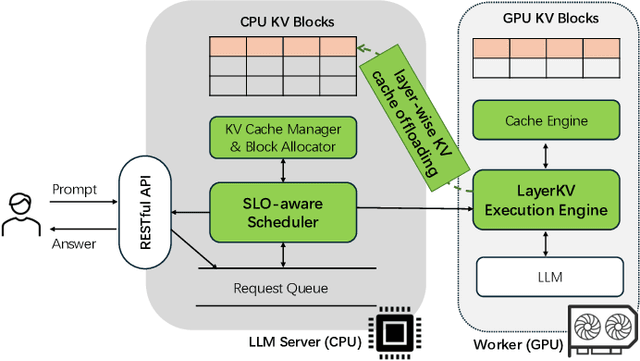
The expanding context windows in large language models (LLMs) have greatly enhanced their capabilities in various applications, but they also introduce significant challenges in maintaining low latency, particularly in Time to First Token (TTFT). This paper identifies that the sharp rise in TTFT as context length increases is predominantly driven by queuing delays, which are caused by the growing demands for GPU Key-Value (KV) cache allocation clashing with the limited availability of KV cache blocks. To address this issue, we propose LayerKV, a simple yet effective plug-in method that effectively reduces TTFT without requiring additional hardware or compromising output performance, while seamlessly integrating with existing parallelism strategies and scheduling techniques. Specifically, LayerKV introduces layer-wise KV block allocation, management, and offloading for fine-grained control over system memory, coupled with an SLO-aware scheduler to optimize overall Service Level Objectives (SLOs). Comprehensive evaluations on representative models, ranging from 7B to 70B parameters, across various GPU configurations, demonstrate that LayerKV improves TTFT latency up to 11x and reduces SLO violation rates by 28.7\%, significantly enhancing the user experience