 Add to Chrome
 Add to Firefox
 Add to Edge
Quality-Aware Modulation for Diffusion Transformers
Jun 29, 2026
Modern text-to-image diffusion models, such as diffusion transformers (DiT), rely on timestep or prompt embeddings to modulate the strength of the denoising process in each timestep. While this modulation communicates the current noise level, it does not provide any quality-aware information, which can lead to generated images that are unaligned, visually inconsistent, and lacking in fidelity. In this paper, we propose the Quality Representation Module (QRM), a lightweight transformer module that learns a quality-aware representation based on existing model inputs, and produces a set of vectors $M_{qrm}$. These vectors adjust the adaptive LayerNorm modulation within the DiT transformer blocks, thereby injecting a quality-sensitive signal into the denoising parameters. The QRM introduces no significant changes to the sampling schedule or diffusion backbone. Experiments include ablations on QRM training losses and architectures, as well as empirical results demonstrating consistent image quality improvements over baseline DiT-based models.

Select-to-Act: Hierarchical Reinforcement Learning via Adaptive Language Guidance
Jun 21, 2026Reinforcement Learning (RL) has been widely applied to sequential decision-making, yet it often suffers from poor sample efficiency due to costly interactions with the environment. A limited line of recent work has started exploring improving RL efficiency by leveraging external knowledge expressed in natural-language instructions. However, the few existing approaches typically treat the entire instruction as a single conditioning input, failing to account for the stage-dependent nature of language guidance, especially in complex environments. In this paper, we propose \emph{Hierarchical Reinforcement Learning with Language Instructions (HRLLI)}, a hierarchical RL framework that explicitly models natural-language instructions as dynamically selectable semantic guidance during decision-making. HRLLI decomposes instructions into a set of piecewise guidance elements, where each instruction piece may become relevant at different stages of interaction with the environment. A novel hierarchical RL policy structure is then formulated in a \emph{Select-to-Act} paradigm: a high-level semantic policy acts as a guidance selector that selects the most relevant instruction piece to the current state to guide the low-level agent's decision, while a low-level policy executes environment actions conditioned on the selected guidance. The two-level policies are learned simultaneously to maximize augmented expected returns from interactions with the environment. This design enables the agent to adaptively ground language instructions into stage-specific decisions during interaction. Experiments on the instruction-intensive RTFM benchmark show that HRLLI consistently outperforms strong instruction-conditioned RL baselines, demonstrating that explicitly modeling adaptive instruction selection significantly improves the effectiveness of RL.
Reliability-Guided Adaptive Ensembling for Robust Test-Time Adaptation
Jun 21, 2026Test-time adaptation (TTA) can mitigate domain shift without source data, but it is highly brittle under adversarially contaminated test streams, where corrupted inputs also destabilize online updates. We study robust test-time adaptation (RTTA) in the adversarial-stream setting, which remains comparatively underexplored relative to standard TTA, and propose SAFER (Stochastic Augmentation Framework for Enhanced Robustness), a training-free reliability-guided augmentation wrapper for RTTA. SAFER preserves the wrapped TTA objective while replacing brittle single-view predictions with a reliability-guided pooled predictor. For each test sample, SAFER generates stochastic augmentations and aggregates their predictions through correlation-weighted pooling with outlier detection. We further study an adaptive-mixing extension that improves clean-performance retention by adjusting original-versus-augmentation weighting using feature disagreement signals. We evaluate on PACS, VLCS, and OfficeHome under PGD attacks at various attack rates. Across benchmarks, SAFER improves resilience of TTA methods to adversarial attacks while maintaining competitive clean performance.
Bi-Level Optimization for Single Domain Generalization
Apr 07, 2026Generalizing from a single labeled source domain to unseen target domains, without access to any target data during training, remains a fundamental challenge in robust machine learning. We address this underexplored setting, known as Single Domain Generalization (SDG), by proposing BiSDG, a bi-level optimization framework that explicitly decouples task learning from domain modeling. BiSDG simulates distribution shifts through surrogate domains constructed via label-preserving transformations of the source data. To capture domain-specific context, we propose a domain prompt encoder that generates lightweight modulation signals to produce augmenting features via feature-wise linear modulation. The learning process is formulated as a bi-level optimization problem: the inner objective optimizes task performance under fixed prompts, while the outer objective maximizes generalization across the surrogate domains by updating the domain prompt encoder. We further develop a practical gradient approximation scheme that enables efficient bi-level training without second-order derivatives. Extensive experiments on various SGD benchmarks demonstrate that BiSDG consistently outperforms prior methods, setting new state-of-the-art performance in the SDG setting.
Bridging Dynamics Gaps via Diffusion Schrödinger Bridge for Cross-Domain Reinforcement Learning
Feb 27, 2026Cross-domain reinforcement learning (RL) aims to learn transferable policies under dynamics shifts between source and target domains. A key challenge lies in the lack of target-domain environment interaction and reward supervision, which prevents direct policy learning. To address this challenge, we propose Bridging Dynamics Gaps for Cross-Domain Reinforcement Learning (BDGxRL), a novel framework that leverages Diffusion Schrödinger Bridge (DSB) to align source transitions with target-domain dynamics encoded in offline demonstrations. Moreover, we introduce a reward modulation mechanism that estimates rewards based on state transitions, applying to DSB-aligned samples to ensure consistency between rewards and target-domain dynamics. BDGxRL performs target-oriented policy learning entirely within the source domain, without access to the target environment or its rewards. Experiments on MuJoCo cross-domain benchmarks demonstrate that BDGxRL outperforms state-of-the-art baselines and shows strong adaptability under transition dynamics shifts.
Diffusion Modulation via Environment Mechanism Modeling for Planning
Feb 23, 2026Diffusion models have shown promising capabilities in trajectory generation for planning in offline reinforcement learning (RL). However, conventional diffusion-based planning methods often fail to account for the fact that generating trajectories in RL requires unique consistency between transitions to ensure coherence in real environments. This oversight can result in considerable discrepancies between the generated trajectories and the underlying mechanisms of a real environment. To address this problem, we propose a novel diffusion-based planning method, termed as Diffusion Modulation via Environment Mechanism Modeling (DMEMM). DMEMM modulates diffusion model training by incorporating key RL environment mechanisms, particularly transition dynamics and reward functions. Experimental results demonstrate that DMEMM achieves state-of-the-art performance for planning with offline reinforcement learning.
Every Step Evolves: Scaling Reinforcement Learning for Trillion-Scale Thinking Model
Oct 21, 2025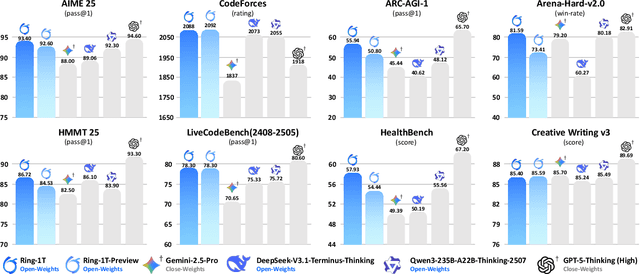
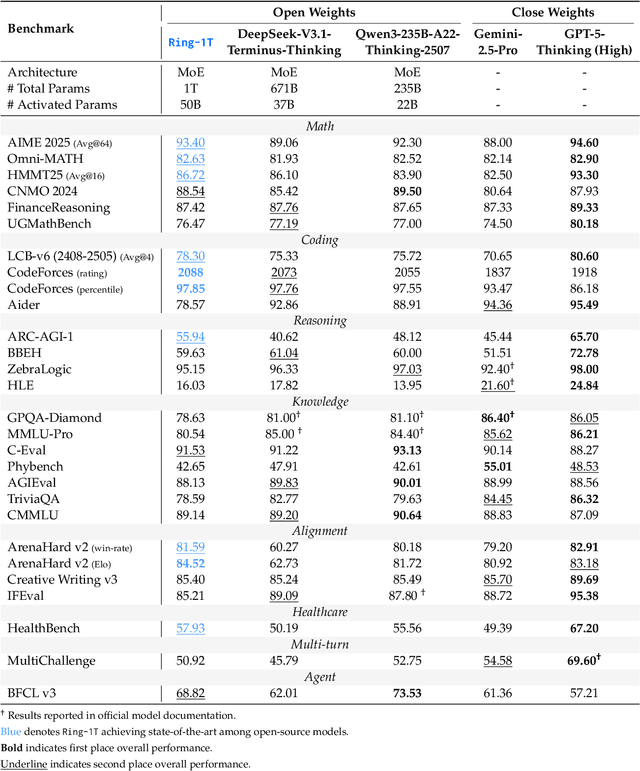
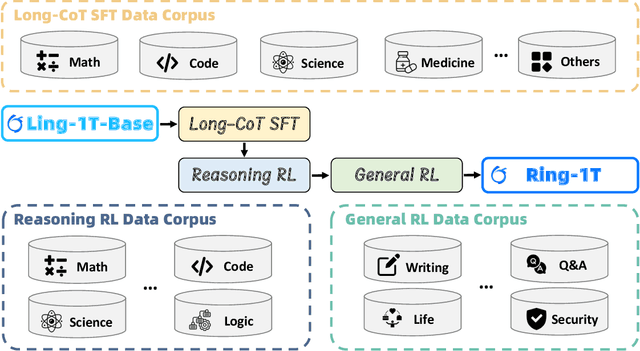
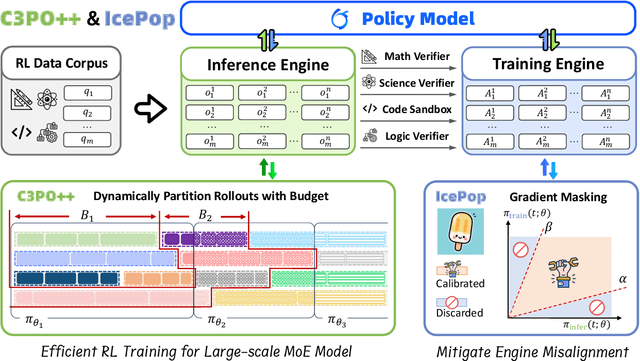
We present Ring-1T, the first open-source, state-of-the-art thinking model with a trillion-scale parameter. It features 1 trillion total parameters and activates approximately 50 billion per token. Training such models at a trillion-parameter scale introduces unprecedented challenges, including train-inference misalignment, inefficiencies in rollout processing, and bottlenecks in the RL system. To address these, we pioneer three interconnected innovations: (1) IcePop stabilizes RL training via token-level discrepancy masking and clipping, resolving instability from training-inference mismatches; (2) C3PO++ improves resource utilization for long rollouts under a token budget by dynamically partitioning them, thereby obtaining high time efficiency; and (3) ASystem, a high-performance RL framework designed to overcome the systemic bottlenecks that impede trillion-parameter model training. Ring-1T delivers breakthrough results across critical benchmarks: 93.4 on AIME-2025, 86.72 on HMMT-2025, 2088 on CodeForces, and 55.94 on ARC-AGI-v1. Notably, it attains a silver medal-level result on the IMO-2025, underscoring its exceptional reasoning capabilities. By releasing the complete 1T parameter MoE model to the community, we provide the research community with direct access to cutting-edge reasoning capabilities. This contribution marks a significant milestone in democratizing large-scale reasoning intelligence and establishes a new baseline for open-source model performance.
Skill-based Safe Reinforcement Learning with Risk Planning
May 02, 2025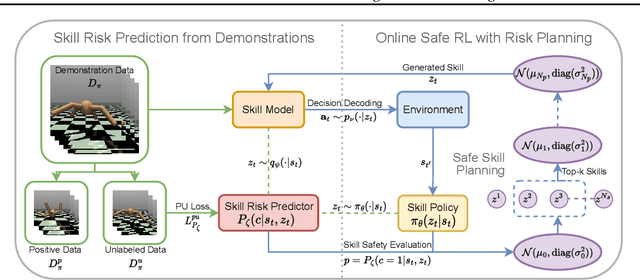
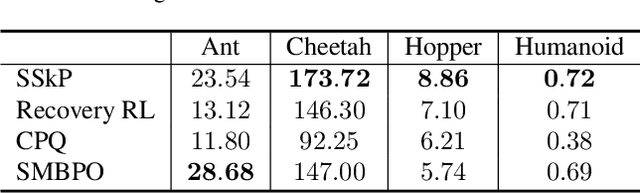

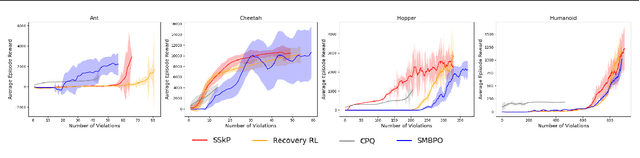
Safe Reinforcement Learning (Safe RL) aims to ensure safety when an RL agent conducts learning by interacting with real-world environments where improper actions can induce high costs or lead to severe consequences. In this paper, we propose a novel Safe Skill Planning (SSkP) approach to enhance effective safe RL by exploiting auxiliary offline demonstration data. SSkP involves a two-stage process. First, we employ PU learning to learn a skill risk predictor from the offline demonstration data. Then, based on the learned skill risk predictor, we develop a novel risk planning process to enhance online safe RL and learn a risk-averse safe policy efficiently through interactions with the online RL environment, while simultaneously adapting the skill risk predictor to the environment. We conduct experiments in several benchmark robotic simulation environments. The experimental results demonstrate that the proposed approach consistently outperforms previous state-of-the-art safe RL methods.
Context-Aware Self-Adaptation for Domain Generalization
Apr 03, 2025Domain generalization aims at developing suitable learning algorithms in source training domains such that the model learned can generalize well on a different unseen testing domain. We present a novel two-stage approach called Context-Aware Self-Adaptation (CASA) for domain generalization. CASA simulates an approximate meta-generalization scenario and incorporates a self-adaptation module to adjust pre-trained meta source models to the meta-target domains while maintaining their predictive capability on the meta-source domains. The core concept of self-adaptation involves leveraging contextual information, such as the mean of mini-batch features, as domain knowledge to automatically adapt a model trained in the first stage to new contexts in the second stage. Lastly, we utilize an ensemble of multiple meta-source models to perform inference on the testing domain. Experimental results demonstrate that our proposed method achieves state-of-the-art performance on standard benchmarks.
Zero-Shot Action Generalization with Limited Observations
Mar 11, 2025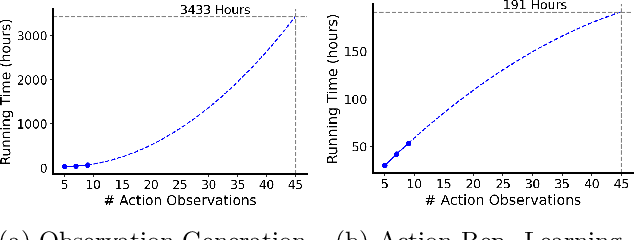
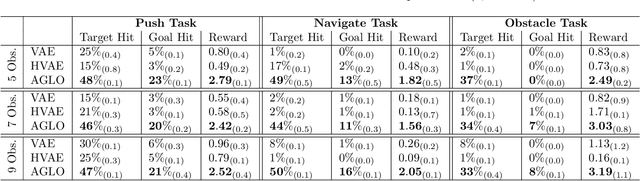
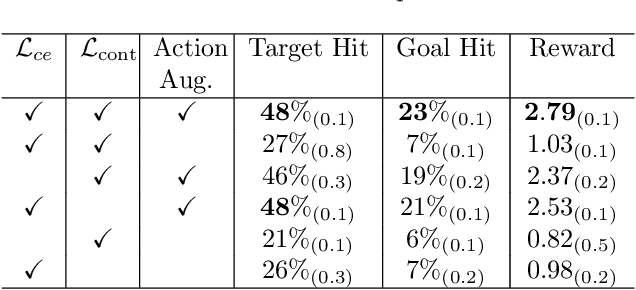
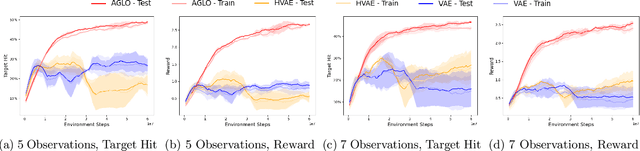
Reinforcement Learning (RL) has demonstrated remarkable success in solving sequential decision-making problems. However, in real-world scenarios, RL agents often struggle to generalize when faced with unseen actions that were not encountered during training. Some previous works on zero-shot action generalization rely on large datasets of action observations to capture the behaviors of new actions, making them impractical for real-world applications. In this paper, we introduce a novel zero-shot framework, Action Generalization from Limited Observations (AGLO). Our framework has two main components: an action representation learning module and a policy learning module. The action representation learning module extracts discriminative embeddings of actions from limited observations, while the policy learning module leverages the learned action representations, along with augmented synthetic action representations, to learn a policy capable of handling tasks with unseen actions. The experimental results demonstrate that our framework significantly outperforms state-of-the-art methods for zero-shot action generalization across multiple benchmark tasks, showcasing its effectiveness in generalizing to new actions with minimal action observations.