 Add to Chrome
 Add to Firefox
 Add to Edge
dMoE: dLLMs with Learnable Block Experts
May 29, 2026
Diffusion Large Language Models (dLLMs) have recently emerged as a promising alternative to autoregressive models, offering competitive performance while naturally supporting parallel decoding. However, as dLLMs are increasingly integrated with Mixture-of-Experts (MoE) architectures to scale model capacity, a fundamental mismatch arises between block parallel decoding and token-level expert selection. Specifically, each dLLM forward pass processes multiple tokens with bidirectional dependencies, whereas conventional MoE layers route each token independently. This mismatch substantially increases the number of uniquely activated experts, making inference increasingly memory-bound. To address this, we propose dMoE, a simple yet effective block-level MoE framework. The central idea of dMoE is to aggregate token-level expert distributions within each block into a unified block-level expert distribution, which is then used to guide expert routing in a more coherent manner. In this way, dMoE substantially reduces the number of uniquely activated experts during inference without sacrificing performance, thereby mitigating the memory-bound bottleneck. Extensive experiments across a variety of benchmarks demonstrate the effectiveness of dMoE. On average, dMoE reduces the number of uniquely activated experts from 69.5 to 14.6 while retaining 99.11% of the original performance. Meanwhile, it reduces memory usage by 76.64% to 79.84% and achieves 1.14$\times$ to 1.66$\times$ end-to-end latency speedup. Code is available at: https://github.com/fscdc/dMoE

Mix-Quant: Quantized Prefilling, Precise Decoding for Agentic LLMs
May 19, 2026LLM agents have recently emerged as a powerful paradigm for solving complex tasks through planning, tool use, memory retrieval, and multi-step interaction. However, these agentic workflows often introduce substantial input-side overhead, making the compute-intensive prefilling stage a key bottleneck in long-context, multi-turn inference. In this work, we propose Mix-Quant, a simple and effective phase-aware quantization framework for fast agentic inference. We first investigate FP4 quantization in agentic LLM workflows and observe that quantizing the entire inference process can incur significant performance degradation. In contrast, the prefilling stage exhibits substantial quantization redundancy and can therefore be quantized with minimal accuracy loss, despite being the dominant source of computation. Based on this insight, we apply high-throughput NVFP4 quantization to the prefilling phase while preserving BF16 precision for decoding. By decoupling prefilling acceleration from decoding quality, Mix-Quant combines phase-aware algorithmic quantization with hardware-efficient NVFP4 execution to alleviate the inference bottleneck in LLM agents. Extensive experiments across long-context and agentic benchmarks demonstrate that Mix-Quant largely preserves task performance while delivering significant efficiency improvements, achieving up to a 3x speedup during prefilling.
DMax: Aggressive Parallel Decoding for dLLMs
Apr 09, 2026We present DMax, a new paradigm for efficient diffusion language models (dLLMs). It mitigates error accumulation in parallel decoding, enabling aggressive decoding parallelism while preserving generation quality. Unlike conventional masked dLLMs that decode through a binary mask-to-token transition, DMax reformulates decoding as a progressive self-refinement from mask embeddings to token embeddings. At the core of our approach is On-Policy Uniform Training, a novel training strategy that efficiently unifies masked and uniform dLLMs, equipping the model to recover clean tokens from both masked inputs and its own erroneous predictions. Building on this foundation, we further propose Soft Parallel Decoding. We represent each intermediate decoding state as an interpolation between the predicted token embedding and the mask embedding, enabling iterative self-revising in embedding space. Extensive experiments across a variety of benchmarks demonstrate the effectiveness of DMax. Compared with the original LLaDA-2.0-mini, our method improves TPF on GSM8K from 2.04 to 5.47 while preserving accuracy. On MBPP, it increases TPF from 2.71 to 5.86 while maintaining comparable performance. On two H200 GPUs, our model achieves an average of 1,338 TPS at batch size 1. Code is available at: https://github.com/czg1225/DMax
ViFeEdit: A Video-Free Tuner of Your Video Diffusion Transformer
Mar 16, 2026Diffusion Transformers (DiTs) have demonstrated remarkable scalability and quality in image and video generation, prompting growing interest in extending them to controllable generation and editing tasks. However, compared to the image counterparts, progress in video control and editing remains limited, mainly due to the scarcity of paired video data and the high computational cost of training video diffusion models. To address this issue, in this paper, we propose a video-free tuning framework termed ViFeEdit for video diffusion transformers. Without requiring any forms of video training data, ViFeEdit achieves versatile video generation and editing, adapted solely with 2D images. At the core of our approach is an architectural reparameterization that decouples spatial independence from the full 3D attention in modern video diffusion transformers, which enables visually faithful editing while maintaining temporal consistency with only minimal additional parameters. Moreover, this design operates in a dual-path pipeline with separate timestep embeddings for noise scheduling, exhibiting strong adaptability to diverse conditioning signals. Extensive experiments demonstrate that our method delivers promising results of controllable video generation and editing with only minimal training on 2D image data. Codes are available https://github.com/Lexie-YU/ViFeEdit.
dVoting: Fast Voting for dLLMs
Feb 12, 2026Diffusion Large Language Models (dLLMs) represent a new paradigm beyond autoregressive modeling, offering competitive performance while naturally enabling a flexible decoding process. Specifically, dLLMs can generate tokens at arbitrary positions in parallel, endowing them with significant potential for parallel test-time scaling, which was previously constrained by severe inefficiency in autoregressive modeling. In this work, we introduce dVoting, a fast voting technique that boosts reasoning capability without training, with only an acceptable extra computational overhead. dVoting is motivated by the observation that, across multiple samples for the same prompt, token predictions remain largely consistent, whereas performance is determined by a small subset of tokens exhibiting cross-sample variability. Leveraging the arbitrary-position generation capability of dLLMs, dVoting performs iterative refinement by sampling, identifying uncertain tokens via consistency analysis, regenerating them through voting, and repeating this process until convergence. Extensive evaluations demonstrate that dVoting consistently improves performance across various benchmarks. It achieves gains of 6.22%-7.66% on GSM8K, 4.40%-7.20% on MATH500, 3.16%-14.84% on ARC-C, and 4.83%-5.74% on MMLU. Our code is available at https://github.com/fscdc/dVoting
dParallel: Learnable Parallel Decoding for dLLMs
Sep 30, 2025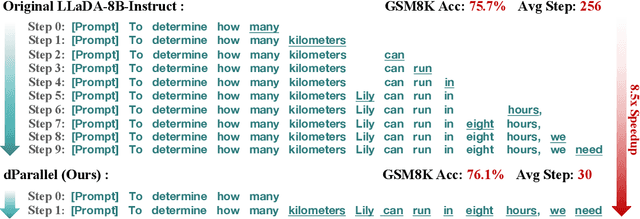
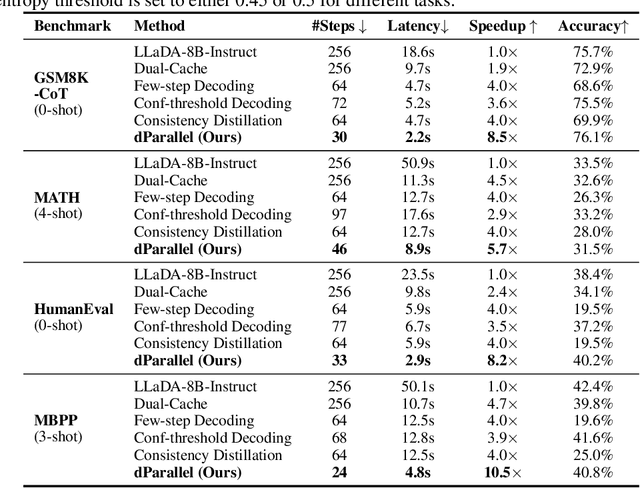
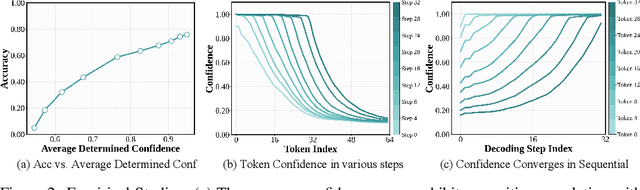
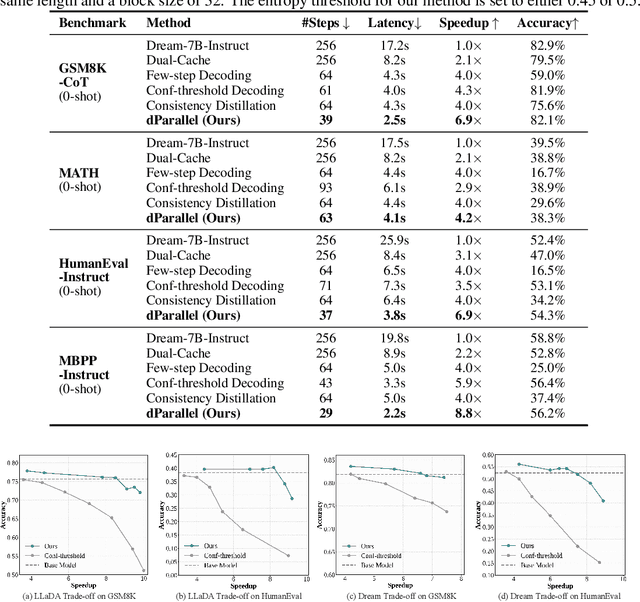
Diffusion large language models (dLLMs) have recently drawn considerable attention within the research community as a promising alternative to autoregressive generation, offering parallel token prediction and lower inference latency. Yet, their parallel decoding potential remains largely underexplored, as existing open-source models still require nearly token-length decoding steps to ensure performance. To address this, we introduce dParallel, a simple and effective method that unlocks the inherent parallelism of dLLMs for fast sampling. We identify that the key bottleneck to parallel decoding arises from the sequential certainty convergence for masked tokens. Building on this insight, we introduce the core of our approach: certainty-forcing distillation, a novel training strategy that distills the model to follow its original sampling trajectories while enforcing it to achieve high certainty on masked tokens more rapidly and in parallel. Extensive experiments across various benchmarks demonstrate that our method can dramatically reduce the number of decoding steps while maintaining performance. When applied to the LLaDA-8B-Instruct model, dParallel reduces decoding steps from 256 to 30 on GSM8K, achieving an 8.5x speedup without performance degradation. On the MBPP benchmark, it cuts decoding steps from 256 to 24, resulting in a 10.5x speedup while maintaining accuracy. Our code is available at https://github.com/czg1225/dParallel
Memory-Efficient Visual Autoregressive Modeling with Scale-Aware KV Cache Compression
May 26, 2025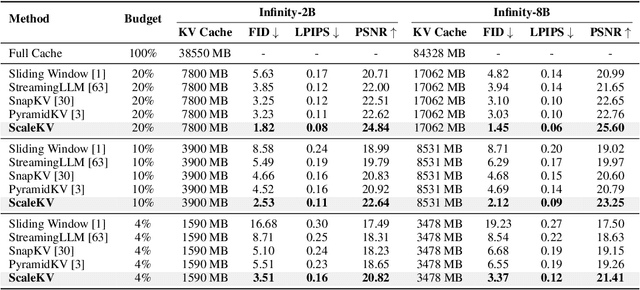
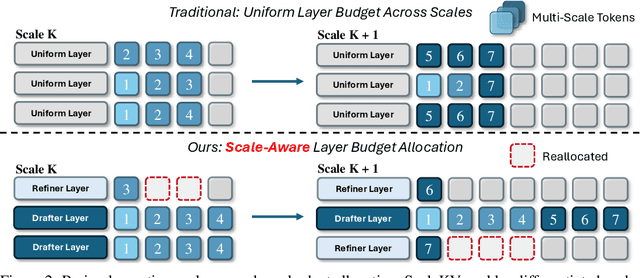
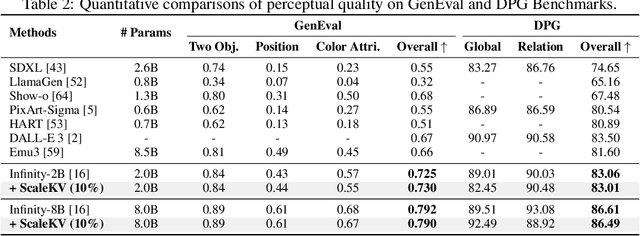
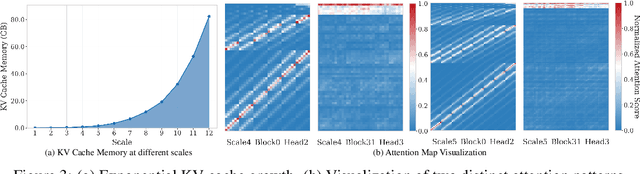
Visual Autoregressive (VAR) modeling has garnered significant attention for its innovative next-scale prediction approach, which yields substantial improvements in efficiency, scalability, and zero-shot generalization. Nevertheless, the coarse-to-fine methodology inherent in VAR results in exponential growth of the KV cache during inference, causing considerable memory consumption and computational redundancy. To address these bottlenecks, we introduce ScaleKV, a novel KV cache compression framework tailored for VAR architectures. ScaleKV leverages two critical observations: varying cache demands across transformer layers and distinct attention patterns at different scales. Based on these insights, ScaleKV categorizes transformer layers into two functional groups: drafters and refiners. Drafters exhibit dispersed attention across multiple scales, thereby requiring greater cache capacity. Conversely, refiners focus attention on the current token map to process local details, consequently necessitating substantially reduced cache capacity. ScaleKV optimizes the multi-scale inference pipeline by identifying scale-specific drafters and refiners, facilitating differentiated cache management tailored to each scale. Evaluation on the state-of-the-art text-to-image VAR model family, Infinity, demonstrates that our approach effectively reduces the required KV cache memory to 10% while preserving pixel-level fidelity.
VeriThinker: Learning to Verify Makes Reasoning Model Efficient
May 23, 2025Large Reasoning Models (LRMs) excel at complex tasks using Chain-of-Thought (CoT) reasoning. However, their tendency to overthinking leads to unnecessarily lengthy reasoning chains, dramatically increasing inference costs. To mitigate this issue, we introduce VeriThinker, a novel approach for CoT compression. Unlike conventional methods that fine-tune LRMs directly on the original reasoning task using synthetic concise CoT data, we innovatively fine-tune the model solely through an auxiliary verification task. By training LRMs to accurately verify the correctness of CoT solutions, the LRMs inherently become more discerning about the necessity of subsequent self-reflection steps, thereby effectively suppressing overthinking. Extensive experiments validate that VeriThinker substantially reduces reasoning chain lengths while maintaining or even slightly improving accuracy. When applied to DeepSeek-R1-Distill-Qwen-7B, our approach reduces reasoning tokens on MATH500 from 3790 to 2125 while improving accuracy by 0.8% (94.0% to 94.8%), and on AIME25, tokens decrease from 14321 to 10287 with a 2.1% accuracy gain (38.7% to 40.8%). Additionally, our experiments demonstrate that VeriThinker can also be zero-shot generalized to speculative reasoning. Code is available at https://github.com/czg1225/VeriThinker
Collaborative Decoding Makes Visual Auto-Regressive Modeling Efficient
Nov 26, 2024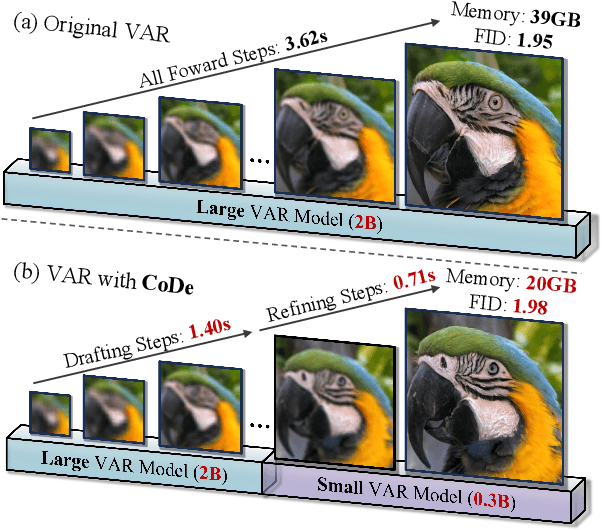
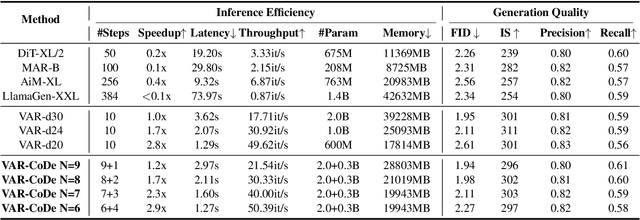
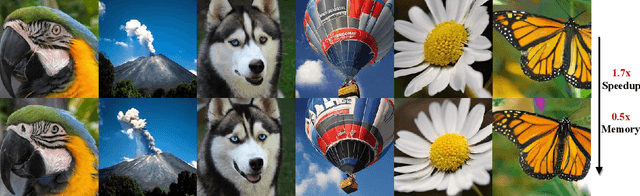
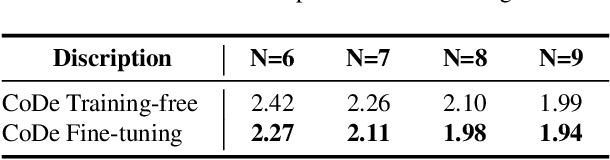
In the rapidly advancing field of image generation, Visual Auto-Regressive (VAR) modeling has garnered considerable attention for its innovative next-scale prediction approach. This paradigm offers substantial improvements in efficiency, scalability, and zero-shot generalization. Yet, the inherently coarse-to-fine nature of VAR introduces a prolonged token sequence, leading to prohibitive memory consumption and computational redundancies. To address these bottlenecks, we propose Collaborative Decoding (CoDe), a novel efficient decoding strategy tailored for the VAR framework. CoDe capitalizes on two critical observations: the substantially reduced parameter demands at larger scales and the exclusive generation patterns across different scales. Based on these insights, we partition the multi-scale inference process into a seamless collaboration between a large model and a small model. The large model serves as the 'drafter', specializing in generating low-frequency content at smaller scales, while the smaller model serves as the 'refiner', solely focusing on predicting high-frequency details at larger scales. This collaboration yields remarkable efficiency with minimal impact on quality: CoDe achieves a 1.7x speedup, slashes memory usage by around 50%, and preserves image quality with only a negligible FID increase from 1.95 to 1.98. When drafting steps are further decreased, CoDe can achieve an impressive 2.9x acceleration ratio, reaching 41 images/s at 256x256 resolution on a single NVIDIA 4090 GPU, while preserving a commendable FID of 2.27. The code is available at https://github.com/czg1225/CoDe
Heavy Labels Out! Dataset Distillation with Label Space Lightening
Aug 15, 2024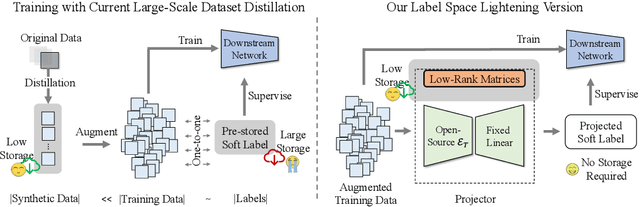
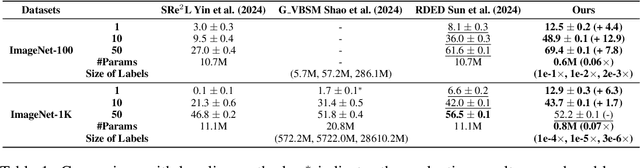


Dataset distillation or condensation aims to condense a large-scale training dataset into a much smaller synthetic one such that the training performance of distilled and original sets on neural networks are similar. Although the number of training samples can be reduced substantially, current state-of-the-art methods heavily rely on enormous soft labels to achieve satisfactory performance. As a result, the required storage can be comparable even to original datasets, especially for large-scale ones. To solve this problem, instead of storing these heavy labels, we propose a novel label-lightening framework termed HeLlO aiming at effective image-to-label projectors, with which synthetic labels can be directly generated online from synthetic images. Specifically, to construct such projectors, we leverage prior knowledge in open-source foundation models, e.g., CLIP, and introduce a LoRA-like fine-tuning strategy to mitigate the gap between pre-trained and target distributions, so that original models for soft-label generation can be distilled into a group of low-rank matrices. Moreover, an effective image optimization method is proposed to further mitigate the potential error between the original and distilled label generators. Extensive experiments demonstrate that with only about 0.003% of the original storage required for a complete set of soft labels, we achieve comparable performance to current state-of-the-art dataset distillation methods on large-scale datasets. Our code will be available.