 Add to Chrome
 Add to Firefox
 Add to Edge
Non-Degenerate Risk Certification for Automated Security Decisions: A Decision-Contract Theory with ATT\&CK-Aligned Triage as a Worked Instance
Aug 12, 2026
An unconditional risk bound on automated decisions can be satisfied without automating anything, since a selector that never acts drives the bound to zero. We show this is structural: any risk certificate is defined over a decision contract, the inputs a system acts on plus the semantic relation under which an output counts correct, and weakening either hides base-classifier error. We develop a decision-contract theory: an error-conservation law showing error is only reassigned among harmful automation, human deferral, and semantic masking; a label-free singleton capacity certifying structural incapacity, with a risk-feasible refinement separating recoverable threshold misalignment from risk-constrained incapacity; and a non-degenerate actionability certificate excluding all-abstain solutions by construction. We instantiate this on ATT\&CK-aligned alert triage for LLM-based intrusion detection, the setting that exposed the vacuity failure. Across 3 IDS datasets, 6 LLMs, and 4 error-rate thresholds, empirical false-attribution risk stays at or below target in 90.3% of configurations, with 83.4% mean correct automation. The capacity diagnostic explains every low-utility configuration; its refinement separates genuine misalignment from risk-constrained incapacity, confirmed by an exhibited alternative threshold; a training-stability re-run finds no confirmed structural-incapacity instance; and real fine-grained attack-subtype labels confirm the coarsening-transfer identity under a genuine many-to-one map, with small but non-zero masking mass.

Post-Hoc Trajectory-Risk Certification for Modular LLM-Based Security Agents
Aug 04, 2026Autonomous security agents operate as staged pipelines, such as classifying network traffic and then attributing attacks to a specific technique. Split conformal prediction gives each stage finite-sample coverage, but deployment requires a trajectory-level guarantee across the full chain. These guarantees do not compose automatically when stages are independently trained and calibrated. Bonferroni allocation is distribution-free but conservative under correlated errors. We show that a natural pairwise-correlation extension to three or more stages is invalid because it gives a lower rather than an upper bound, and derive a valid spanning-tree alternative. We distinguish whether stages are dependent from whether an audit sample is large enough to certify that dependence, and give matching upper and information-theoretic lower sample-complexity bounds. We also show that coarse-to-fine label selection can create near-perfect measured correlation without learned dependence. On a two-stage intrusion-detection pipeline across 6 open LLMs and 2 datasets, removing this artifact reduces measured correlation from near 1 to 0-0.78. A direct audit of trajectory failure becomes 13.7% tighter than Bonferroni once the audit reaches the required sample size, but is worse when undersized. A modular certificate using per-stage certificates and a pairwise overlap bound yields a positive average gain of 0.6%, quantifying the cost of lacking joint access. Same-model, cross-model, and permuted-pairing tests show that residual dependence reflects shared sample difficulty, not shared model representations. Average trajectory coverage across 12 configurations is 92.7% +/- 2.4% at alpha = 0.10. Under cross-dataset deployment, single-step miscoverage reaches 100% even when accuracy remains 78%, showing that distribution shift destroys calibrated confidence before raw accuracy.
Traffic-Aware Randomized Smoothing for LLM-Based Network Intrusion Detection
Jul 15, 2026Large language model (LLM)-based intrusion detection systems (IDS) are increasingly studied for security monitoring, yet their robustness against feasible traffic manipulation remains largely empirical. We present Traffic-Aware Randomized Smoothing (TA-RS), a classifier-agnostic certified defense that injects Gaussian noise exclusively into the directly controllable (DC) subspace -- features a remote attacker can modify -- during both fine-tuning and certification, aligning the smoothing distribution with the attacker-controllable subspace. We identify a critical prerequisite: applying standard randomized smoothing to clean-trained LLM-IDS yields weak certified accuracy in three of four (model, dataset) pairs tested (14-33%, at or below random) and only 57% in the fourth (43 pp below the noise-augmented result); noise-augmented fine-tuning recovers to 68-100% on two of three benchmark datasets (at sigma=0.25). At the L_inf-equivalent threshold R_inf = epsilon*sqrt(|DC|) (epsilon=0.05), TA-RS achieves 55-100% certified accuracy on CIC-IDS-2018 and HIKARI-2021, with median certified radii (R approx 0.45-0.96) exceeding R_inf by 1.8-5x (across sigma=0.25-1.00). Against a fairly trained iso-trained RS baseline the residual advantage is dataset-dependent (4-19 pp on CIC-IDS-2018). The larger gap -- up to 72 pp against an isotropic RS baseline that shares the DC-noise-augmented training recipe -- primarily reflects the training-certification mismatch rather than DC alignment alone: isotropic test-time noise perturbs uncontrollable features the attacker cannot exploit, triggering abstention rates up to 68%. RT-IoT2022 probes the limits of the method: it fails under the default fine-tuning recipe but recovers to 76%/69% certified accuracy (LLaMA3-8B/Qwen3-8B) when noise augmentation is increased.
AIDE: A Vision-Driven Multi-View, Multi-Modal, Multi-Tasking Dataset for Assistive Driving Perception
Aug 01, 2023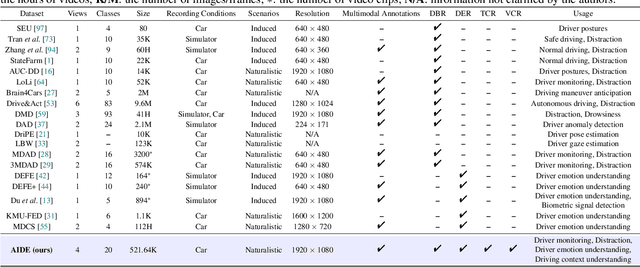
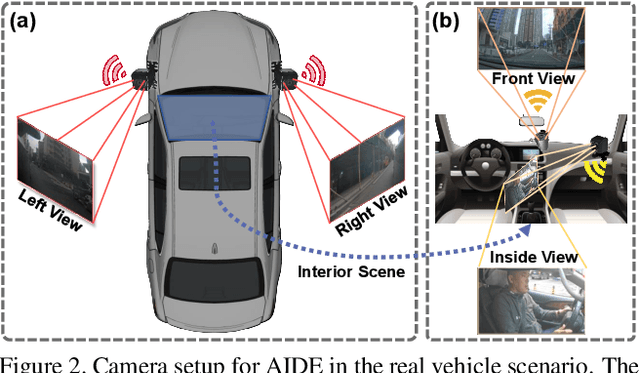
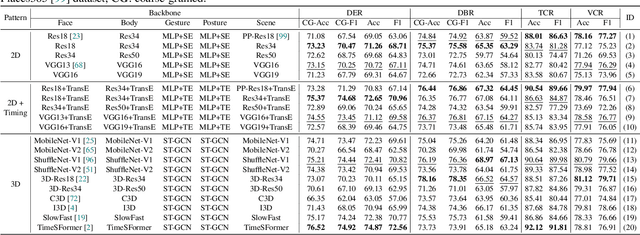
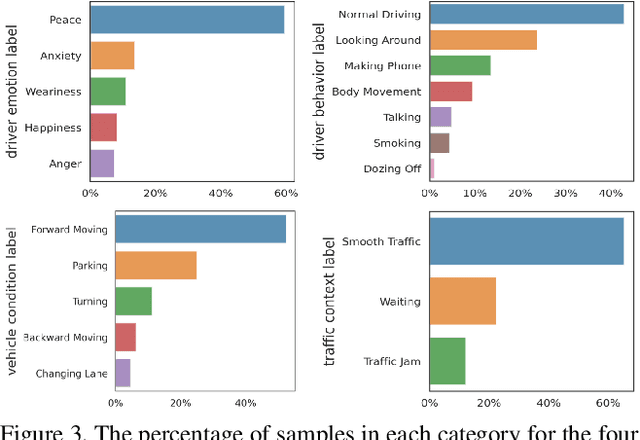
Driver distraction has become a significant cause of severe traffic accidents over the past decade. Despite the growing development of vision-driven driver monitoring systems, the lack of comprehensive perception datasets restricts road safety and traffic security. In this paper, we present an AssIstive Driving pErception dataset (AIDE) that considers context information both inside and outside the vehicle in naturalistic scenarios. AIDE facilitates holistic driver monitoring through three distinctive characteristics, including multi-view settings of driver and scene, multi-modal annotations of face, body, posture, and gesture, and four pragmatic task designs for driving understanding. To thoroughly explore AIDE, we provide experimental benchmarks on three kinds of baseline frameworks via extensive methods. Moreover, two fusion strategies are introduced to give new insights into learning effective multi-stream/modal representations. We also systematically investigate the importance and rationality of the key components in AIDE and benchmarks. The project link is https://github.com/ydk122024/AIDE.
Learning Low-dimensional Manifolds for Scoring of Tissue Microarray Images
Feb 22, 2021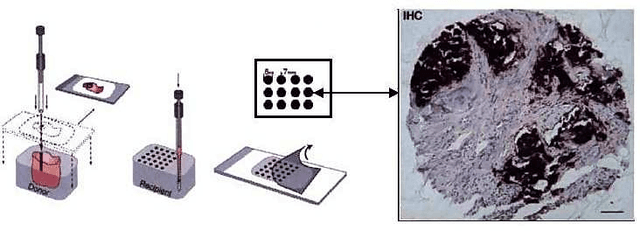
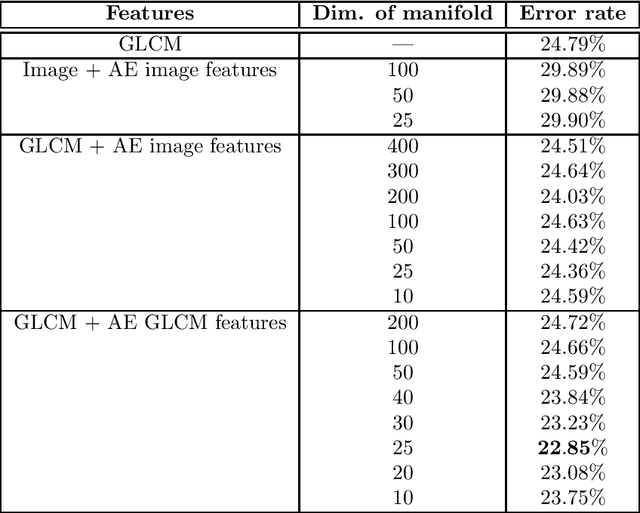
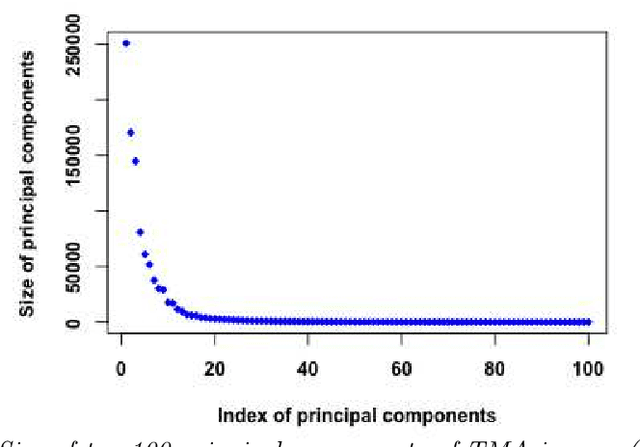
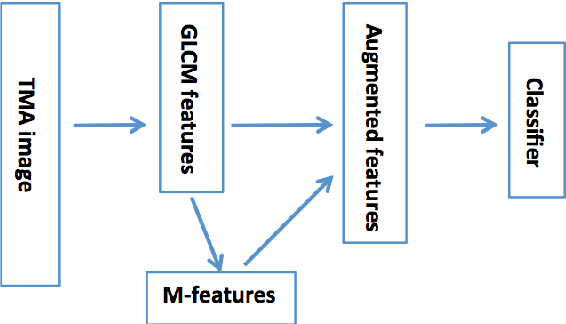
Tissue microarray (TMA) images have emerged as an important high-throughput tool for cancer study and the validation of biomarkers. Efforts have been dedicated to further improve the accuracy of TACOMA, a cutting-edge automatic scoring algorithm for TMA images. One major advance is due to deepTacoma, an algorithm that incorporates suitable deep representations of a group nature. Inspired by the recent advance in semi-supervised learning and deep learning, we propose mfTacoma to learn alternative deep representations in the context of TMA image scoring. In particular, mfTacoma learns the low-dimensional manifolds, a common latent structure in high dimensional data. Deep representation learning and manifold learning typically requires large data. By encoding deep representation of the manifolds as regularizing features, mfTacoma effectively leverages the manifold information that is potentially crude due to small data. Our experiments show that deep features by manifolds outperforms two alternatives -- deep features by linear manifolds with principal component analysis or by leveraging the group property.
Domain Adaptation with Incomplete Target Domains
Dec 03, 2020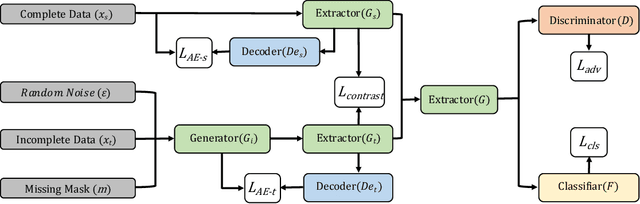
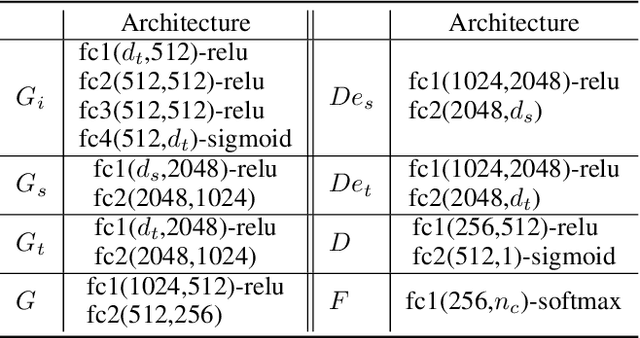
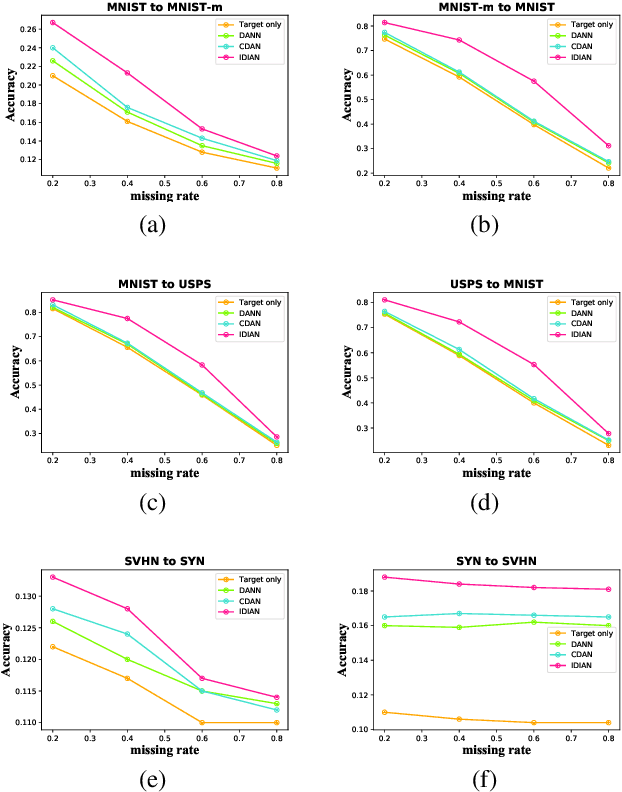

Domain adaptation, as a task of reducing the annotation cost in a target domain by exploiting the existing labeled data in an auxiliary source domain, has received a lot of attention in the research community. However, the standard domain adaptation has assumed perfectly observed data in both domains, while in real world applications the existence of missing data can be prevalent. In this paper, we tackle a more challenging domain adaptation scenario where one has an incomplete target domain with partially observed data. We propose an Incomplete Data Imputation based Adversarial Network (IDIAN) model to address this new domain adaptation challenge. In the proposed model, we design a data imputation module to fill the missing feature values based on the partial observations in the target domain, while aligning the two domains via deep adversarial adaption. We conduct experiments on both cross-domain benchmark tasks and a real world adaptation task with imperfect target domains. The experimental results demonstrate the effectiveness of the proposed method.
A Transductive Multi-Head Model for Cross-Domain Few-Shot Learning
Jun 08, 2020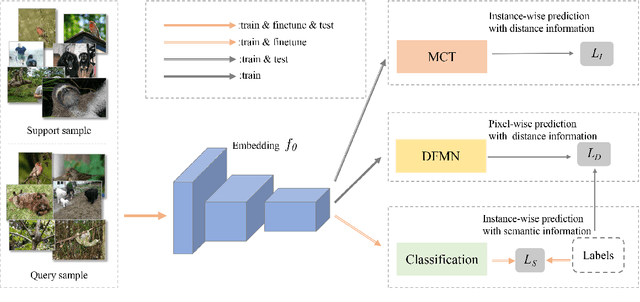
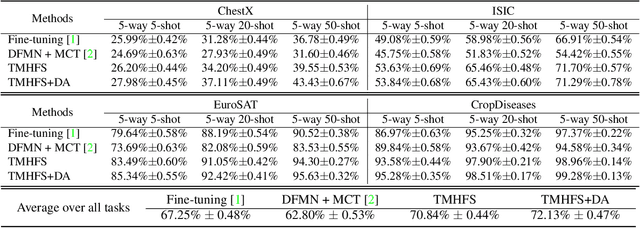
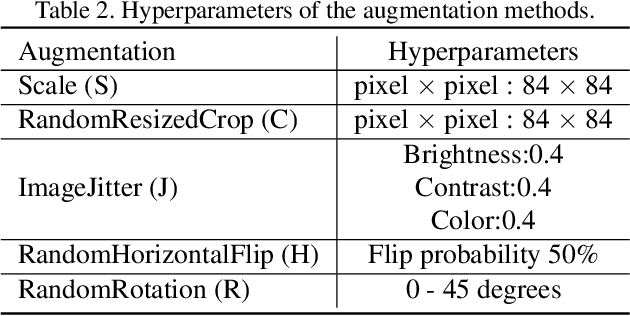
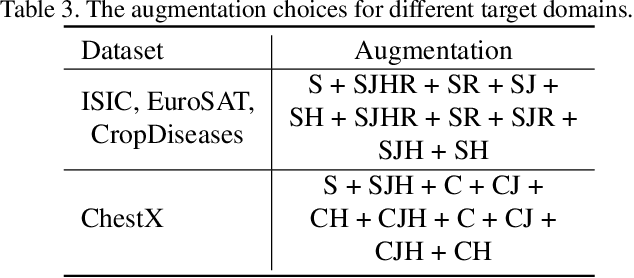
In this paper, we present a new method, Transductive Multi-Head Few-Shot learning (TMHFS), to address the Cross-Domain Few-Shot Learning (CD-FSL) challenge. The TMHFS method extends the Meta-Confidence Transduction (MCT) and Dense Feature-Matching Networks (DFMN) method [2] by introducing a new prediction head, i.e, an instance-wise global classification network based on semantic information, after the common feature embedding network. We train the embedding network with the multiple heads, i.e,, the MCT loss, the DFMN loss and the semantic classifier loss, simultaneously in the source domain. For the few-shot learning in the target domain, we first perform fine-tuning on the embedding network with only the semantic global classifier and the support instances, and then use the MCT part to predict labels of the query set with the fine-tuned embedding network. Moreover, we further exploit data augmentation techniques during the fine-tuning and test stages to improve the prediction performance. The experimental results demonstrate that the proposed methods greatly outperform the strong baseline, fine-tuning, on four different target domains.
Feature Transformation Ensemble Model with Batch Spectral Regularization for Cross-Domain Few-Shot Classification
May 21, 2020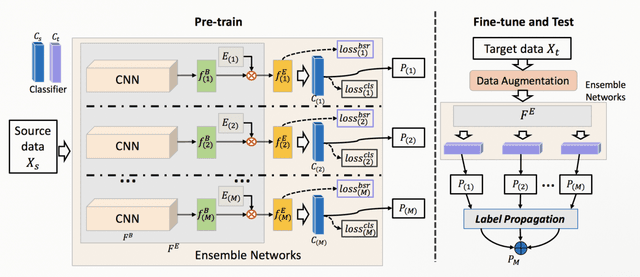
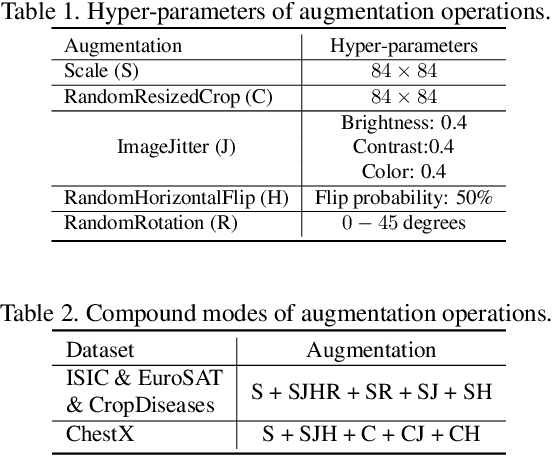
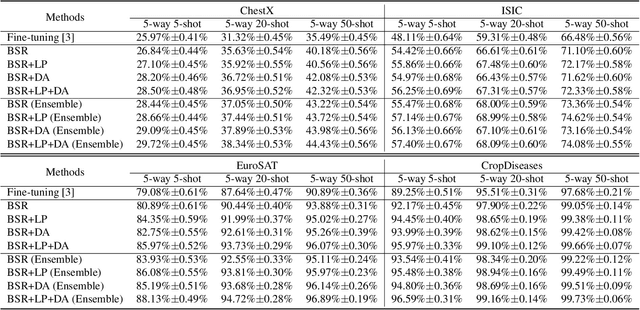
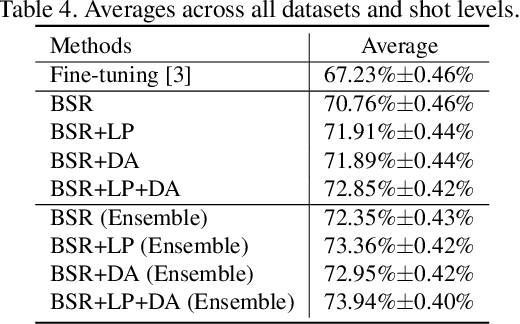
In this paper, we propose a feature transformation ensemble model with batch spectral regularization for the Cross-domain few-shot learning (CD-FSL) challenge. Specifically, we proposes to construct an ensemble prediction model by performing diverse feature transformations after a feature extraction network. On each branch prediction network of the model we use a batch spectral regularization term to suppress the singular values of the feature matrix during pre-training to improve the generalization ability of the model. The proposed model can then be fine tuned in the target domain to address few-shot classification. We also further apply label propagation, entropy minimization and data augmentation to mitigate the shortage of labeled data in target domains. Experiments are conducted on a number of CD-FSL benchmark tasks with four target domains and the results demonstrate the superiority of our proposed model.
Mutual Learning Network for Multi-Source Domain Adaptation
Mar 29, 2020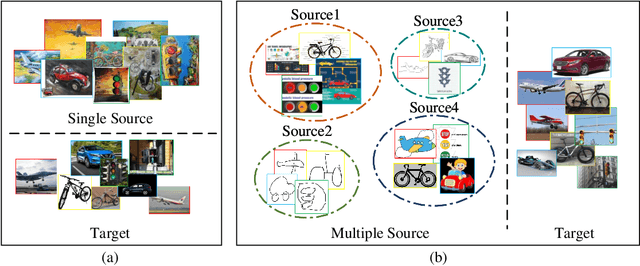
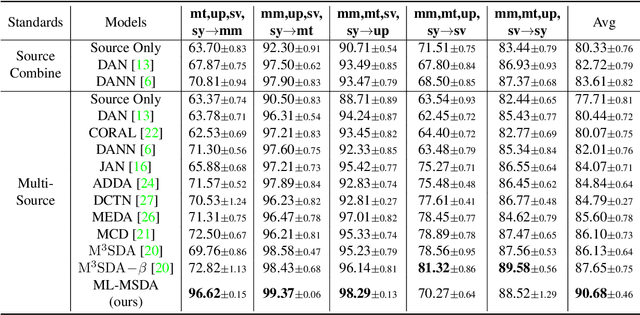
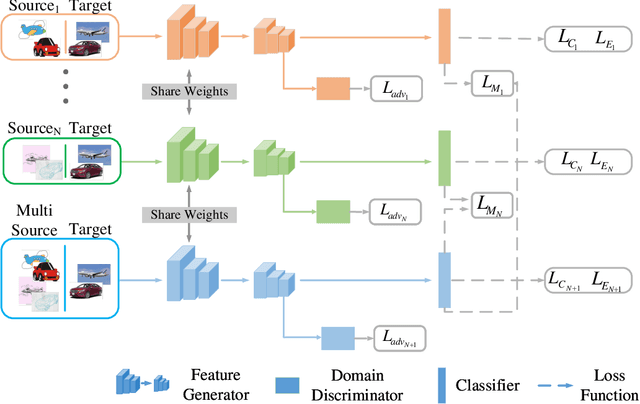
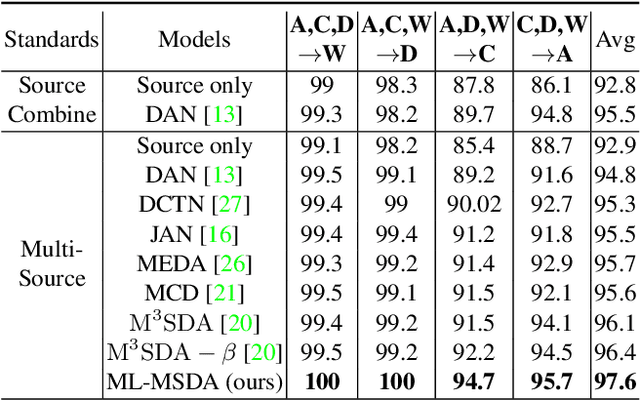
Early Unsupervised Domain Adaptation (UDA) methods have mostly assumed the setting of a single source domain, where all the labeled source data come from the same distribution. However, in practice the labeled data can come from multiple source domains with different distributions. In such scenarios, the single source domain adaptation methods can fail due to the existence of domain shifts across different source domains and multi-source domain adaptation methods need to be designed. In this paper, we propose a novel multi-source domain adaptation method, Mutual Learning Network for Multiple Source Domain Adaptation (ML-MSDA). Under the framework of mutual learning, the proposed method pairs the target domain with each single source domain to train a conditional adversarial domain adaptation network as a branch network, while taking the pair of the combined multi-source domain and target domain to train a conditional adversarial adaptive network as the guidance network. The multiple branch networks are aligned with the guidance network to achieve mutual learning by enforcing JS-divergence regularization over their prediction probability distributions on the corresponding target data. We conduct extensive experiments on multiple multi-source domain adaptation benchmark datasets. The results show the proposed ML-MSDA method outperforms the comparison methods and achieves the state-of-the-art performance.
K-nearest Neighbor Search by Random Projection Forests
Dec 31, 2018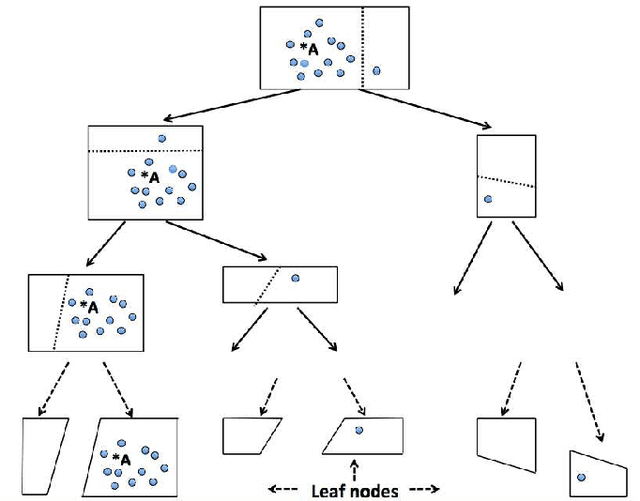
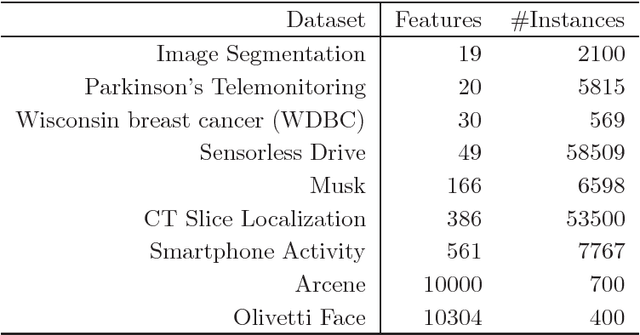
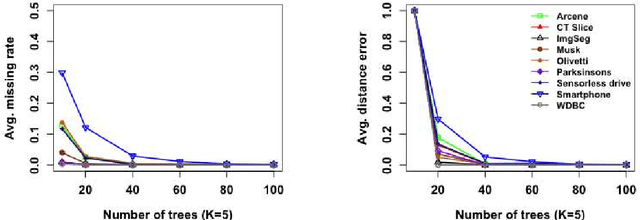
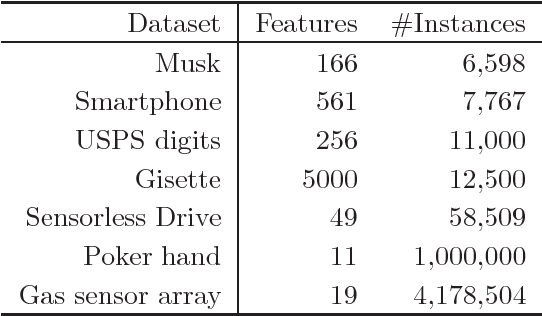
K-nearest neighbor (kNN) search has wide applications in many areas, including data mining, machine learning, statistics and many applied domains. Inspired by the success of ensemble methods and the flexibility of tree-based methodology, we propose random projection forests (rpForests), for kNN search. rpForests finds kNNs by aggregating results from an ensemble of random projection trees with each constructed recursively through a series of carefully chosen random projections. rpForests achieves a remarkable accuracy in terms of fast decay in the missing rate of kNNs and that of discrepancy in the kNN distances. rpForests has a very low computational complexity. The ensemble nature of rpForests makes it easily run in parallel on multicore or clustered computers; the running time is expected to be nearly inversely proportional to the number of cores or machines. We give theoretical insights by showing the exponential decay of the probability that neighboring points would be separated by ensemble random projection trees when the ensemble size increases. Our theory can be used to refine the choice of random projections in the growth of trees, and experiments show that the effect is remarkable.