 Add to Chrome
 Add to Firefox
 Add to Edge
Voxtral TTS
Mar 26, 2026
We introduce Voxtral TTS, an expressive multilingual text-to-speech model that generates natural speech from as little as 3 seconds of reference audio. Voxtral TTS adopts a hybrid architecture that combines auto-regressive generation of semantic speech tokens with flow-matching for acoustic tokens. These tokens are encoded and decoded with Voxtral Codec, a speech tokenizer trained from scratch with a hybrid VQ-FSQ quantization scheme. In human evaluations conducted by native speakers, Voxtral TTS is preferred for multilingual voice cloning due to its naturalness and expressivity, achieving a 68.4\% win rate over ElevenLabs Flash v2.5. We release the model weights under a CC BY-NC license.

The Appeal and Reality of Recycling LoRAs with Adaptive Merging
Feb 12, 2026The widespread availability of fine-tuned LoRA modules for open pre-trained models has led to an interest in methods that can adaptively merge LoRAs to improve performance. These methods typically include some way of selecting LoRAs from a pool and tune merging coefficients based on a task-specific dataset. While adaptive merging methods have demonstrated improvements in some settings, no past work has attempted to recycle LoRAs found "in the wild" on model repositories like the Hugging Face Hub. To address this gap, we consider recycling from a pool of nearly 1,000 user-contributed LoRAs trained from the Llama 3.1 8B-Instruct language model. Our empirical study includes a range of adaptive and non-adaptive merging methods in addition to a new method designed via a wide search over the methodological design space. We demonstrate that adaptive merging methods can improve performance over the base model but provide limited benefit over training a new LoRA on the same data used to set merging coefficients. We additionally find not only that the specific choice of LoRAs to merge has little importance, but that using LoRAs with randomly initialized parameter values yields similar performance. This raises the possibility that adaptive merging from recycled LoRAs primarily works via some kind of regularization effect, rather than by enabling positive cross-task transfer. To better understand why past work has proven successful, we confirm that positive transfer is indeed possible when there are highly relevant LoRAs in the pool. We release the model checkpoints and code online.
Voxtral Realtime
Feb 11, 2026We introduce Voxtral Realtime, a natively streaming automatic speech recognition model that matches offline transcription quality at sub-second latency. Unlike approaches that adapt offline models through chunking or sliding windows, Voxtral Realtime is trained end-to-end for streaming, with explicit alignment between audio and text streams. Our architecture builds on the Delayed Streams Modeling framework, introducing a new causal audio encoder and Ada RMS-Norm for improved delay conditioning. We scale pretraining to a large-scale dataset spanning 13 languages. At a delay of 480ms, Voxtral Realtime achieves performance on par with Whisper, the most widely deployed offline transcription system. We release the model weights under the Apache 2.0 license.
Spherical Leech Quantization for Visual Tokenization and Generation
Dec 16, 2025

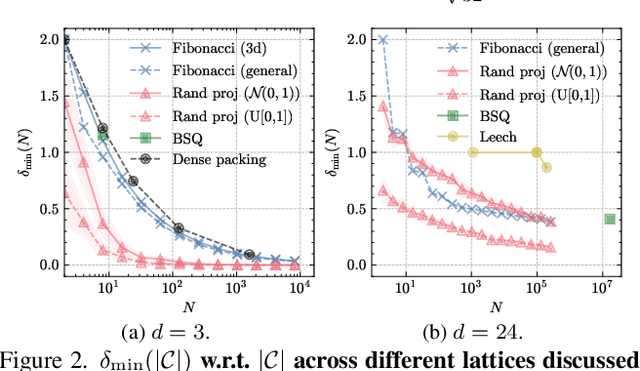
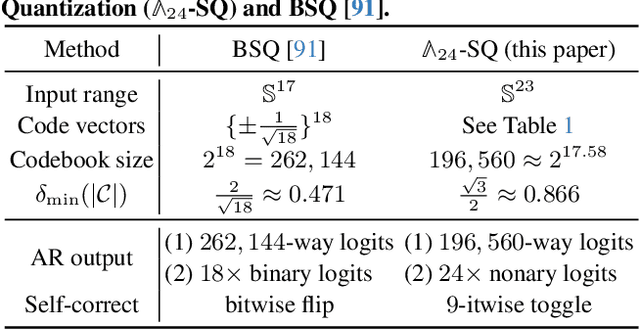
Non-parametric quantization has received much attention due to its efficiency on parameters and scalability to a large codebook. In this paper, we present a unified formulation of different non-parametric quantization methods through the lens of lattice coding. The geometry of lattice codes explains the necessity of auxiliary loss terms when training auto-encoders with certain existing lookup-free quantization variants such as BSQ. As a step forward, we explore a few possible candidates, including random lattices, generalized Fibonacci lattices, and densest sphere packing lattices. Among all, we find the Leech lattice-based quantization method, which is dubbed as Spherical Leech Quantization ($Λ_{24}$-SQ), leads to both a simplified training recipe and an improved reconstruction-compression tradeoff thanks to its high symmetry and even distribution on the hypersphere. In image tokenization and compression tasks, this quantization approach achieves better reconstruction quality across all metrics than BSQ, the best prior art, while consuming slightly fewer bits. The improvement also extends to state-of-the-art auto-regressive image generation frameworks.
The Common Pile v0.1: An 8TB Dataset of Public Domain and Openly Licensed Text
Jun 05, 2025Large language models (LLMs) are typically trained on enormous quantities of unlicensed text, a practice that has led to scrutiny due to possible intellectual property infringement and ethical concerns. Training LLMs on openly licensed text presents a first step towards addressing these issues, but prior data collection efforts have yielded datasets too small or low-quality to produce performant LLMs. To address this gap, we collect, curate, and release the Common Pile v0.1, an eight terabyte collection of openly licensed text designed for LLM pretraining. The Common Pile comprises content from 30 sources that span diverse domains including research papers, code, books, encyclopedias, educational materials, audio transcripts, and more. Crucially, we validate our efforts by training two 7 billion parameter LLMs on text from the Common Pile: Comma v0.1-1T and Comma v0.1-2T, trained on 1 and 2 trillion tokens respectively. Both models attain competitive performance to LLMs trained on unlicensed text with similar computational budgets, such as Llama 1 and 2 7B. In addition to releasing the Common Pile v0.1 itself, we also release the code used in its creation as well as the training mixture and checkpoints for the Comma v0.1 models.
GEXIA: Granularity Expansion and Iterative Approximation for Scalable Multi-grained Video-language Learning
Dec 10, 2024
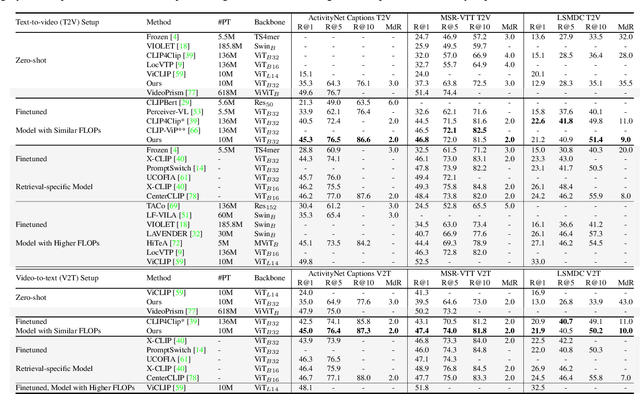
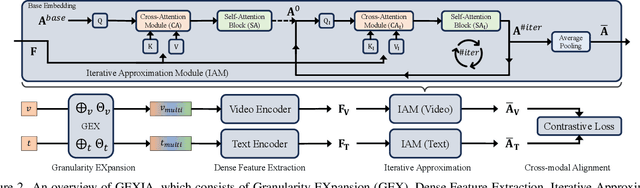
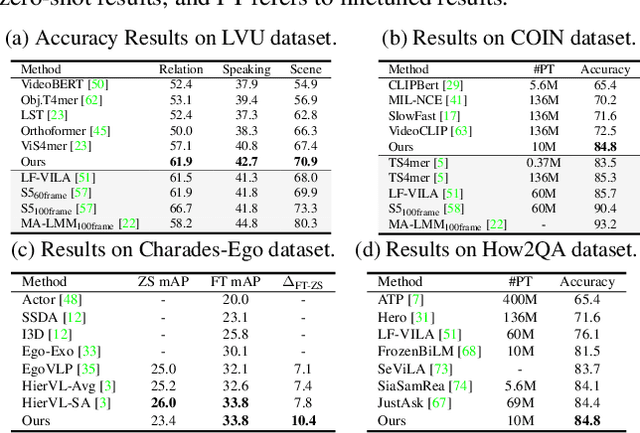
In various video-language learning tasks, the challenge of achieving cross-modality alignment with multi-grained data persists. We propose a method to tackle this challenge from two crucial perspectives: data and modeling. Given the absence of a multi-grained video-text pretraining dataset, we introduce a Granularity EXpansion (GEX) method with Integration and Compression operations to expand the granularity of a single-grained dataset. To better model multi-grained data, we introduce an Iterative Approximation Module (IAM), which embeds multi-grained videos and texts into a unified, low-dimensional semantic space while preserving essential information for cross-modal alignment. Furthermore, GEXIA is highly scalable with no restrictions on the number of video-text granularities for alignment. We evaluate our work on three categories of video tasks across seven benchmark datasets, showcasing state-of-the-art or comparable performance. Remarkably, our model excels in tasks involving long-form video understanding, even though the pretraining dataset only contains short video clips.
Self-Supervised Multi-Object Tracking with Path Consistency
Apr 08, 2024In this paper, we propose a novel concept of path consistency to learn robust object matching without using manual object identity supervision. Our key idea is that, to track a object through frames, we can obtain multiple different association results from a model by varying the frames it can observe, i.e., skipping frames in observation. As the differences in observations do not alter the identities of objects, the obtained association results should be consistent. Based on this rationale, we generate multiple observation paths, each specifying a different set of frames to be skipped, and formulate the Path Consistency Loss that enforces the association results are consistent across different observation paths. We use the proposed loss to train our object matching model with only self-supervision. By extensive experiments on three tracking datasets (MOT17, PersonPath22, KITTI), we demonstrate that our method outperforms existing unsupervised methods with consistent margins on various evaluation metrics, and even achieves performance close to supervised methods.
Challenges of Zero-Shot Recognition with Vision-Language Models: Granularity and Correctness
Jun 28, 2023

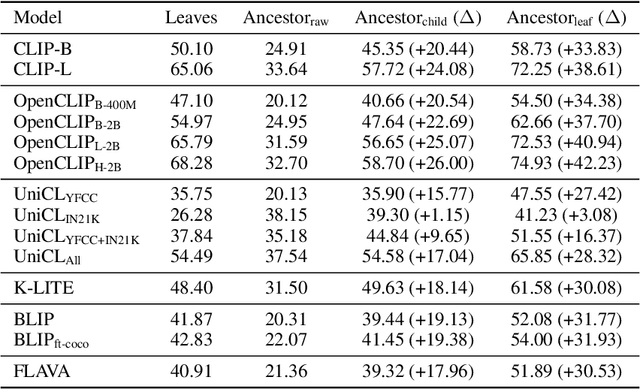

This paper investigates the challenges of applying vision-language models (VLMs) to zero-shot visual recognition tasks in an open-world setting, with a focus on contrastive vision-language models such as CLIP. We first examine the performance of VLMs on concepts of different granularity levels. We propose a way to fairly evaluate the performance discrepancy under two experimental setups and find that VLMs are better at recognizing fine-grained concepts. Furthermore, we find that the similarity scores from VLMs do not strictly reflect the correctness of the textual inputs given visual input. We propose an evaluation protocol to test our hypothesis that the scores can be biased towards more informative descriptions, and the nature of the similarity score between embedding makes it challenging for VLMs to recognize the correctness between similar but wrong descriptions. Our study highlights the challenges of using VLMs in open-world settings and suggests directions for future research to improve their zero-shot capabilities.
ScaleDet: A Scalable Multi-Dataset Object Detector
Jun 08, 2023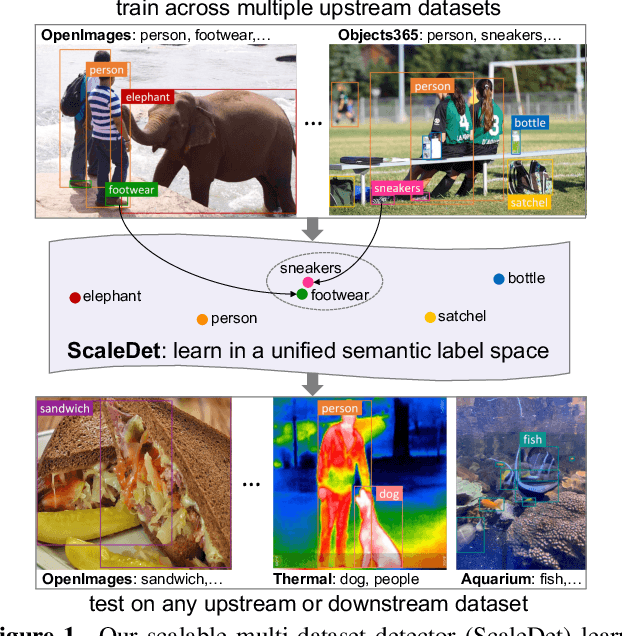
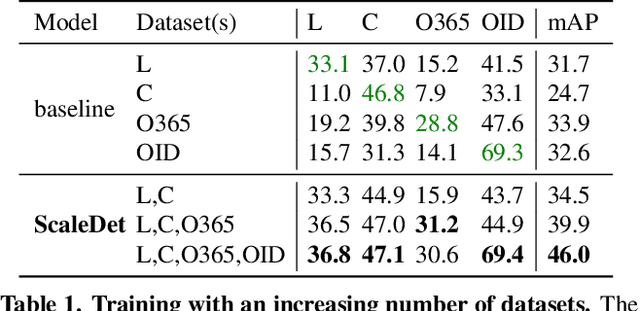
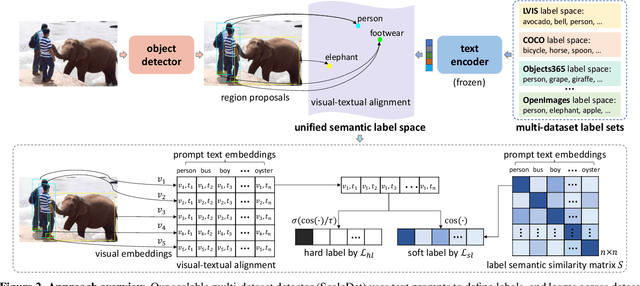
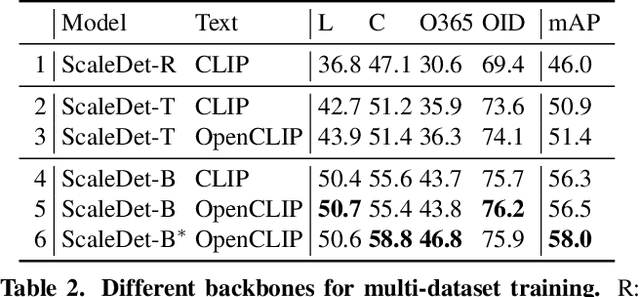
Multi-dataset training provides a viable solution for exploiting heterogeneous large-scale datasets without extra annotation cost. In this work, we propose a scalable multi-dataset detector (ScaleDet) that can scale up its generalization across datasets when increasing the number of training datasets. Unlike existing multi-dataset learners that mostly rely on manual relabelling efforts or sophisticated optimizations to unify labels across datasets, we introduce a simple yet scalable formulation to derive a unified semantic label space for multi-dataset training. ScaleDet is trained by visual-textual alignment to learn the label assignment with label semantic similarities across datasets. Once trained, ScaleDet can generalize well on any given upstream and downstream datasets with seen and unseen classes. We conduct extensive experiments using LVIS, COCO, Objects365, OpenImages as upstream datasets, and 13 datasets from Object Detection in the Wild (ODinW) as downstream datasets. Our results show that ScaleDet achieves compelling strong model performance with an mAP of 50.7 on LVIS, 58.8 on COCO, 46.8 on Objects365, 76.2 on OpenImages, and 71.8 on ODinW, surpassing state-of-the-art detectors with the same backbone.
Improving Dense Contrastive Learning with Dense Negative Pairs
Oct 11, 2022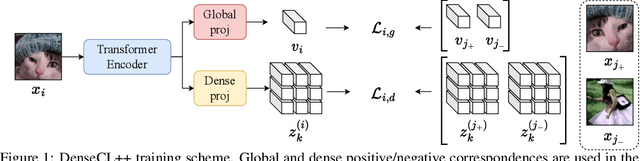
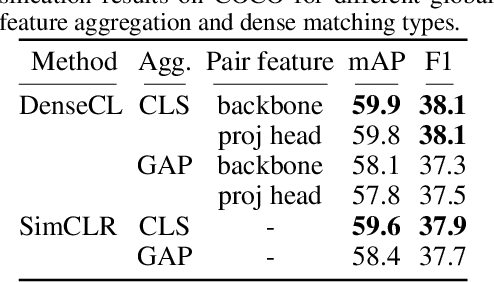
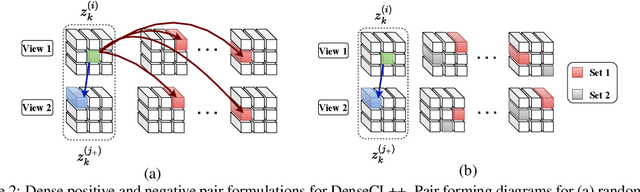
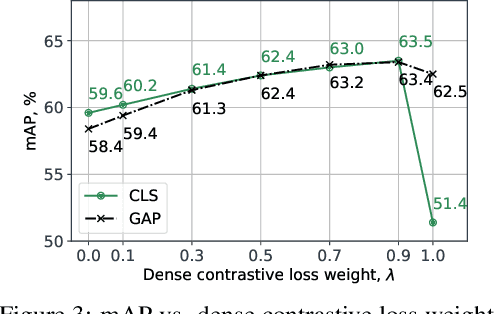
Many contrastive representation learning methods learn a single global representation of an entire image. However, dense contrastive representation learning methods such as DenseCL [19] can learn better representations for tasks requiring stronger spatial localization of features, such as multi-label classification, detection, and segmentation. In this work, we study how to improve the quality of the representations learned by DenseCL by modifying the training scheme and objective function, and propose DenseCL++. We also conduct several ablation studies to better understand the effects of: (i) various techniques to form dense negative pairs among augmentations of different images, (ii) cross-view dense negative and positive pairs, and (iii) an auxiliary reconstruction task. Our results show 3.5% and 4% mAP improvement over SimCLR [3] and DenseCL in COCO multi-label classification. In COCO and VOC segmentation tasks, we achieve 1.8% and 0.7% mIoU improvements over SimCLR, respectively.