 Add to Chrome
 Add to Firefox
 Add to Edge
Foresight: Failure Detection for Long-Horizon Robotic Manipulation with Action-Conditioned World Model Latents
Jun 22, 2026
Long-horizon tasks are common in real-world robotic deployments, yet failure detection for such tasks remains underexplored. Detecting failures in long-horizon robotic tasks is particularly challenging because failure onset is often ambiguous and dense temporal annotations are typically unavailable. We present Foresight, a failure detection framework that monitors manipulation trajectories using latent representations from an action-conditioned world model. Foresight is trained using only final task-level success or failure labels. By leveraging predictive world-model embeddings, our method provides a unified framework for failure detection across different policies. We further use functional conformal prediction (FCP) to calibrate detection thresholds adaptively. We evaluate Foresight with state-of-the-art vision-language-action policies in simulation on LIBERO-Long, ManiSkill-Long, and BEHAVIOR-1K, compare it against state-of-the-artfailure detection methods, and validate it on real robots with three long-horizon tasks on a ReactorX-200 arm and one task on a Franka arm. Our results suggest that action-conditioned world-model embeddings provide a scalable representation for reliable failure monitoring in long-horizon manipulation.

VLGA: Vision-Language-Geometry-Action Models for Autonomous Driving
Jun 10, 2026Vision-language-action (VLA) models can describe scenes and reason about them in language, yet still struggle to ground their actions in the dense 3D world around them. Existing approaches either inject features from a frozen 3D foundation model without an objective that ensures the policy uses them, or constrain geometry with sparse box and map losses that provide no dense spatial signal. We introduce VLGA, the first vision-language-action model supervised to reconstruct the dense 3D world it drives through. VLGA introduces geometry as a fourth modality alongside vision, language, and action through a dedicated expert supervised by a per-pixel pointmap regression loss against LiDAR. Extensive experiments conducted on challenging nuScenes and Bench2Drive datasets for open-loop and closed-loop evaluations, respectively, show the superiority of VLGA over counterpart VLA methods. In particular, on open-loop nuScenes, VLGA sets a new state of the art among VLA methods without ego status, with the lowest L2 (0.50\,m average) and 3-second collision rate (0.18\%). On closed-loop Bench2Drive, VLGA attains the state-of-the-art driving score of 79.08, +0.71 over the strongest prior VLA, at comparable efficiency and comfort.
OmniShotCut: Holistic Relational Shot Boundary Detection with Shot-Query Transformer
Apr 27, 2026Shot Boundary Detection (SBD) aims to automatically identify shot changes and divide a video into coherent shots. While SBD was widely studied in the literature, existing state-of-the-art methods often produce non-interpretable boundaries on transitions, miss subtle yet harmful discontinuities, and rely on noisy, low-diversity annotations and outdated benchmarks. To alleviate these limitations, we propose OmniShotCut to formulate SBD as structured relational prediction, jointly estimating shot ranges with intra-shot relations and inter-shot relations, by a shot query-based dense video Transformer. To avoid imprecise manual labeling, we adopt a fully synthetic transition synthesis pipeline that automatically reproduces major transition families with precise boundaries and parameterized variants. We also introduce OmniShotCutBench, a modern wide-domain benchmark enabling holistic and diagnostic evaluation.
WildRayZer: Self-supervised Large View Synthesis in Dynamic Environments
Jan 15, 2026We present WildRayZer, a self-supervised framework for novel view synthesis (NVS) in dynamic environments where both the camera and objects move. Dynamic content breaks the multi-view consistency that static NVS models rely on, leading to ghosting, hallucinated geometry, and unstable pose estimation. WildRayZer addresses this by performing an analysis-by-synthesis test: a camera-only static renderer explains rigid structure, and its residuals reveal transient regions. From these residuals, we construct pseudo motion masks, distill a motion estimator, and use it to mask input tokens and gate loss gradients so supervision focuses on cross-view background completion. To enable large-scale training and evaluation, we curate Dynamic RealEstate10K (D-RE10K), a real-world dataset of 15K casually captured dynamic sequences, and D-RE10K-iPhone, a paired transient and clean benchmark for sparse-view transient-aware NVS. Experiments show that WildRayZer consistently outperforms optimization-based and feed-forward baselines in both transient-region removal and full-frame NVS quality with a single feed-forward pass.
LabelAny3D: Label Any Object 3D in the Wild
Jan 04, 2026Detecting objects in 3D space from monocular input is crucial for applications ranging from robotics to scene understanding. Despite advanced performance in the indoor and autonomous driving domains, existing monocular 3D detection models struggle with in-the-wild images due to the lack of 3D in-the-wild datasets and the challenges of 3D annotation. We introduce LabelAny3D, an \emph{analysis-by-synthesis} framework that reconstructs holistic 3D scenes from 2D images to efficiently produce high-quality 3D bounding box annotations. Built on this pipeline, we present COCO3D, a new benchmark for open-vocabulary monocular 3D detection, derived from the MS-COCO dataset and covering a wide range of object categories absent from existing 3D datasets. Experiments show that annotations generated by LabelAny3D improve monocular 3D detection performance across multiple benchmarks, outperforming prior auto-labeling approaches in quality. These results demonstrate the promise of foundation-model-driven annotation for scaling up 3D recognition in realistic, open-world settings.
Empowering Dynamic Urban Navigation with Stereo and Mid-Level Vision
Dec 11, 2025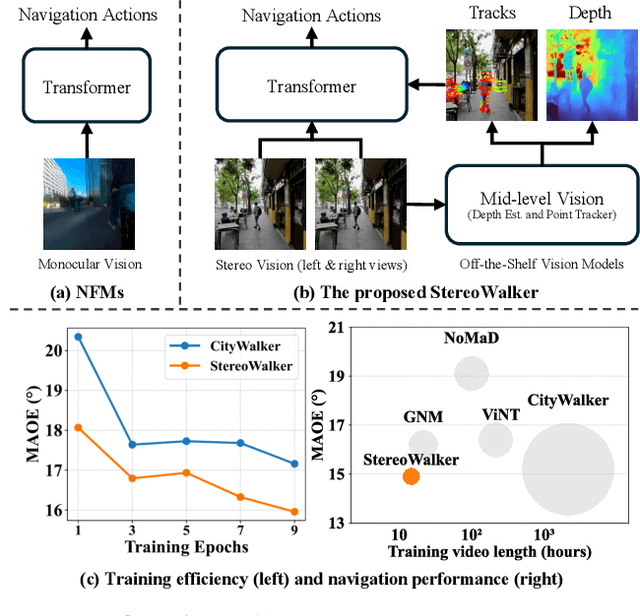
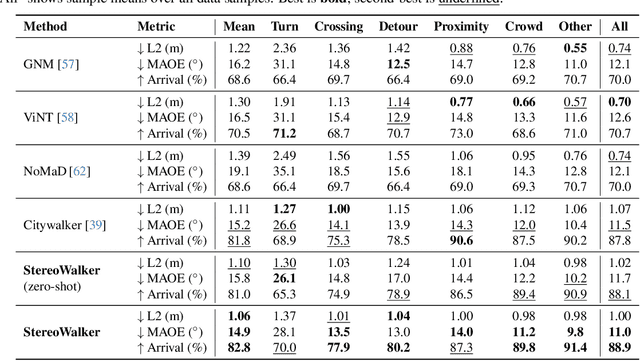
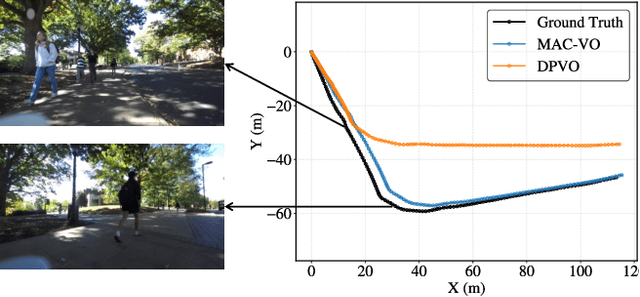
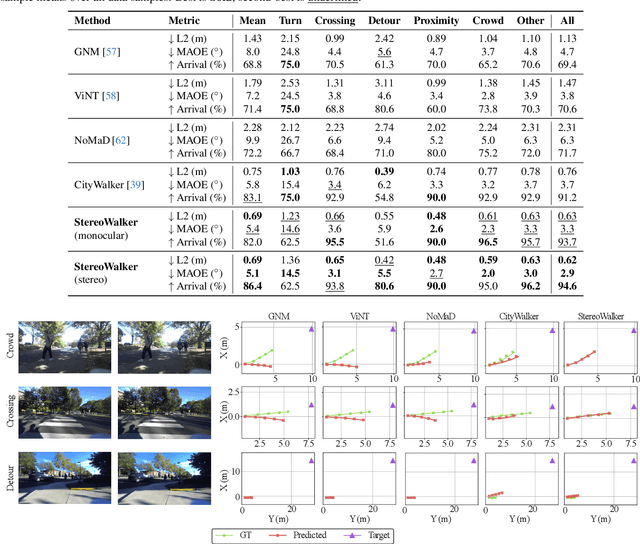
The success of foundation models in language and vision motivated research in fully end-to-end robot navigation foundation models (NFMs). NFMs directly map monocular visual input to control actions and ignore mid-level vision modules (tracking, depth estimation, etc) entirely. While the assumption that vision capabilities will emerge implicitly is compelling, it requires large amounts of pixel-to-action supervision that are difficult to obtain. The challenge is especially pronounced in dynamic and unstructured settings, where robust navigation requires precise geometric and dynamic understanding, while the depth-scale ambiguity in monocular views further limits accurate spatial reasoning. In this paper, we show that relying on monocular vision and ignoring mid-level vision priors is inefficient. We present StereoWalker, which augments NFMs with stereo inputs and explicit mid-level vision such as depth estimation and dense pixel tracking. Our intuition is straightforward: stereo inputs resolve the depth-scale ambiguity, and modern mid-level vision models provide reliable geometric and motion structure in dynamic scenes. We also curate a large stereo navigation dataset with automatic action annotation from Internet stereo videos to support training of StereoWalker and to facilitate future research. Through our experiments, we find that mid-level vision enables StereoWalker to achieve a comparable performance as the state-of-the-art using only 1.5% of the training data, and surpasses the state-of-the-art using the full data. We also observe that stereo vision yields higher navigation performance than monocular input.
Point-MoE: Towards Cross-Domain Generalization in 3D Semantic Segmentation via Mixture-of-Experts
May 29, 2025While scaling laws have transformed natural language processing and computer vision, 3D point cloud understanding has yet to reach that stage. This can be attributed to both the comparatively smaller scale of 3D datasets, as well as the disparate sources of the data itself. Point clouds are captured by diverse sensors (e.g., depth cameras, LiDAR) across varied domains (e.g., indoor, outdoor), each introducing unique scanning patterns, sampling densities, and semantic biases. Such domain heterogeneity poses a major barrier towards training unified models at scale, especially under the realistic constraint that domain labels are typically inaccessible at inference time. In this work, we propose Point-MoE, a Mixture-of-Experts architecture designed to enable large-scale, cross-domain generalization in 3D perception. We show that standard point cloud backbones degrade significantly in performance when trained on mixed-domain data, whereas Point-MoE with a simple top-k routing strategy can automatically specialize experts, even without access to domain labels. Our experiments demonstrate that Point-MoE not only outperforms strong multi-domain baselines but also generalizes better to unseen domains. This work highlights a scalable path forward for 3D understanding: letting the model discover structure in diverse 3D data, rather than imposing it via manual curation or domain supervision.
Frame In-N-Out: Unbounded Controllable Image-to-Video Generation
May 27, 2025Controllability, temporal coherence, and detail synthesis remain the most critical challenges in video generation. In this paper, we focus on a commonly used yet underexplored cinematic technique known as Frame In and Frame Out. Specifically, starting from image-to-video generation, users can control the objects in the image to naturally leave the scene or provide breaking new identity references to enter the scene, guided by user-specified motion trajectory. To support this task, we introduce a new dataset curated semi-automatically, a comprehensive evaluation protocol targeting this setting, and an efficient identity-preserving motion-controllable video Diffusion Transformer architecture. Our evaluation shows that our proposed approach significantly outperforms existing baselines.
Open Vocabulary Monocular 3D Object Detection
Nov 25, 2024In this work, we pioneer the study of open-vocabulary monocular 3D object detection, a novel task that aims to detect and localize objects in 3D space from a single RGB image without limiting detection to a predefined set of categories. We formalize this problem, establish baseline methods, and introduce a class-agnostic approach that leverages open-vocabulary 2D detectors and lifts 2D bounding boxes into 3D space. Our approach decouples the recognition and localization of objects in 2D from the task of estimating 3D bounding boxes, enabling generalization across unseen categories. Additionally, we propose a target-aware evaluation protocol to address inconsistencies in existing datasets, improving the reliability of model performance assessment. Extensive experiments on the Omni3D dataset demonstrate the effectiveness of the proposed method in zero-shot 3D detection for novel object categories, validating its robust generalization capabilities. Our method and evaluation protocols contribute towards the development of open-vocabulary object detection models that can effectively operate in real-world, category-diverse environments.
Learning 3D Representations from Procedural 3D Programs
Nov 25, 2024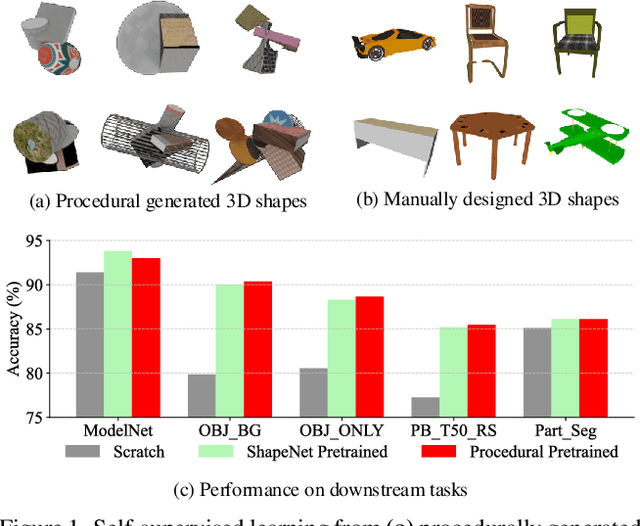
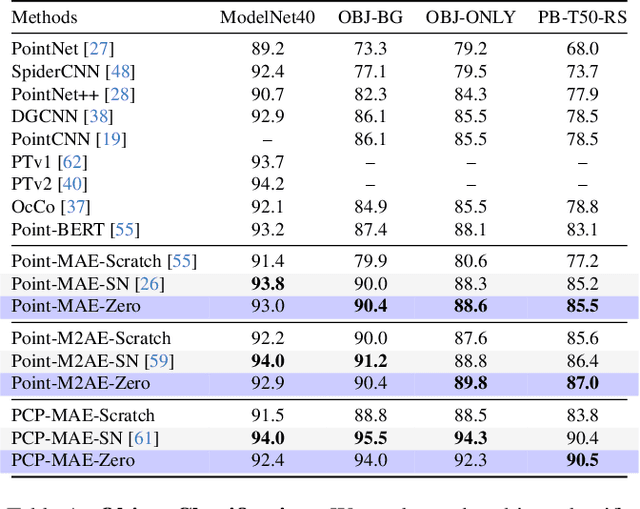
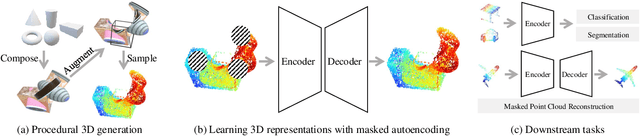
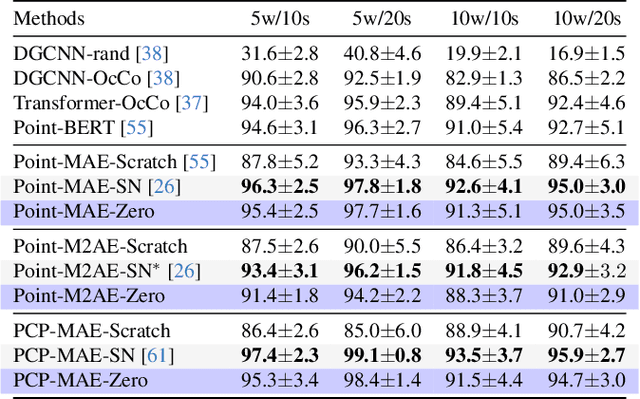
Self-supervised learning has emerged as a promising approach for acquiring transferable 3D representations from unlabeled 3D point clouds. Unlike 2D images, which are widely accessible, acquiring 3D assets requires specialized expertise or professional 3D scanning equipment, making it difficult to scale and raising copyright concerns. To address these challenges, we propose learning 3D representations from procedural 3D programs that automatically generate 3D shapes using simple primitives and augmentations. Remarkably, despite lacking semantic content, the 3D representations learned from this synthesized dataset perform on par with state-of-the-art representations learned from semantically recognizable 3D models (e.g., airplanes) across various downstream 3D tasks, including shape classification, part segmentation, and masked point cloud completion. Our analysis further suggests that current self-supervised learning methods primarily capture geometric structures rather than high-level semantics.