 Add to Chrome
 Add to Firefox
 Add to Edge
NTIRE 2026 The Second Challenge on Day and Night Raindrop Removal for Dual-Focused Images: Methods and Results
Apr 12, 2026
This paper presents an overview of the NTIRE 2026 Second Challenge on Day and Night Raindrop Removal for Dual-Focused Images. Building upon the success of the first edition, this challenge attracted a wide range of impressive solutions, all developed and evaluated on our real-world Raindrop Clarity dataset~\cite{jin2024raindrop}. For this edition, we adjust the dataset with 14,139 images for training, 407 images for validation, and 593 images for testing. The primary goal of this challenge is to establish a strong and practical benchmark for the removal of raindrops under various illumination and focus conditions. In total, 168 teams have registered for the competition, and 17 teams submitted valid final solutions and fact sheets for the testing phase. The submitted methods achieved strong performance on the Raindrop Clarity dataset, demonstrating the growing progress in this challenging task.

NTIRE 2026 3D Restoration and Reconstruction in Real-world Adverse Conditions: RealX3D Challenge Results
Apr 05, 2026This paper presents a comprehensive review of the NTIRE 2026 3D Restoration and Reconstruction (3DRR) Challenge, detailing the proposed methods and results. The challenge seeks to identify robust reconstruction pipelines that are robust under real-world adverse conditions, specifically extreme low-light and smoke-degraded environments, as captured by our RealX3D benchmark. A total of 279 participants registered for the competition, of whom 33 teams submitted valid results. We thoroughly evaluate the submitted approaches against state-of-the-art baselines, revealing significant progress in 3D reconstruction under adverse conditions. Our analysis highlights shared design principles among top-performing methods and provides insights into effective strategies for handling 3D scene degradation.
Color Enhancement for V-PCC Compressed Point Cloud via 2D Attribute Map Optimization
Dec 19, 2024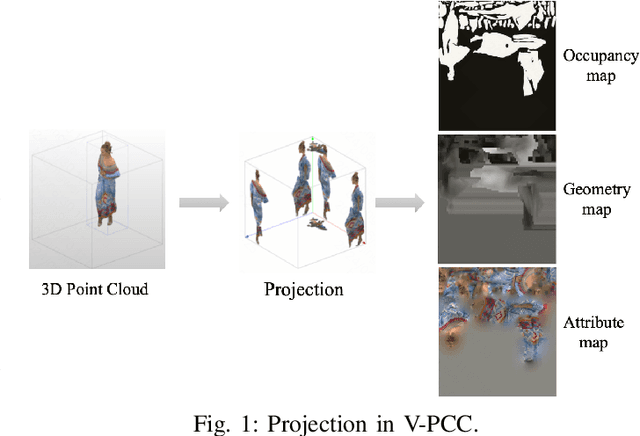

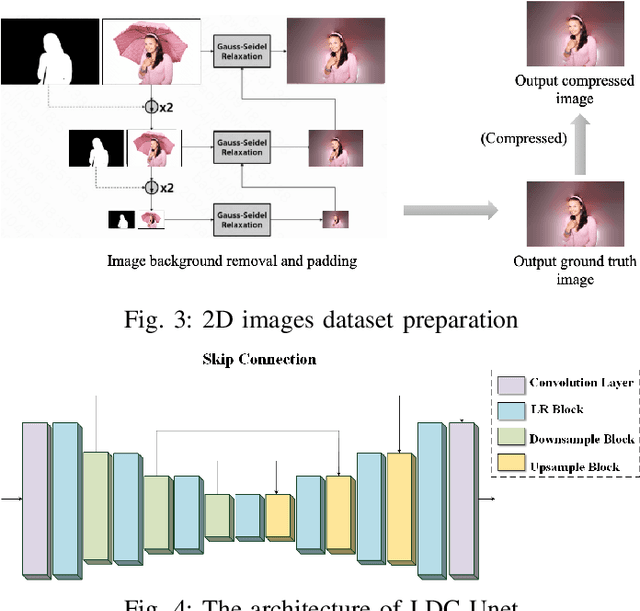
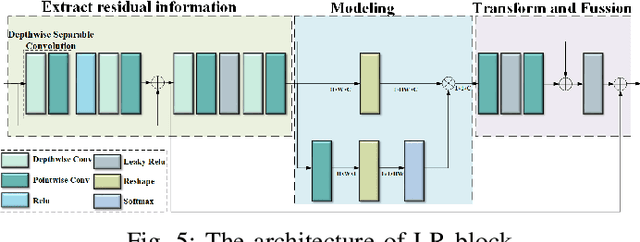
Video-based point cloud compression (V-PCC) converts the dynamic point cloud data into video sequences using traditional video codecs for efficient encoding. However, this lossy compression scheme introduces artifacts that degrade the color attributes of the data. This paper introduces a framework designed to enhance the color quality in the V-PCC compressed point clouds. We propose the lightweight de-compression Unet (LDC-Unet), a 2D neural network, to optimize the projection maps generated during V-PCC encoding. The optimized 2D maps will then be back-projected to the 3D space to enhance the corresponding point cloud attributes. Additionally, we introduce a transfer learning strategy and develop a customized natural image dataset for the initial training. The model was then fine-tuned using the projection maps of the compressed point clouds. The whole strategy effectively addresses the scarcity of point cloud training data. Our experiments, conducted on the public 8i voxelized full bodies long sequences (8iVSLF) dataset, demonstrate the effectiveness of our proposed method in improving the color quality.