 Add to Chrome
 Add to Firefox
 Add to Edge
From $\boldsymbol{\logπ}$ to $\boldsymbolπ$: Taming Divergence in Soft Clipping via Bilateral Decoupled Decay of Probability Gradient Weight
Mar 15, 2026
Reinforcement Learning with Verifiable Rewards (RLVR) has catalyzed a leap in Large Language Model (LLM) reasoning, yet its optimization dynamics remain fragile. Standard algorithms like GRPO enforce stability via ``hard clipping'', which inadvertently stifles exploration by discarding gradients of tokens outside the trust region. While recent ``soft clipping'' methods attempt to recover these gradients, they suffer from a critical challenge: relying on log-probability gradient ($\nabla_θ\log π_θ$) yields divergent weights as probabilities vanish, destabilizing LLM training. We rethink this convention by establishing probability gradient ($\nabla_θπ_θ$) as the superior optimization primitive. Accordingly, we propose Decoupled Gradient Policy Optimization (DGPO), which employs a decoupled decay mechanism based on importance sampling ratios. By applying asymmetric, continuous decay to boundary tokens, DGPO resolves the conflict between stability and sustained exploration. Extensive experiments across DeepSeek-R1-Distill-Qwen series models (1.5B/7B/14B) demonstrate that DGPO consistently outperforms strong baselines on various mathematical benchmarks, offering a robust and scalable solution for RLVR. Our code and implementation are available at: https://github.com/VenomRose-Juri/DGPO-RL.

MASPO: Unifying Gradient Utilization, Probability Mass, and Signal Reliability for Robust and Sample-Efficient LLM Reasoning
Feb 19, 2026Existing Reinforcement Learning with Verifiable Rewards (RLVR) algorithms, such as GRPO, rely on rigid, uniform, and symmetric trust region mechanisms that are fundamentally misaligned with the complex optimization dynamics of Large Language Models (LLMs). In this paper, we identify three critical challenges in these methods: (1) inefficient gradient utilization caused by the binary cutoff of hard clipping, (2) insensitive probability mass arising from uniform ratio constraints that ignore the token distribution, and (3) asymmetric signal reliability stemming from the disparate credit assignment ambiguity between positive and negative samples. To bridge these gaps, we propose Mass-Adaptive Soft Policy Optimization (MASPO), a unified framework designed to harmonize these three dimensions. MASPO integrates a differentiable soft Gaussian gating to maximize gradient utility, a mass-adaptive limiter to balance exploration across the probability spectrum, and an asymmetric risk controller to align update magnitudes with signal confidence. Extensive evaluations demonstrate that MASPO serves as a robust, all-in-one RLVR solution, significantly outperforming strong baselines. Our code is available at: https://anonymous.4open.science/r/ma1/README.md.
ChartInsighter: An Approach for Mitigating Hallucination in Time-series Chart Summary Generation with A Benchmark Dataset
Jan 16, 2025
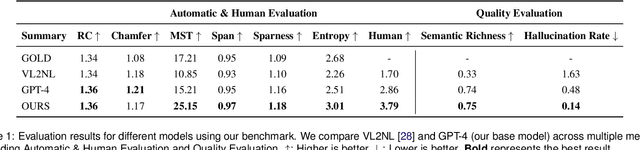
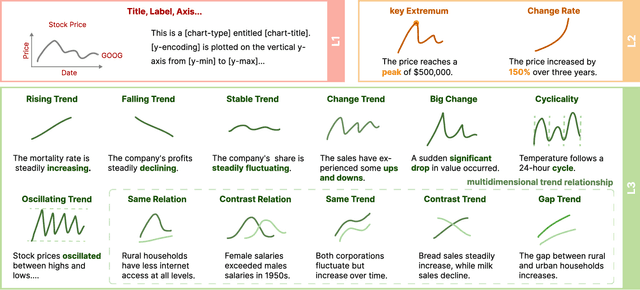
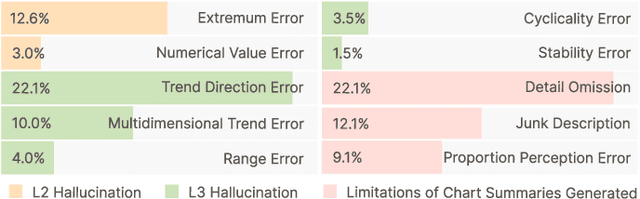
Effective chart summary can significantly reduce the time and effort decision makers spend interpreting charts, enabling precise and efficient communication of data insights. Previous studies have faced challenges in generating accurate and semantically rich summaries of time-series data charts. In this paper, we identify summary elements and common hallucination types in the generation of time-series chart summaries, which serve as our guidelines for automatic generation. We introduce ChartInsighter, which automatically generates chart summaries of time-series data, effectively reducing hallucinations in chart summary generation. Specifically, we assign multiple agents to generate the initial chart summary and collaborate iteratively, during which they invoke external data analysis modules to extract insights and compile them into a coherent summary. Additionally, we implement a self-consistency test method to validate and correct our summary. We create a high-quality benchmark of charts and summaries, with hallucination types annotated on a sentence-by-sentence basis, facilitating the evaluation of the effectiveness of reducing hallucinations. Our evaluations using our benchmark show that our method surpasses state-of-the-art models, and that our summary hallucination rate is the lowest, which effectively reduces various hallucinations and improves summary quality. The benchmark is available at https://github.com/wangfen01/ChartInsighter.
A Comprehensive Capability Analysis of GPT-3 and GPT-3.5 Series Models
Mar 18, 2023

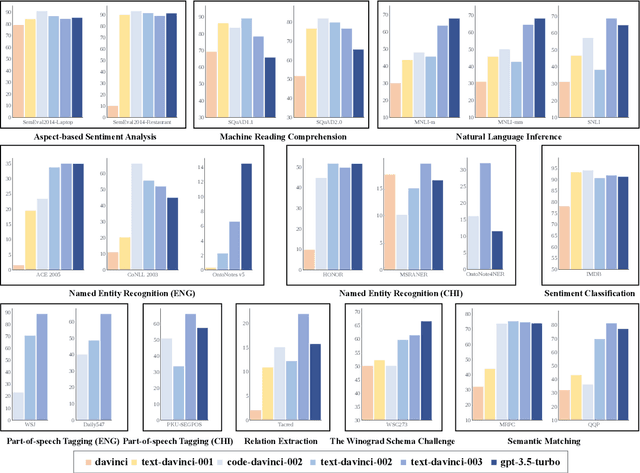

GPT series models, such as GPT-3, CodeX, InstructGPT, ChatGPT, and so on, have gained considerable attention due to their exceptional natural language processing capabilities. However, despite the abundance of research on the difference in capabilities between GPT series models and fine-tuned models, there has been limited attention given to the evolution of GPT series models' capabilities over time. To conduct a comprehensive analysis of the capabilities of GPT series models, we select six representative models, comprising two GPT-3 series models (i.e., davinci and text-davinci-001) and four GPT-3.5 series models (i.e., code-davinci-002, text-davinci-002, text-davinci-003, and gpt-3.5-turbo). We evaluate their performance on nine natural language understanding (NLU) tasks using 21 datasets. In particular, we compare the performance and robustness of different models for each task under zero-shot and few-shot scenarios. Our extensive experiments reveal that the overall ability of GPT series models on NLU tasks does not increase gradually as the models evolve, especially with the introduction of the RLHF training strategy. While this strategy enhances the models' ability to generate human-like responses, it also compromises their ability to solve some tasks. Furthermore, our findings indicate that there is still room for improvement in areas such as model robustness.