 Add to Chrome
 Add to Firefox
 Add to Edge
How Much, Then Where: Credit-Conserving Action-to-Token Allocation for Multi-Turn Agent Reinforcement Learning
Aug 07, 2026
Credit assignment in multi-turn agent reinforcement learning operates at two levels: assigning trajectory-level credit to actions and distributing each action's credit across its tokens. In this paper, we introduce FACTOR, which separates these decisions. FACTOR uses checkpoint-calibrated TD residuals to assign per-action credits that telescope to the trajectory advantage, and feedback-conditioned teacher-student likelihood gaps to allocate each credit across the realized action tokens. Per-action normalization preserves the action-average coefficient and prevents token-level sign flips. We pair this construction with an action-mean reduction, removing the implicit dependence of an action's scalar surrogate weight on its token length. At the behavior policy and before clipping, each action's inner action-mean surrogate equals its TD credit. FACTOR consistently improves over competitive baselines across ALFWorld, WebShop, and ScienceWorld, with every environment-seed comparison favoring FACTOR and the largest gains emerging on the longest-horizon environment. The same hyperparameters transfer without retuning to a larger backbone and to a different model family. Ablations identify TD action credit as the dominant driver of the improvement, with hindsight token allocation contributing complementary gains.

From $\boldsymbol{\logπ}$ to $\boldsymbolπ$: Taming Divergence in Soft Clipping via Bilateral Decoupled Decay of Probability Gradient Weight
Mar 15, 2026Reinforcement Learning with Verifiable Rewards (RLVR) has catalyzed a leap in Large Language Model (LLM) reasoning, yet its optimization dynamics remain fragile. Standard algorithms like GRPO enforce stability via ``hard clipping'', which inadvertently stifles exploration by discarding gradients of tokens outside the trust region. While recent ``soft clipping'' methods attempt to recover these gradients, they suffer from a critical challenge: relying on log-probability gradient ($\nabla_θ\log π_θ$) yields divergent weights as probabilities vanish, destabilizing LLM training. We rethink this convention by establishing probability gradient ($\nabla_θπ_θ$) as the superior optimization primitive. Accordingly, we propose Decoupled Gradient Policy Optimization (DGPO), which employs a decoupled decay mechanism based on importance sampling ratios. By applying asymmetric, continuous decay to boundary tokens, DGPO resolves the conflict between stability and sustained exploration. Extensive experiments across DeepSeek-R1-Distill-Qwen series models (1.5B/7B/14B) demonstrate that DGPO consistently outperforms strong baselines on various mathematical benchmarks, offering a robust and scalable solution for RLVR. Our code and implementation are available at: https://github.com/VenomRose-Juri/DGPO-RL.
How to Allocate, How to Learn? Dynamic Rollout Allocation and Advantage Modulation for Policy Optimization
Feb 22, 2026Reinforcement Learning with Verifiable Rewards (RLVR) has proven effective for Large Language Model (LLM) reasoning, yet current methods face key challenges in resource allocation and policy optimization dynamics: (i) uniform rollout allocation ignores gradient variance heterogeneity across problems, and (ii) the softmax policy structure causes gradient attenuation for high-confidence correct actions, while excessive gradient updates may destabilize training. Therefore, we propose DynaMO, a theoretically-grounded dual-pronged optimization framework. At the sequence level, we prove that uniform allocation is suboptimal and derive variance-minimizing allocation from the first principle, establishing Bernoulli variance as a computable proxy for gradient informativeness. At the token level, we develop gradient-aware advantage modulation grounded in theoretical analysis of gradient magnitude bounds. Our framework compensates for gradient attenuation of high-confidence correct actions while utilizing entropy changes as computable indicators to stabilize excessive update magnitudes. Extensive experiments conducted on a diverse range of mathematical reasoning benchmarks demonstrate consistent improvements over strong RLVR baselines. Our implementation is available at: \href{https://anonymous.4open.science/r/dynamo-680E/README.md}{https://anonymous.4open.science/r/dynamo}.
Proximity-Based Multi-Turn Optimization: Practical Credit Assignment for LLM Agent Training
Feb 22, 2026Multi-turn LLM agents are becoming pivotal to production systems, spanning customer service automation, e-commerce assistance, and interactive task management, where accurately distinguishing high-value informative signals from stochastic noise is critical for sample-efficient training. In real-world scenarios, a failure in a trivial task may reflect random instability, whereas success in a high-difficulty task signifies a genuine capability breakthrough. Yet, existing group-based policy optimization methods rigidly rely on statistical deviation within discrete batches, frequently misallocating credit when task difficulty fluctuates. To address this issue, we propose Proximity-based Multi-turn Optimization (ProxMO), a practical and robust framework engineered specifically for the constraints of real-world deployment. ProxMO integrates global context via two lightweight mechanisms: success-rate-aware modulation dynamically adapts gradient intensity based on episode-level difficulty, while proximity-based soft aggregation derives baselines through continuous semantic weighting at the step level. Extensive evaluations on ALFWorld and WebShop benchmarks demonstrate that ProxMO yields substantial performance gains over existing baselines with negligible computational cost. Ablation studies further validate the independent and synergistic efficacy of both mechanisms. Crucially, ProxMO offers plug-and-play compatibility with standard GRPO frameworks, facilitating immediate, low-friction adoption in existing industrial training pipelines. Our implementation is available at: \href{https://anonymous.4open.science/r/proxmo-B7E7/README.md}{https://anonymous.4open.science/r/proxmo}.
MASPO: Unifying Gradient Utilization, Probability Mass, and Signal Reliability for Robust and Sample-Efficient LLM Reasoning
Feb 19, 2026Existing Reinforcement Learning with Verifiable Rewards (RLVR) algorithms, such as GRPO, rely on rigid, uniform, and symmetric trust region mechanisms that are fundamentally misaligned with the complex optimization dynamics of Large Language Models (LLMs). In this paper, we identify three critical challenges in these methods: (1) inefficient gradient utilization caused by the binary cutoff of hard clipping, (2) insensitive probability mass arising from uniform ratio constraints that ignore the token distribution, and (3) asymmetric signal reliability stemming from the disparate credit assignment ambiguity between positive and negative samples. To bridge these gaps, we propose Mass-Adaptive Soft Policy Optimization (MASPO), a unified framework designed to harmonize these three dimensions. MASPO integrates a differentiable soft Gaussian gating to maximize gradient utility, a mass-adaptive limiter to balance exploration across the probability spectrum, and an asymmetric risk controller to align update magnitudes with signal confidence. Extensive evaluations demonstrate that MASPO serves as a robust, all-in-one RLVR solution, significantly outperforming strong baselines. Our code is available at: https://anonymous.4open.science/r/ma1/README.md.
LaVida Drive: Vision-Text Interaction VLM for Autonomous Driving with Token Selection, Recovery and Enhancement
Nov 20, 2024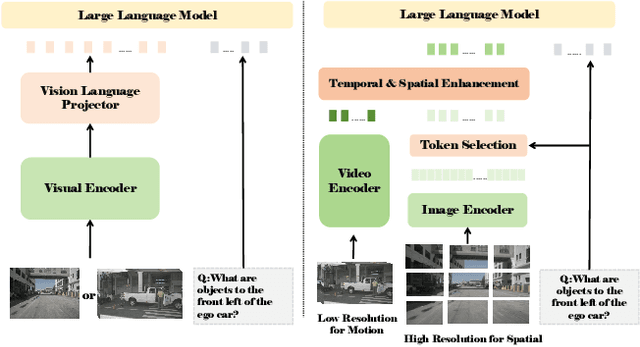
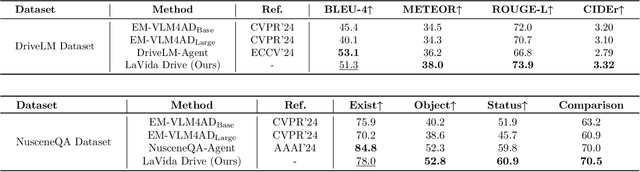
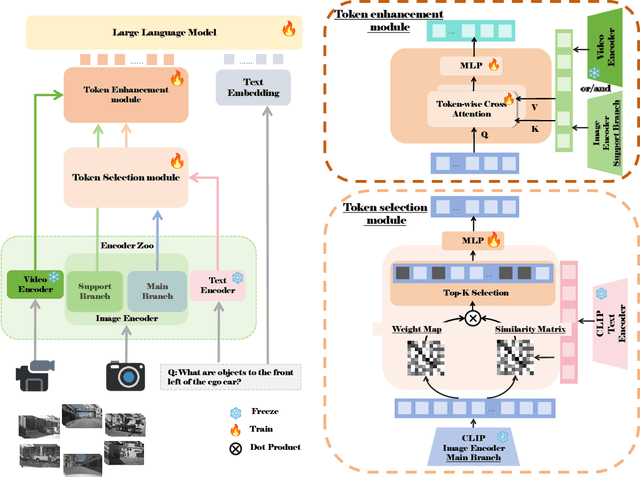
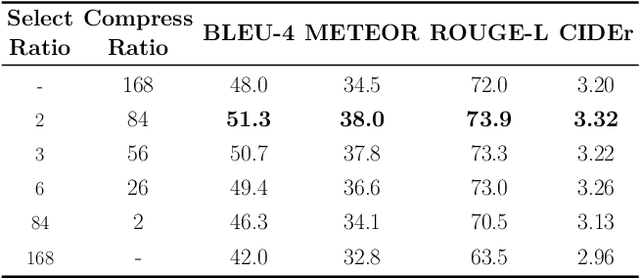
Recent advancements in Visual Language Models (VLMs) have made them crucial for visual question answering (VQA) in autonomous driving, enabling natural human-vehicle interactions. However, existing methods often struggle in dynamic driving environments, as they usually focus on static images or videos and rely on downsampling to manage computational costs. This results in the loss of critical details and the difficulty in effectively integrating spatial and temporal information, undermining fine-grained perception and temporal coherence essential for effective decision-making. To tackle these challenges, we introduce LaVida Drive, a novel and efficient VQA framework for autonomous driving. LaVida Drive seamlessly integrates temporal data while maintaining high-resolution inputs for detailed visual perception. It optimizes spatial processing by retaining high-resolution data for intricate details and using lower-resolution inputs for temporal analysis to focus on motion-related features, thereby boosting computational efficiency. The core of LaVida Drive consists of two modules: the \textit{Query-aware Token Selection} module and the \textit{Spatial-Temporal Token Recovery and Enhancement} module. The former dynamically selects the most relevant visual tokens based on semantic alignment with the input query, reducing the token count from high-resolution spatial input. The latter ensures smooth and coherent interactions between spatial and temporal information, preserving contextual continuity across frames. Extensive experiments on various autonomous driving question-answering benchmarks show that LaVida Drive significantly reduces visual tokens, enhances efficiency, and improves overall performance.