 Add to Chrome
 Add to Firefox
 Add to Edge
SeaEvo: Advancing Algorithm Discovery with Strategy Space Evolution
Apr 27, 2026
LLM-guided evolutionary search has emerged as a promising paradigm for automated algorithm discovery, yet most systems track search progress primarily through executable programs and scalar fitness. Even when natural-language reflection is used, it is often used locally in mutation prompts or stored without an explicit population-level organization of strategic directions. As a result, evolutionary search can struggle to distinguish syntactically different implementations of the same idea, preserve lower-fitness but strategically promising directions, or detect when an entire family of strategies has saturated. We introduce \model, a modular strategy-space layer that elevates natural-language strategy descriptions from transient prompt context to first-class population-level evolutionary state in LLM-driven program search. \model augments each candidate program with an explicit natural language strategy description and uses this representation in three ways: Strategy Articulation turns mutation into a diagnose-direct-implement process; Stratified Experience Retrieval organizes the archive into strategy clusters and selects inspirations by behavioral complementarity; and Strategic Landscape Navigation periodically summarizes effective, saturated, and underexplored strategy families to guide future mutations. Across mathematical algorithm discovery, systems optimization, and agent-scaffold benchmarks, \model improves the underlying evolutionary backbones in most settings, with particularly large gains (21% relative improvement) on open-ended system optimization tasks. These results suggest that persistent strategy representations provide a practical mechanism for improving the robustness and efficiency of LLM-guided evolutionary search, suggesting a path toward compound AI systems that accumulate algorithmic knowledge over time.

ShapLoRA: Allocation of Low-rank Adaption on Large Language Models via Shapley Value Inspired Importance Estimation
Jan 25, 2026Low-rank adaption (LoRA) is a representative method in the field of parameter-efficient fine-tuning (PEFT), and is key to Democratizating the modern large language models (LLMs). The vanilla LoRA is implemented with uniform ranks, and the recent literature have found that properly allocating ranks on the LLM backbones results in performance boosts. However, the previous rank allocation methods have limitations since they rely on inexplanable and unreliable importance measures for the LoRA ranks. To address the above issues, we propose the ShapLoRA framework. Inspired by the explanable attribution measure Shapley Value, we combine the sensitivity-based measures with the idea of coalitions in the collaborative games among LoRA ranks, and propose a more explainable importance measure called Shapley sensitivity. In addition, we optimize the workflow of the existing works by: (a) calculating Shapley sensitivity on a separate validation set; (b) Setting up the allocating-retraining procedures for fair comparisons. We have conducted experiments on various challenging tasks, and the experimental results demonstrate that our ShapLoRA method can outperform the recent baselines with comparable tunable parameters.\footnote{Codes and fine-tuned models will be open-sourced to facilitate future research.
X-VFL: A New Vertical Federated Learning Framework with Cross Completion and Decision Subspace Alignment
Aug 07, 2025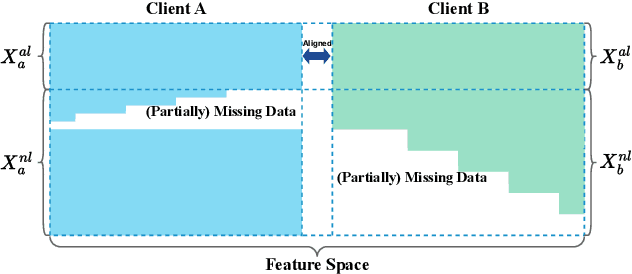

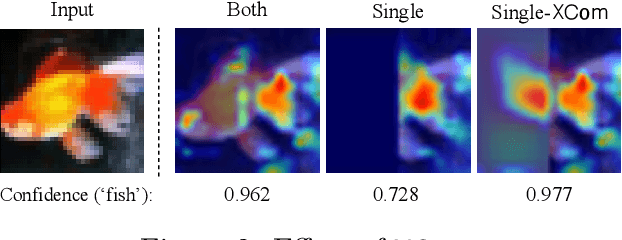
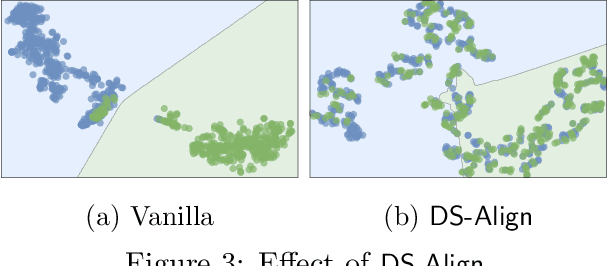
Vertical Federated Learning (VFL) enables collaborative learning by integrating disjoint feature subsets from multiple clients/parties. However, VFL typically faces two key challenges: i) the requirement for perfectly aligned data samples across all clients (missing features are not allowed); ii) the requirement for joint collaborative inference/prediction involving all clients (it does not support locally independent inference on a single client). To address these challenges, we propose X-VFL, a new VFL framework designed to deal with the non-aligned data samples with (partially) missing features and to support locally independent inference of new data samples for each client. In particular, we design two novel modules in X-VFL: Cross Completion (XCom) and Decision Subspace Alignment (DS-Align). XCom can complete/reconstruct missing features for non-aligned data samples by leveraging information from other clients. DS-Align aligns local features with completed and global features across all clients within the decision subspace, thus enabling locally independent inference at each client. Moreover, we provide convergence theorems for different algorithms used in training X-VFL, showing an $O(1/\sqrt{T})$ convergence rate for SGD-type algorithms and an $O(1/T)$ rate for PAGE-type algorithms, where $T$ denotes the number of training update steps. Extensive experiments on real-world datasets demonstrate that X-VFL significantly outperforms existing methods, e.g., achieving a 15% improvement in accuracy on the image CIFAR-10 dataset and a 43% improvement on the medical MIMIC-III dataset. These results validate the practical effectiveness and superiority of X-VFL, particularly in scenarios involving partially missing features and locally independent inference.