 Add to Chrome
 Add to Firefox
 Add to Edge
Temporal-Spectral Alignment with Frequency Adaptation for Source-Free Time-Series Adaptation
Jun 22, 2026
The goal of source-free domain adaptation (SFDA) for time-series data is to transfer knowledge from a pre-trained source model to an unlabeled target domain without requiring access to source data, while addressing feature shift and temporal drift inherent in the signals. Although existing approaches have explored temporal dynamics in unsupervised source-free adaptation, they largely overlook spectral shifts in time-series data. Towards this end, we propose a novel approach termed temporal-Spectral Alignment with Frequency Adaptation (SAFA) for source-free time-series domain adaptation. Specifically, we first model the source domain at multiple scales by jointly capturing temporal dependencies and spectral characteristics. To adapt time-series data in the target domain, we introduce a trainable frequency adaptation module that modulates the phase and amplitude of target signals in the frequency domain to align them with the source distribution. Extensive experiments on multiple benchmark datasets demonstrate the efficacy and robustness of SAFA.

ClarifyMT-Bench: Benchmarking and Improving Multi-Turn Clarification for Conversational Large Language Models
Dec 24, 2025Large language models (LLMs) are increasingly deployed as conversational assistants in open-domain, multi-turn settings, where users often provide incomplete or ambiguous information. However, existing LLM-focused clarification benchmarks primarily assume single-turn interactions or cooperative users, limiting their ability to evaluate clarification behavior in realistic settings. We introduce \textbf{ClarifyMT-Bench}, a benchmark for multi-turn clarification grounded in a five-dimensional ambiguity taxonomy and a set of six behaviorally diverse simulated user personas. Through a hybrid LLM-human pipeline, we construct 6,120 multi-turn dialogues capturing diverse ambiguity sources and interaction patterns. Evaluating ten representative LLMs uncovers a consistent under-clarification bias: LLMs tend to answer prematurely, and performance degrades as dialogue depth increases. To mitigate this, we propose \textbf{ClarifyAgent}, an agentic approach that decomposes clarification into perception, forecasting, tracking, and planning, substantially improving robustness across ambiguity conditions. ClarifyMT-Bench establishes a reproducible foundation for studying when LLMs should ask, when they should answer, and how to navigate ambiguity in real-world human-LLM interactions.
PLUTUS: A Well Pre-trained Large Unified Transformer can Unveil Financial Time Series Regularities
Aug 20, 2024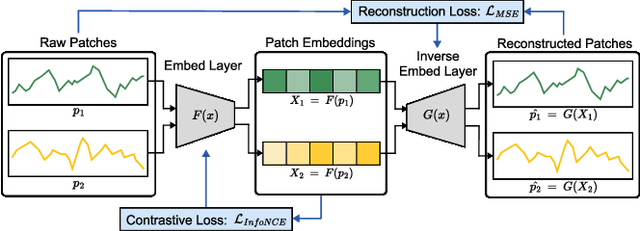
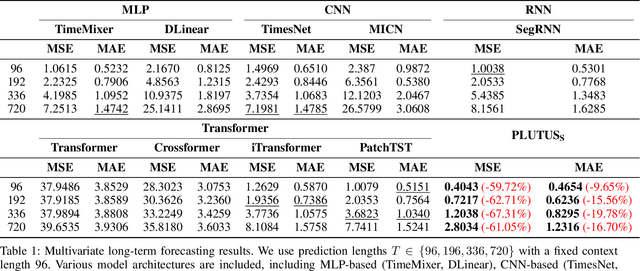
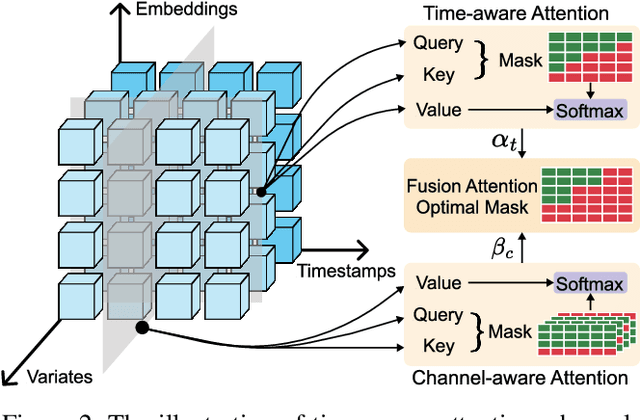
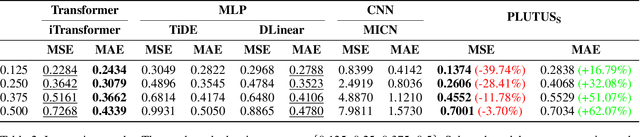
Financial time series modeling is crucial for understanding and predicting market behaviors but faces challenges such as non-linearity, non-stationarity, and high noise levels. Traditional models struggle to capture complex patterns due to these issues, compounded by limitations in computational resources and model capacity. Inspired by the success of large language models in NLP, we introduce $\textbf{PLUTUS}$, a $\textbf{P}$re-trained $\textbf{L}$arge $\textbf{U}$nified $\textbf{T}$ransformer-based model that $\textbf{U}$nveils regularities in financial time $\textbf{S}$eries. PLUTUS uses an invertible embedding module with contrastive learning and autoencoder techniques to create an approximate one-to-one mapping between raw data and patch embeddings. TimeFormer, an attention based architecture, forms the core of PLUTUS, effectively modeling high-noise time series. We incorporate a novel attention mechanisms to capture features across both variable and temporal dimensions. PLUTUS is pre-trained on an unprecedented dataset of 100 billion observations, designed to thrive in noisy financial environments. To our knowledge, PLUTUS is the first open-source, large-scale, pre-trained financial time series model with over one billion parameters. It achieves state-of-the-art performance in various tasks, demonstrating strong transferability and establishing a robust foundational model for finance. Our research provides technical guidance for pre-training financial time series data, setting a new standard in the field.