 Add to Chrome
 Add to Firefox
 Add to Edge
Ripple-Pivot Search: Active Parallel Decoding for Diffusion Large Language Models
Aug 12, 2026
Diffusion Large Language Models (dLLMs) have emerged as a competitive alternative to autoregressive language models, offering the potential for substantially faster inference through parallel decoding. Existing parallel decoding schedulers typically commit positions only after they meet a per-position criterion, overlooking how early commitments may benefit subsequent decoding. We identify a ripple effect in dLLM decoding: proactively committing a mid-entropy pivot position can induce a pronounced reduction in uncertainty across the remaining masked positions. This uncertainty reduction allows subsequent steps to unmask more tokens in parallel, thereby accelerating the overall decoding process. To exploit the ripple effect, we propose Ripple-Pivot Search (RPS), a novel training-free decoding method that seeks mid-entropy positions as promising candidate pivots (where to decode), and determines their token assignment that yields the greatest downstream benefit via lookahead evaluation (what to decode). Across 3 dLLMs and 4 reasoning and code-generation benchmarks, RPS achieves 4-10$\times$ wall-clock speedup over the standard decoder while preserving generation quality, and improves accuracy over the previous lookahead baseline by up to 5.49% while delivering higher throughput in most settings. When integrated with KV caching, RPS further achieves up to 18$\times$ wall-clock speedup over the standard decoder.

Rejection Mixing: Fast Semantic Propagation of Mask Tokens for Efficient DLLM Inference
Feb 26, 2026Diffusion Large Language Models (DLLMs) promise fast non-autoregressive inference but suffer a severe quality-speed trade-off in parallel decoding. This stems from the ''combinatorial contradiction'' phenomenon, where parallel tokens form semantically inconsistent combinations. We address this by integrating continuous representations into the discrete decoding process, as they preserve rich inter-position dependency. We propose ReMix (Rejection Mixing), a framework that introduces a novel Continuous Mixing State as an intermediate between the initial masked state and the final decoded token state. This intermediate state allows a token's representation to be iteratively refined in a continuous space, resolving mutual conflicts with other tokens before collapsing into a final discrete sample. Furthermore, a rejection rule reverts uncertain representations from the continuous state back to the masked state for reprocessing, ensuring stability and preventing error propagation. ReMix thus mitigates combinatorial contradictions by enabling continuous-space refinement during discrete diffusion decoding. Extensive experiments demonstrate that ReMix, as a training-free method, achieves a $2-8 \times$ inference speedup without any quality degradation.
Wide-In, Narrow-Out: Revokable Decoding for Efficient and Effective DLLMs
Jul 24, 2025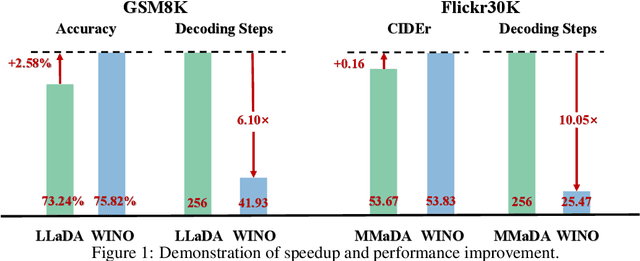
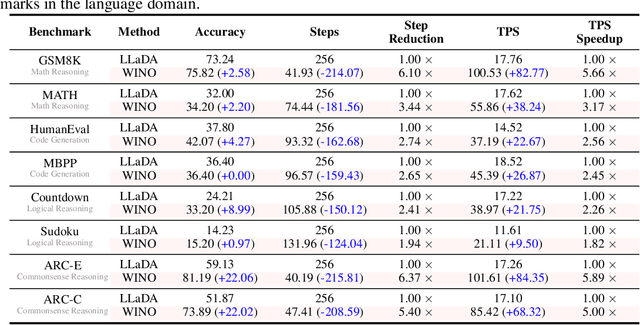
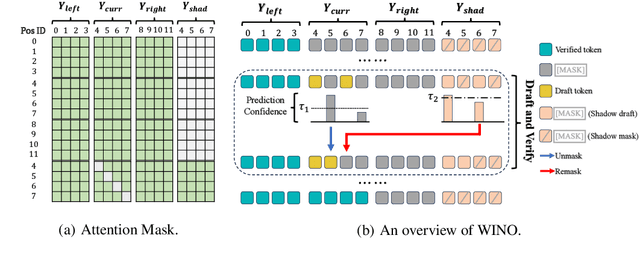
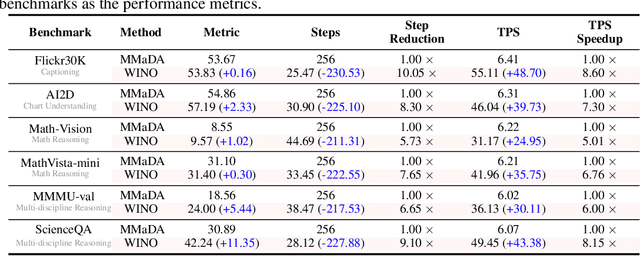
Diffusion Large Language Models (DLLMs) have emerged as a compelling alternative to Autoregressive models, designed for fast parallel generation. However, existing DLLMs are plagued by a severe quality-speed trade-off, where faster parallel decoding leads to significant performance degradation. We attribute this to the irreversibility of standard decoding in DLLMs, which is easily polarized into the wrong decoding direction along with early error context accumulation. To resolve this, we introduce Wide-In, Narrow-Out (WINO), a training-free decoding algorithm that enables revokable decoding in DLLMs. WINO employs a parallel draft-and-verify mechanism, aggressively drafting multiple tokens while simultaneously using the model's bidirectional context to verify and re-mask suspicious ones for refinement. Verified in open-source DLLMs like LLaDA and MMaDA, WINO is shown to decisively improve the quality-speed trade-off. For instance, on the GSM8K math benchmark, it accelerates inference by 6$\times$ while improving accuracy by 2.58%; on Flickr30K captioning, it achieves a 10$\times$ speedup with higher performance. More comprehensive experiments are conducted to demonstrate the superiority and provide an in-depth understanding of WINO.
Noisy Label Detection for Speaker Recognition
Dec 01, 2022The success of deep neural networks requires both high annotation quality and massive data. However, the size and the quality of a dataset are usually a trade-off in practice, as data collection and cleaning are expensive and time-consuming. Therefore, automatic noisy label detection (NLD) techniques are critical to real-world applications, especially those using crowdsourcing datasets. As this is an under-explored topic in automatic speaker verification (ASV), we present a simple but effective solution to the task. First, we compare the effectiveness of various commonly used metric learning loss functions under different noise settings. Then, we propose two ranking-based NLD methods, inter-class inconsistency and intra-class inconsistency ranking. They leverage the inconsistent nature of noisy labels and show high detection precision even under a high level of noise. Our solution gives rise to both efficient and effective cleaning of large-scale speaker recognition datasets.