 Add to Chrome
 Add to Firefox
 Add to Edge
Design Generative AI for Practitioners: Exploring Interaction Approaches Aligned with Creative Practice
Mar 03, 2026
Design is a non-linear, reflective process in which practitioners engage with visual, semantic, and other expressive materials to explore, iterate, and refine ideas. As Generative AI (GenAI) becomes integrated into professional design practice, traditional interaction approaches focusing on prompts or whole-image manipulation can misalign AI output with designers' intent, forcing visual thinkers into verbal reasoning or post-hoc adjustments. We present three interaction approaches from DesignPrompt, FusAIn, and DesignTrace that distribute control across intent, input, and process, enabling designers to guide AI alignment at different stages of interaction. We further argue that alignment is a dynamic negotiation, with AI adopting proactive or reactive roles according to designers' instrumental and inspirational needs and the creative stage.

M3KE: A Massive Multi-Level Multi-Subject Knowledge Evaluation Benchmark for Chinese Large Language Models
May 21, 2023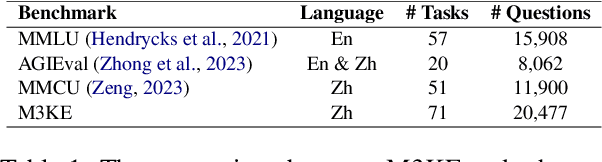
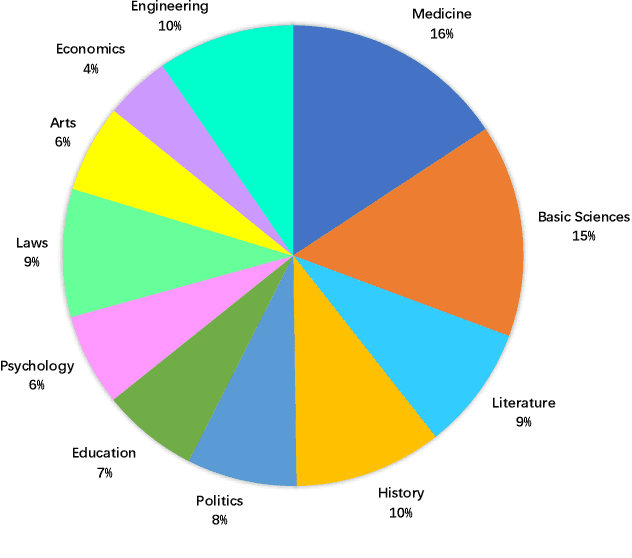
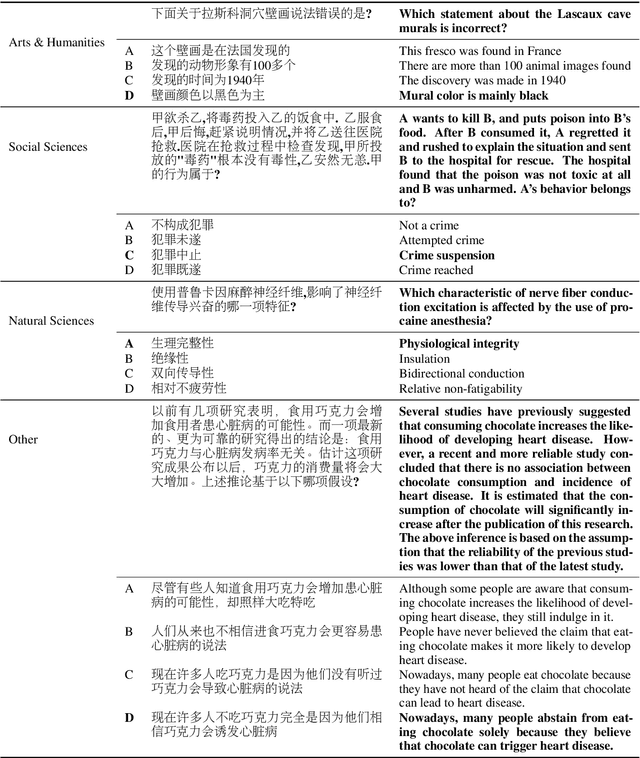
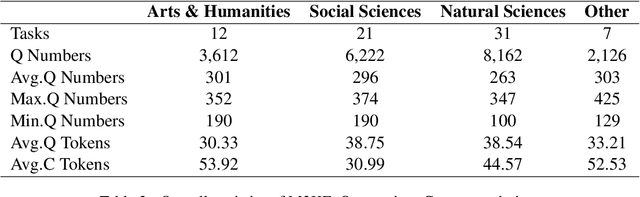
Large language models have recently made tremendous progress in a variety of aspects, e.g., cross-task generalization, instruction following. Comprehensively evaluating the capability of large language models in multiple tasks is of great importance. In this paper, we propose M3KE, a Massive Multi-Level Multi-Subject Knowledge Evaluation benchmark, which is developed to measure knowledge acquired by Chinese large language models by testing their multitask accuracy in zero- and few-shot settings. We have collected 20,477 questions from 71 tasks. Our selection covers all major levels of Chinese education system, ranging from the primary school to college, as well as a wide variety of subjects, including humanities, history, politics, law, education, psychology, science, technology, art and religion. All questions are multiple-choice questions with four options, hence guaranteeing a standardized and unified assessment process. We've assessed a number of state-of-the-art open-source Chinese large language models on the proposed benchmark. The size of these models varies from 335M to 130B parameters. Experiment results demonstrate that they perform significantly worse than GPT-3.5 that reaches an accuracy of ~ 48% on M3KE. The dataset is available at https://github.com/tjunlp-lab/M3KE.