 Add to Chrome
 Add to Firefox
 Add to Edge
M$^\text{4}$World: A Multi-view Multimodal Driving World Model for Interactive Object Manipulation and Minute-long Streaming
Jul 15, 2026
Driving-world generation has emerged as a core capability for scalable autonomous-driving simulation, yet existing methods remain limited in object-level controllability and long-horizon stability. We present M$^\text{4}$World, a Multi-view and Multimodal generative driving world model that synthesizes future surround-view video streams and synchronized LiDAR scans while supporting interactive object Manipulation and stable Minute-long streaming. Fine-grained object manipulation is realized through a flexible conditioning interface that supports explicit control over both the spatial layout and visual appearance of individual objects. Stable minute-long streaming, on the other hand, is achieved through a multi-stage training framework that enables online causal generation in only four denoising steps while maintaining coherent world dynamics throughout extended rollouts. Building on these components, we introduce an efficient few-clip post-training as well as a suite of visual reference-conditioned generation models, preserving general generation ability while allowing rare-case customization for long-tail controllability. To assess controllability beyond realism, we further introduce an automated VLM-based judging pipeline that evaluates scene-level condition adherence, view-wise object controllability, and cross-view object consistency. Comprehensive experiments show that M$^\text{4}$World consistently delivers high generation quality, precise controllability, and stable minute-long streaming. Together with downstream long-tail augmentation and scene editing, these results demonstrate the potential of M$^\text{4}$World for controllable, scalable driving simulation.

Unveiling Fine-Grained Visual Traces: Evaluating Multimodal Interleaved Reasoning Chains in Multimodal STEM Tasks
Apr 21, 2026Multimodal large language models (MLLMs) have shown promising reasoning abilities, yet evaluating their performance in specialized domains remains challenging. STEM reasoning is a particularly valuable testbed because it provides highly verifiable feedback, but existing benchmarks often permit unimodal shortcuts due to modality redundancy and focus mainly on final-answer accuracy, overlooking the reasoning process itself. To address this challenge, we introduce StepSTEM: a graduate-level benchmark of 283 problems across mathematics, physics, chemistry, biology, and engineering for fine-grained evaluation of cross-modal reasoning in MLLMs. StepSTEM is constructed through a rigorous curation pipeline that enforces strict complementarity between textual and visual inputs. We further propose a general step-level evaluation framework for both text-only chain-of-thought and interleaved image-text reasoning, using dynamic programming to align predicted reasoning steps with multiple reference solutions. Experiments across a wide range of models show that current MLLMs still rely heavily on textual reasoning, with even Gemini 3.1 Pro and Claude Opus 4.6 achieving only 38.29% accuracy. These results highlight substantial headroom for genuine cross-modal STEM reasoning and position StepSTEM as a benchmark for fine-grained evaluation of multimodal reasoning. Source code is available at https://github.com/lll-hhh/STEPSTEM.
Event-based Robotic Grasping Detection with Neuromorphic Vision Sensor and Event-Stream Dataset
May 01, 2020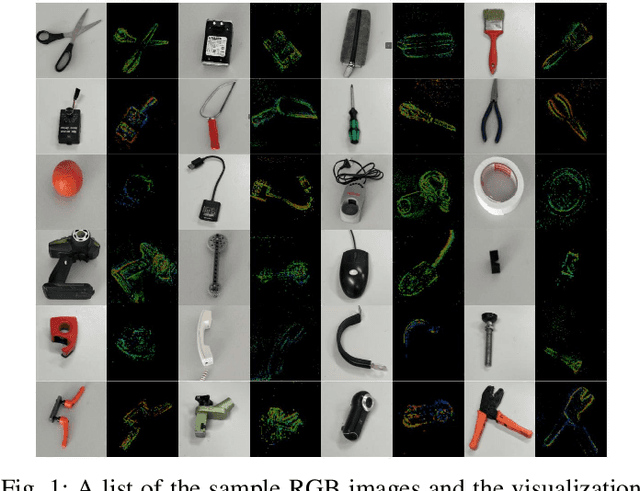
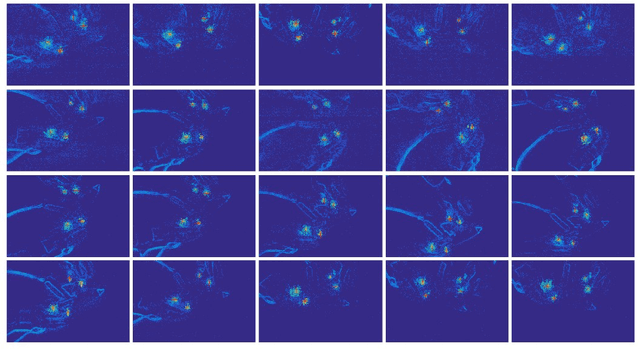
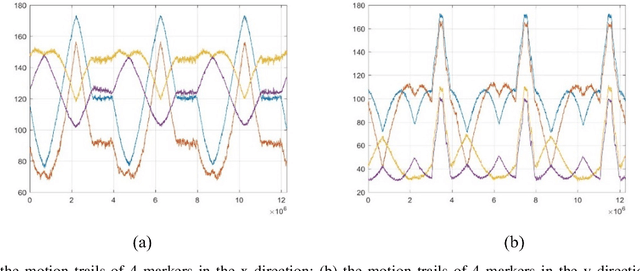

Robotic grasping plays an important role in the field of robotics. The current state-of-the-art robotic grasping detection systems are usually built on the conventional vision, such as RGB-D camera. Compared to traditional frame-based computer vision, neuromorphic vision is a small and young community of research. Currently, there are limited event-based datasets due to the troublesome annotation of the asynchronous event stream. Annotating large scale vision dataset often takes lots of computation resources, especially the troublesome data for video-level annotation. In this work, we consider the problem of detecting robotic grasps in a moving camera view of a scene containing objects. To obtain more agile robotic perception, a neuromorphic vision sensor (DAVIS) attaching to the robot gripper is introduced to explore the potential usage in grasping detection. We construct a robotic grasping dataset named Event-Stream Dataset with 91 objects. A spatio-temporal mixed particle filter (SMP Filter) is proposed to track the led-based grasp rectangles which enables video-level annotation of a single grasp rectangle per object. As leds blink at high frequency, the Event-Stream dataset is annotated in a high frequency of 1 kHz. Based on the Event-Stream dataset, we develop a deep neural network for grasping detection which consider the angle learning problem as classification instead of regression. The method performs high detection accuracy on our Event-Stream dataset with 93% precision at object-wise level. This work provides a large-scale and well-annotated dataset, and promotes the neuromorphic vision applications in agile robot.