 Add to Chrome
 Add to Firefox
 Add to Edge
M$^\text{4}$World: A Multi-view Multimodal Driving World Model for Interactive Object Manipulation and Minute-long Streaming
Jul 15, 2026
Driving-world generation has emerged as a core capability for scalable autonomous-driving simulation, yet existing methods remain limited in object-level controllability and long-horizon stability. We present M$^\text{4}$World, a Multi-view and Multimodal generative driving world model that synthesizes future surround-view video streams and synchronized LiDAR scans while supporting interactive object Manipulation and stable Minute-long streaming. Fine-grained object manipulation is realized through a flexible conditioning interface that supports explicit control over both the spatial layout and visual appearance of individual objects. Stable minute-long streaming, on the other hand, is achieved through a multi-stage training framework that enables online causal generation in only four denoising steps while maintaining coherent world dynamics throughout extended rollouts. Building on these components, we introduce an efficient few-clip post-training as well as a suite of visual reference-conditioned generation models, preserving general generation ability while allowing rare-case customization for long-tail controllability. To assess controllability beyond realism, we further introduce an automated VLM-based judging pipeline that evaluates scene-level condition adherence, view-wise object controllability, and cross-view object consistency. Comprehensive experiments show that M$^\text{4}$World consistently delivers high generation quality, precise controllability, and stable minute-long streaming. Together with downstream long-tail augmentation and scene editing, these results demonstrate the potential of M$^\text{4}$World for controllable, scalable driving simulation.

PlanaReLoc: Camera Relocalization in 3D Planar Primitives via Region-Based Structure Matching
Mar 21, 2026While structure-based relocalizers have long strived for point correspondences when establishing or regressing query-map associations, in this paper, we pioneer the use of planar primitives and 3D planar maps for lightweight 6-DoF camera relocalization in structured environments. Planar primitives, beyond being fundamental entities in projective geometry, also serve as region-based representations that encapsulate both structural and semantic richness. This motivates us to introduce PlanaReLoc, a streamlined plane-centric paradigm where a deep matcher associates planar primitives across the query image and the map within a learned unified embedding space, after which the 6-DoF pose is solved and refined under a robust framework. Through comprehensive experiments on the ScanNet and 12Scenes datasets across hundreds of scenes, our method demonstrates the superiority of planar primitives in facilitating reliable cross-modal structural correspondences and achieving effective camera relocalization without requiring realistically textured/colored maps, pose priors, or per-scene training. The code and data are available at https://github.com/3dv-casia/PlanaReLoc .
PolyRoom: Room-aware Transformer for Floorplan Reconstruction
Jul 15, 2024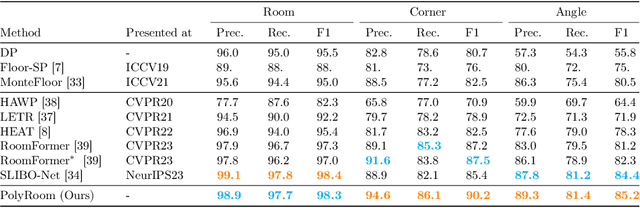
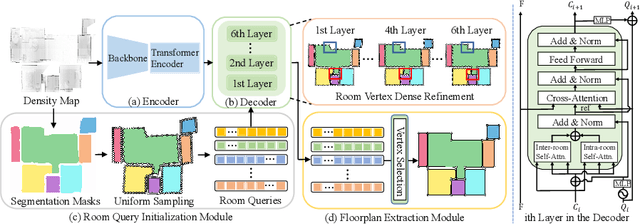
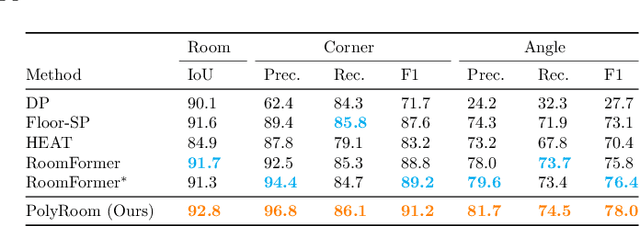
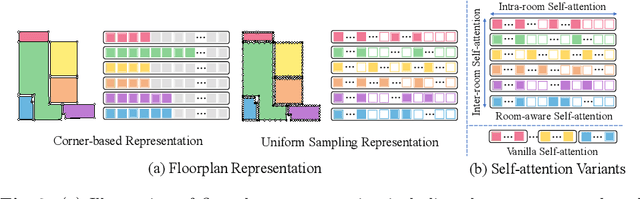
Reconstructing geometry and topology structures from raw unstructured data has always been an important research topic in indoor mapping research. In this paper, we aim to reconstruct the floorplan with a vectorized representation from point clouds. Despite significant advancements achieved in recent years, current methods still encounter several challenges, such as missing corners or edges, inaccuracies in corner positions or angles, self-intersecting or overlapping polygons, and potentially implausible topology. To tackle these challenges, we present PolyRoom, a room-aware Transformer that leverages uniform sampling representation, room-aware query initialization, and room-aware self-attention for floorplan reconstruction. Specifically, we adopt a uniform sampling floorplan representation to enable dense supervision during training and effective utilization of angle information. Additionally, we propose a room-aware query initialization scheme to prevent non-polygonal sequences and introduce room-aware self-attention to enhance memory efficiency and model performance. Experimental results on two widely used datasets demonstrate that PolyRoom surpasses current state-of-the-art methods both quantitatively and qualitatively. Our code is available at: https://github.com/3dv-casia/PolyRoom/.