 Add to Chrome
 Add to Firefox
 Add to Edge
M$^\text{4}$World: A Multi-view Multimodal Driving World Model for Interactive Object Manipulation and Minute-long Streaming
Jul 15, 2026
Driving-world generation has emerged as a core capability for scalable autonomous-driving simulation, yet existing methods remain limited in object-level controllability and long-horizon stability. We present M$^\text{4}$World, a Multi-view and Multimodal generative driving world model that synthesizes future surround-view video streams and synchronized LiDAR scans while supporting interactive object Manipulation and stable Minute-long streaming. Fine-grained object manipulation is realized through a flexible conditioning interface that supports explicit control over both the spatial layout and visual appearance of individual objects. Stable minute-long streaming, on the other hand, is achieved through a multi-stage training framework that enables online causal generation in only four denoising steps while maintaining coherent world dynamics throughout extended rollouts. Building on these components, we introduce an efficient few-clip post-training as well as a suite of visual reference-conditioned generation models, preserving general generation ability while allowing rare-case customization for long-tail controllability. To assess controllability beyond realism, we further introduce an automated VLM-based judging pipeline that evaluates scene-level condition adherence, view-wise object controllability, and cross-view object consistency. Comprehensive experiments show that M$^\text{4}$World consistently delivers high generation quality, precise controllability, and stable minute-long streaming. Together with downstream long-tail augmentation and scene editing, these results demonstrate the potential of M$^\text{4}$World for controllable, scalable driving simulation.

A GPU-accelerated Large-scale Simulator for Transportation System Optimization Benchmarking
Jun 15, 2024With the development of artificial intelligence techniques, transportation system optimization is evolving from traditional methods relying on expert experience to simulation and learning-based decision optimization methods. Learning-based optimization methods require extensive interaction with highly realistic microscopic traffic simulators for optimization. However, existing microscopic traffic simulators are computationally inefficient in large-scale scenarios and therefore significantly reduce the efficiency of the data sampling process of optimization algorithms. In addition, the optimization scenarios supported by existing simulators are limited, mainly focusing on the traffic signal control. To address these challenges and limitations, we propose the first open-source GPU-accelerated large-scale microscopic simulator for transportation system simulation. The simulator is able to iterate at 84.09Hz, which achieves 88.92 times computational acceleration in the large-scale scenario with more than a million vehicles compared to the best baseline. Based on the simulator, we implement a set of microscopic and macroscopic controllable objects and metrics to support most typical transportation system optimization scenarios. These controllable objects and metrics are all provided by Python API for ease of use. We choose five important and representative transportation system optimization scenarios and benchmark classical rule-based algorithms, reinforcement learning, and black-box optimization in four cities. The codes are available at \url{https://github.com/tsinghua-fib-lab/moss-benchmark} with the MIT License.
CityLight: A Universal Model Towards Real-world City-scale Traffic Signal Control Coordination
Jun 04, 2024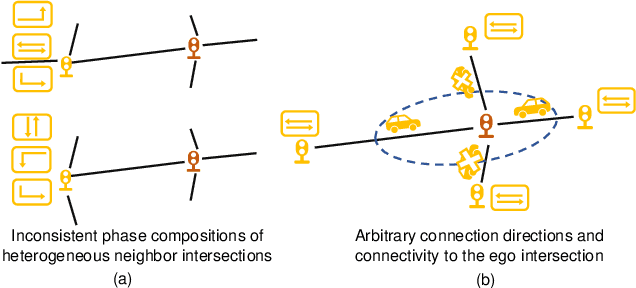
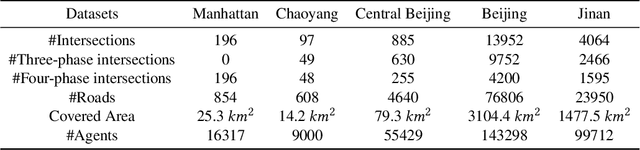
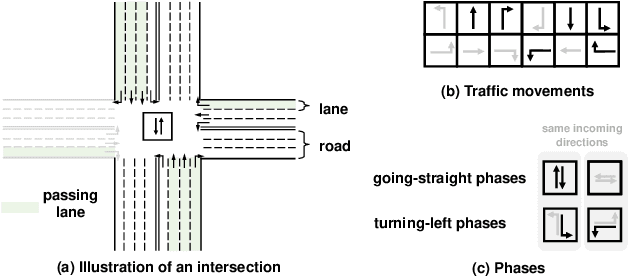
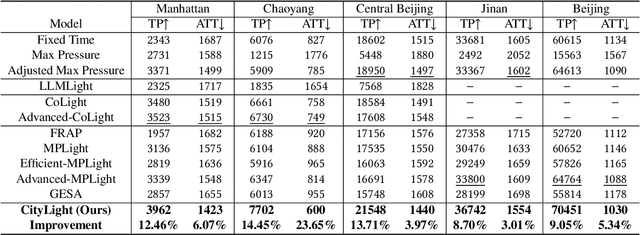
Traffic signal control (TSC) is a promising low-cost measure to enhance transportation efficiency without affecting existing road infrastructure. While various reinforcement learning-based TSC methods have been proposed and experimentally outperform conventional rule-based methods, none of them has been deployed in the real world. An essential gap lies in the oversimplification of the scenarios in terms of intersection heterogeneity and road network intricacy. To make TSC applicable in urban traffic management, we target TSC coordination in city-scale high-authenticity road networks, aiming to solve the three unique and important challenges: city-level scalability, heterogeneity of real-world intersections, and effective coordination among intricate neighbor connections. Since optimizing multiple agents in a parameter-sharing paradigm can boost the training efficiency and help achieve scalability, we propose our method, CityLight, based on the well-acknowledged optimization framework, parameter-sharing MAPPO. To ensure the unified policy network can learn to fit large-scale heterogeneous intersections and tackle the intricate between-neighbor coordination, CityLight proposes a universal representation module that consists of two key designs: heterogeneous intersection alignment and neighborhood impact alignment for coordination. To further boost coordination, CityLight adopts neighborhood-integrated rewards to transition from achieving local optimal to global optimal. Extensive experiments on datasets with hundreds to tens of thousands of real-world intersections and authentic traffic demands validate the surprising effectiveness and generalizability of CityLight, with an overall performance gain of 11.66% and a 22.59% improvement in transfer scenarios in terms of throughput.