 Add to Chrome
 Add to Firefox
 Add to Edge
Control-Diverse Reinforcement Fine-Tuning: Decoupling the Shared Control Bottleneck of RL Post-Training
Aug 08, 2026
Reinforcement learning post-training unlocks complex reasoning in LLMs. Yet benchmark scores reveal only whether a model improved, not what changed inside it, nor how it splits finite capability across tasks. A representative interpretability line attributes the success of RL fine-tuning to stronger and more diverse circuit activation. We challenge this activation-centered account by separating activation from control: an activated circuit need not control the post-training reward gain. Adapting Metabolic Control Analysis, we define the Post-training Control Coefficient to measure component control over reward gain and arrange these coefficients by task family into a control matrix, paired with an activation-magnitude matrix. We call cross-task control concentration the Shared Control Bottleneck and the difference between activation and control concentration the Activation-Control Gap. This reveals that highly shared activations can coexist with task-specific control, while a small gap indicates that control has collapsed onto a shared direction and lost task specificity. To reduce this collapse, we regularize the post-training loss with the Shared Control Bottleneck and propose Control-Diverse Reinforcement Fine-Tuning (CD-RFT). The exact regularizer gradient requires second-order automatic differentiation incompatible with flash attention, so we derive a first-order proxy with worst-case overhead below eight percent. On Qwen2.5-7B, CD-RFT achieves the largest control decoupling and improves multi-task capability over matched GRPO across mathematics, code, and logic. The no-KL variant leads on pass@1, and the KL-penalized variant leads on large-k pass@k coverage that KL otherwise degrades. Together, these results show that the Shared Control Bottleneck is both a mechanistic diagnostic and a training regularizer, and that control decoupling and capability gains transfer to Llama-3.2-3B.

KPIs 2024 Challenge: Advancing Glomerular Segmentation from Patch- to Slide-Level
Feb 11, 2025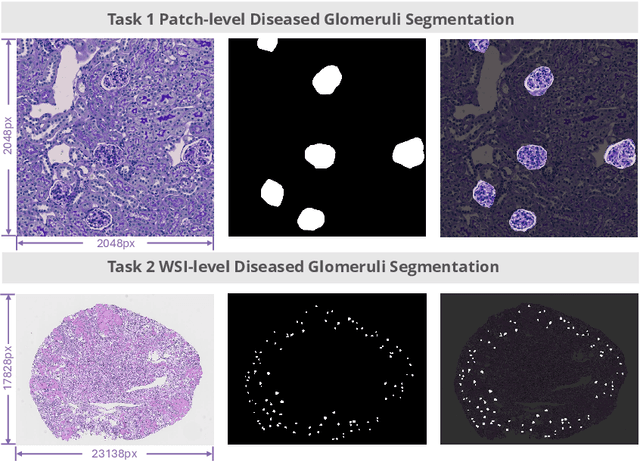

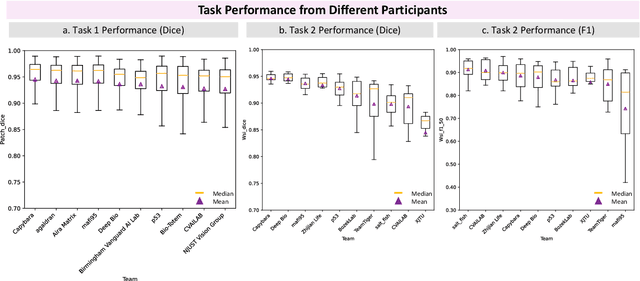
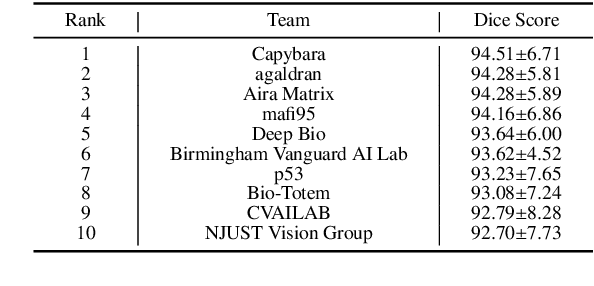
Chronic kidney disease (CKD) is a major global health issue, affecting over 10% of the population and causing significant mortality. While kidney biopsy remains the gold standard for CKD diagnosis and treatment, the lack of comprehensive benchmarks for kidney pathology segmentation hinders progress in the field. To address this, we organized the Kidney Pathology Image Segmentation (KPIs) Challenge, introducing a dataset that incorporates preclinical rodent models of CKD with over 10,000 annotated glomeruli from 60+ Periodic Acid Schiff (PAS)-stained whole slide images. The challenge includes two tasks, patch-level segmentation and whole slide image segmentation and detection, evaluated using the Dice Similarity Coefficient (DSC) and F1-score. By encouraging innovative segmentation methods that adapt to diverse CKD models and tissue conditions, the KPIs Challenge aims to advance kidney pathology analysis, establish new benchmarks, and enable precise, large-scale quantification for disease research and diagnosis.