 Add to Chrome
 Add to Firefox
 Add to Edge
A Survey on Scenario-Based Testing for Automated Driving Systems in High-Fidelity Simulation
Dec 02, 2021
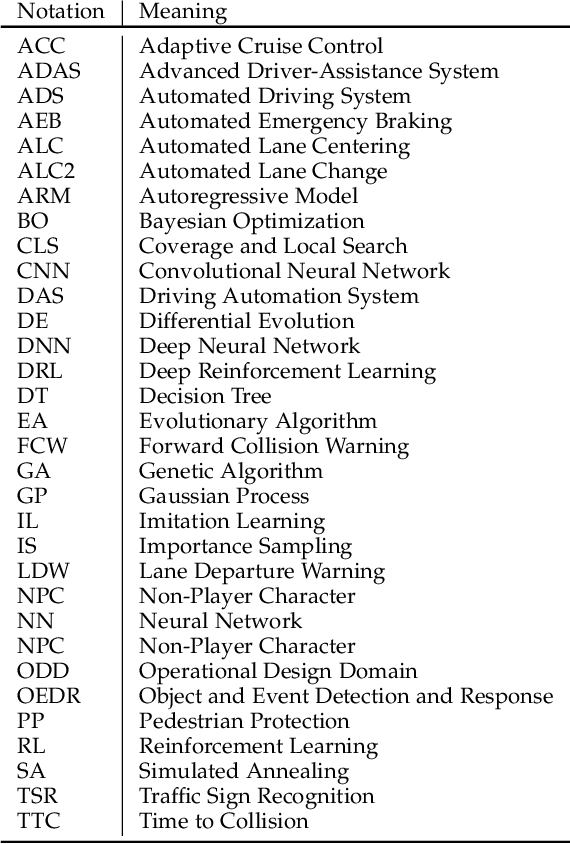
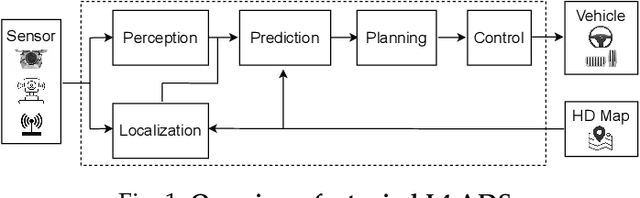

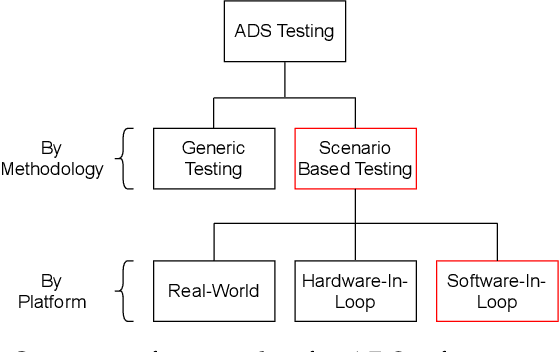
Automated Driving Systems (ADSs) have seen rapid progress in recent years. To ensure the safety and reliability of these systems, extensive testings are being conducted before their future mass deployment. Testing the system on the road is the closest to real-world and desirable approach, but it is incredibly costly. Also, it is infeasible to cover rare corner cases using such real-world testing. Thus, a popular alternative is to evaluate an ADS's performance in some well-designed challenging scenarios, a.k.a. scenario-based testing. High-fidelity simulators have been widely used in this setting to maximize flexibility and convenience in testing what-if scenarios. Although many works have been proposed offering diverse frameworks/methods for testing specific systems, the comparisons and connections among these works are still missing. To bridge this gap, in this work, we provide a generic formulation of scenario-based testing in high-fidelity simulation and conduct a literature review on the existing works. We further compare them and present the open challenges as well as potential future research directions.

Direct simultaneous speech to speech translation
Oct 15, 2021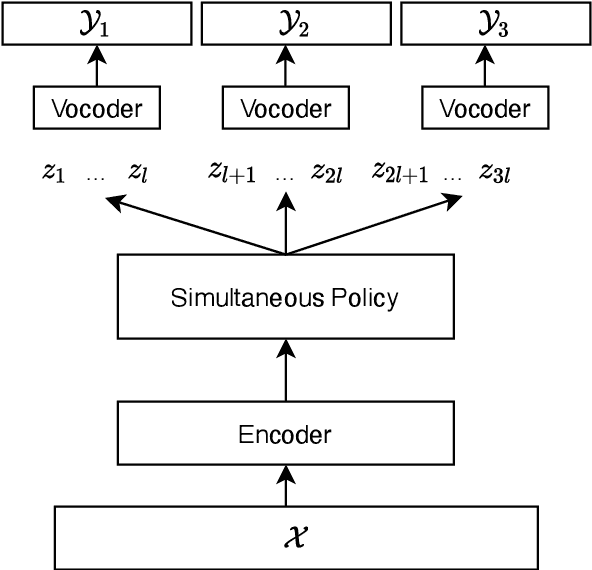
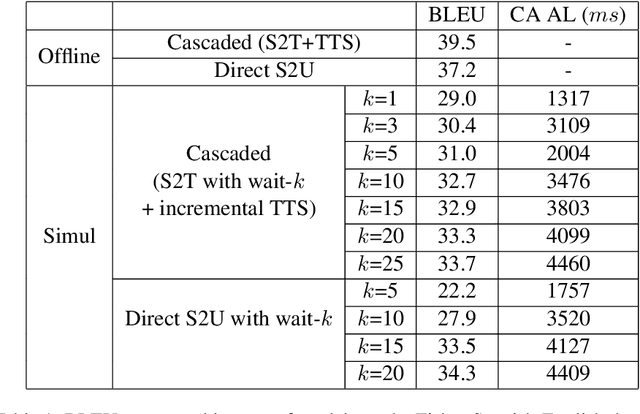
We present the first direct simultaneous speech-to-speech translation (Simul-S2ST) model, with the ability to start generating translation in the target speech before consuming the full source speech content and independently from intermediate text representations. Our approach leverages recent progress on direct speech-to-speech translation with discrete units. Instead of continuous spectrogram features, a sequence of direct representations, which are learned in a unsupervised manner, are predicted from the model and passed directly to a vocoder for speech synthesis. The simultaneous policy then operates on source speech features and target discrete units. Finally, a vocoder synthesize the target speech from discrete units on-the-fly. We carry out numerical studies to compare cascaded and direct approach on Fisher Spanish-English dataset.
Incremental Speech Synthesis For Speech-To-Speech Translation
Oct 15, 2021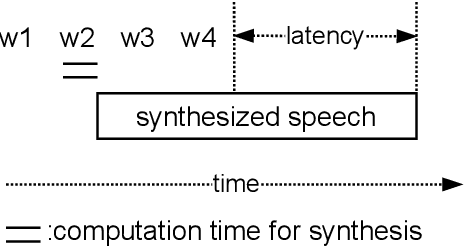
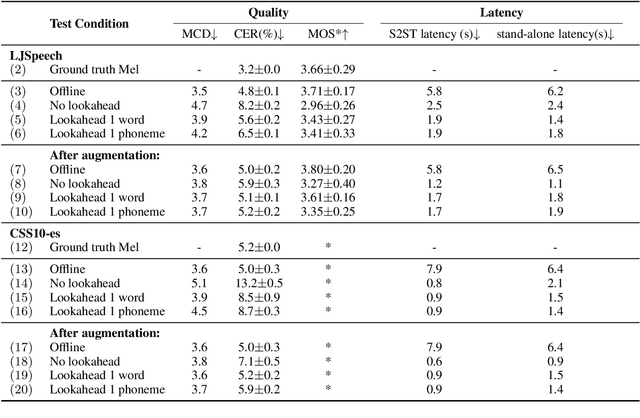
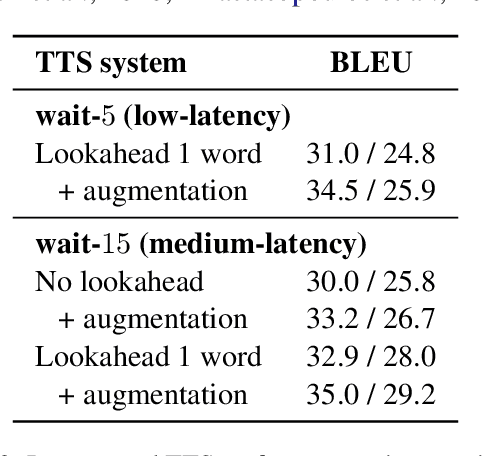
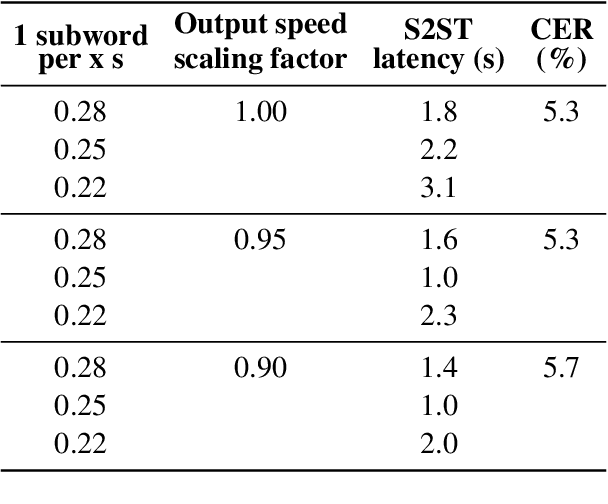
In a speech-to-speech translation (S2ST) pipeline, the text-to-speech (TTS) module is an important component for delivering the translated speech to users. To enable incremental S2ST, the TTS module must be capable of synthesizing and playing utterances while its input text is still streaming in. In this work, we focus on improving the incremental synthesis performance of TTS models. With a simple data augmentation strategy based on prefixes, we are able to improve the incremental TTS quality to approach offline performance. Furthermore, we bring our incremental TTS system to the practical scenario in combination with an upstream simultaneous speech translation system, and show the gains also carry over to this use-case. In addition, we propose latency metrics tailored to S2ST applications, and investigate methods for latency reduction in this context.
FST: the FAIR Speech Translation System for the IWSLT21 Multilingual Shared Task
Aug 14, 2021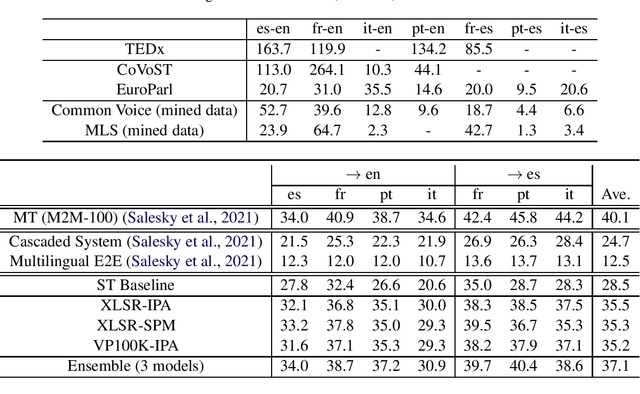
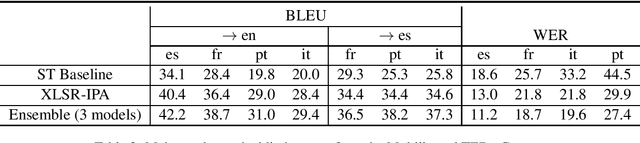
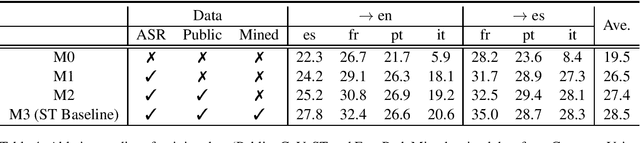
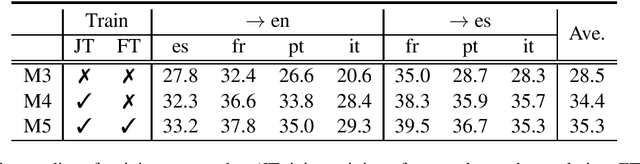
In this paper, we describe our end-to-end multilingual speech translation system submitted to the IWSLT 2021 evaluation campaign on the Multilingual Speech Translation shared task. Our system is built by leveraging transfer learning across modalities, tasks and languages. First, we leverage general-purpose multilingual modules pretrained with large amounts of unlabelled and labelled data. We further enable knowledge transfer from the text task to the speech task by training two tasks jointly. Finally, our multilingual model is finetuned on speech translation task-specific data to achieve the best translation results. Experimental results show our system outperforms the reported systems, including both end-to-end and cascaded based approaches, by a large margin. In some translation directions, our speech translation results evaluated on the public Multilingual TEDx test set are even comparable with the ones from a strong text-to-text translation system, which uses the oracle speech transcripts as input.
Improving Speech Translation by Understanding and Learning from the Auxiliary Text Translation Task
Jul 12, 2021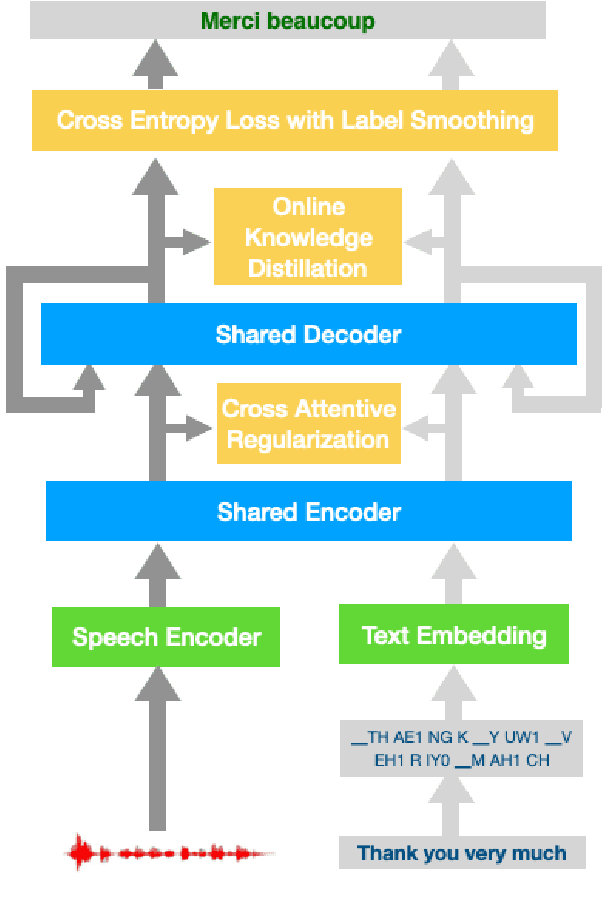
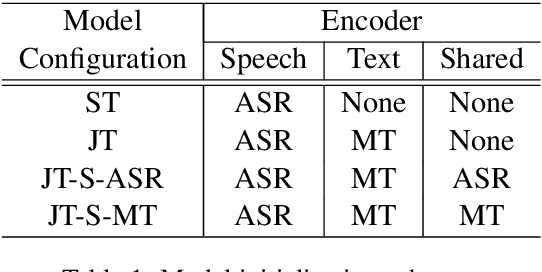
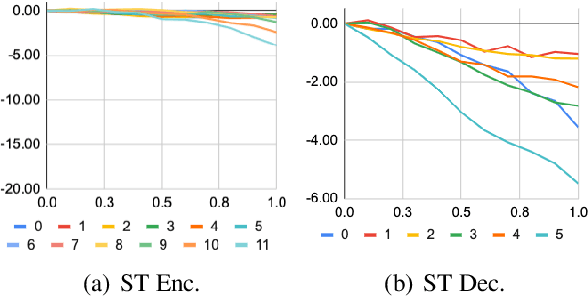
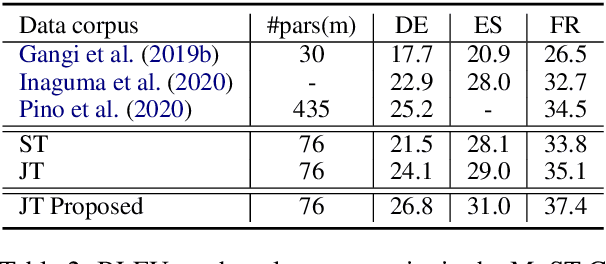
Pretraining and multitask learning are widely used to improve the speech to text translation performance. In this study, we are interested in training a speech to text translation model along with an auxiliary text to text translation task. We conduct a detailed analysis to understand the impact of the auxiliary task on the primary task within the multitask learning framework. Our analysis confirms that multitask learning tends to generate similar decoder representations from different modalities and preserve more information from the pretrained text translation modules. We observe minimal negative transfer effect between the two tasks and sharing more parameters is helpful to transfer knowledge from the text task to the speech task. The analysis also reveals that the modality representation difference at the top decoder layers is still not negligible, and those layers are critical for the translation quality. Inspired by these findings, we propose three methods to improve translation quality. First, a parameter sharing and initialization strategy is proposed to enhance information sharing between the tasks. Second, a novel attention-based regularization is proposed for the encoders and pulls the representations from different modalities closer. Third, an online knowledge distillation is proposed to enhance the knowledge transfer from the text to the speech task. Our experiments show that the proposed approach improves translation performance by more than 2 BLEU over a strong baseline and achieves state-of-the-art results on the \textsc{MuST-C} English-German, English-French and English-Spanish language pairs.
Direct speech-to-speech translation with discrete units
Jul 12, 2021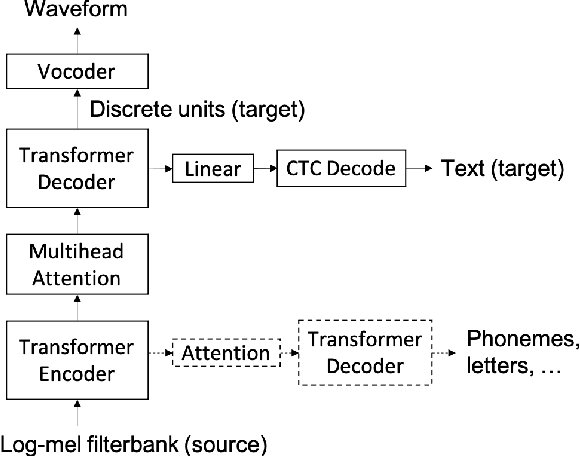
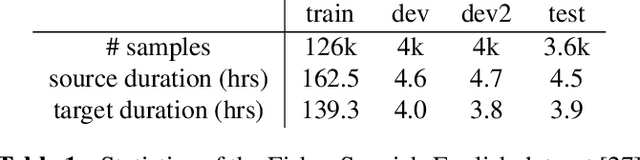
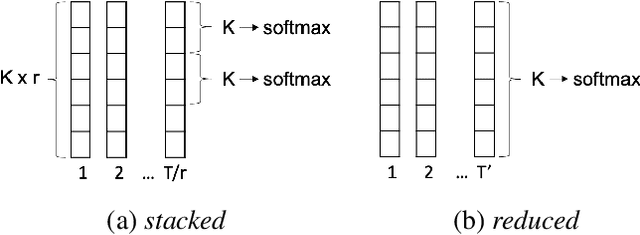
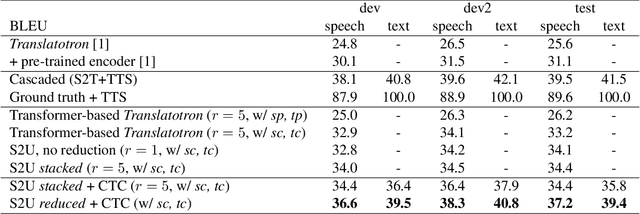
We present a direct speech-to-speech translation (S2ST) model that translates speech from one language to speech in another language without relying on intermediate text generation. Previous work addresses the problem by training an attention-based sequence-to-sequence model that maps source speech spectrograms into target spectrograms. To tackle the challenge of modeling continuous spectrogram features of the target speech, we propose to predict the self-supervised discrete representations learned from an unlabeled speech corpus instead. When target text transcripts are available, we design a multitask learning framework with joint speech and text training that enables the model to generate dual mode output (speech and text) simultaneously in the same inference pass. Experiments on the Fisher Spanish-English dataset show that predicting discrete units and joint speech and text training improve model performance by 11 BLEU compared with a baseline that predicts spectrograms and bridges 83% of the performance gap towards a cascaded system. When trained without any text transcripts, our model achieves similar performance as a baseline that predicts spectrograms and is trained with text data.
Pay Better Attention to Attention: Head Selection in Multilingual and Multi-Domain Sequence Modeling
Jun 21, 2021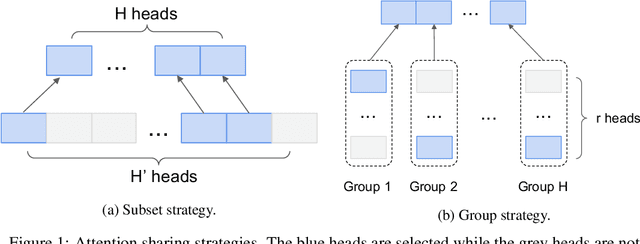
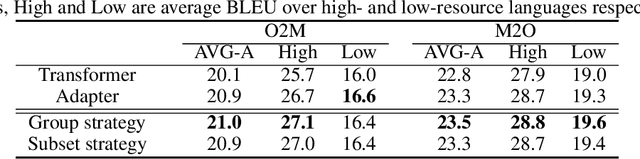

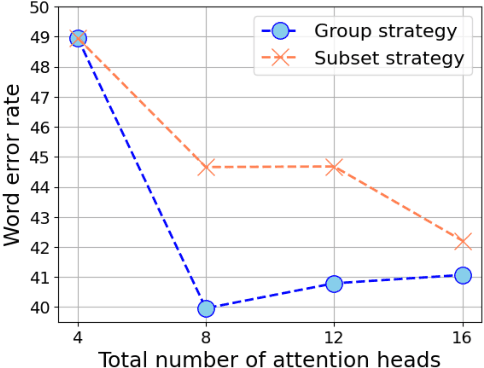
Multi-head attention has each of the attention heads collect salient information from different parts of an input sequence, making it a powerful mechanism for sequence modeling. Multilingual and multi-domain learning are common scenarios for sequence modeling, where the key challenge is to maximize positive transfer and mitigate negative transfer across languages and domains. In this paper, we find that non-selective attention sharing is sub-optimal for achieving good generalization across all languages and domains. We further propose attention sharing strategies to facilitate parameter sharing and specialization in multilingual and multi-domain sequence modeling. Our approach automatically learns shared and specialized attention heads for different languages and domains to mitigate their interference. Evaluated in various tasks including speech recognition, text-to-text and speech-to-text translation, the proposed attention sharing strategies consistently bring gains to sequence models built upon multi-head attention. For speech-to-text translation, our approach yields an average of $+2.0$ BLEU over $13$ language directions in multilingual setting and $+2.0$ BLEU over $3$ domains in multi-domain setting.
Cross-Modal Transfer Learning for Multilingual Speech-to-Text Translation
Oct 24, 2020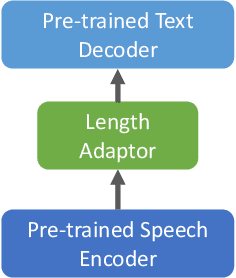
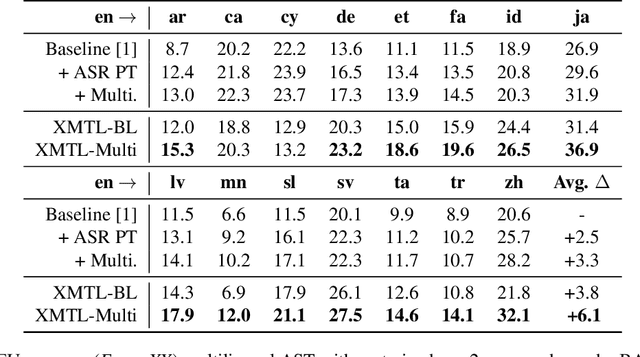
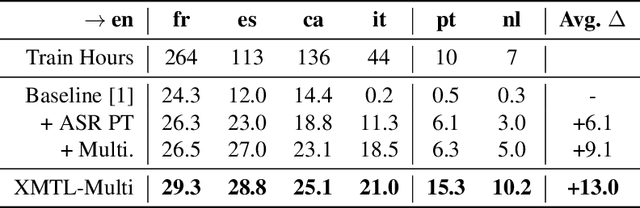
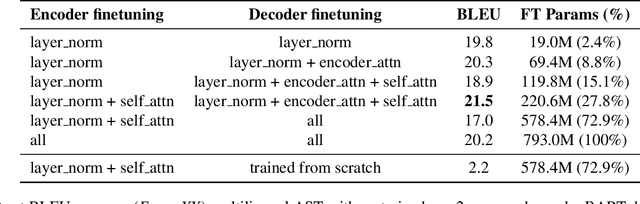
We propose an effective approach to utilize pretrained speech and text models to perform speech-to-text translation (ST). Our recipe to achieve cross-modal and cross-lingual transfer learning (XMTL) is simple and generalizable: using an adaptor module to bridge the modules pretrained in different modalities, and an efficient finetuning step which leverages the knowledge from pretrained modules yet making it work on a drastically different downstream task. With this approach, we built a multilingual speech-to-text translation model with pretrained audio encoder (wav2vec) and multilingual text decoder (mBART), which achieves new state-of-the-art on CoVoST 2 ST benchmark [1] for English into 15 languages as well as 6 Romance languages into English with on average +2.8 BLEU and +3.9 BLEU, respectively. On low-resource languages (with less than 10 hours training data), our approach significantly improves the quality of speech-to-text translation with +9.0 BLEU on Portuguese-English and +5.2 BLEU on Dutch-English.
A General Multi-Task Learning Framework to Leverage Text Data for Speech to Text Tasks
Oct 21, 2020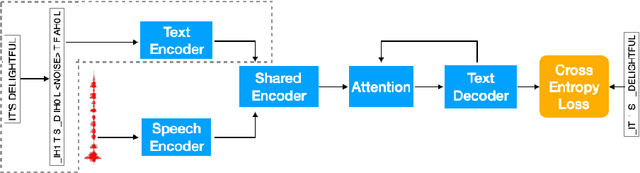
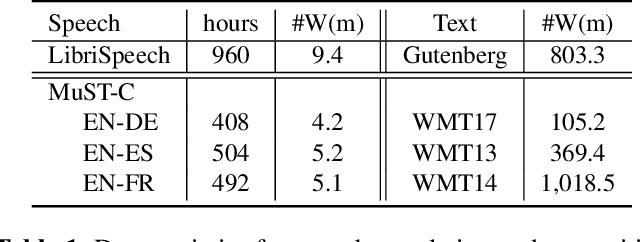
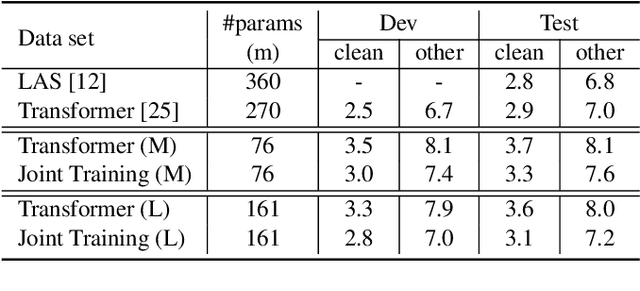
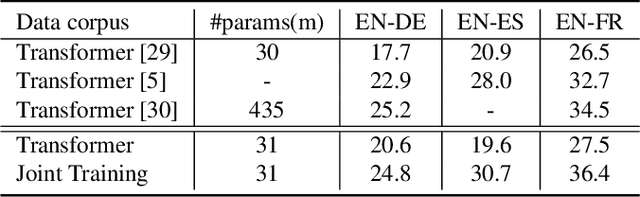
Attention-based sequence-to-sequence modeling provides a powerful and elegant solution for applications that need to map one sequence to a different sequence. Its success heavily relies on the availability of large amounts of training data. This presents a challenge for speech applications where labelled speech data is very expensive to obtain, such as automatic speech recognition (ASR) and speech translation (ST). In this study, we propose a general multi-task learning framework to leverage text data for ASR and ST tasks. Two auxiliary tasks, a denoising autoencoder task and machine translation task, are proposed to be co-trained with ASR and ST tasks respectively. We demonstrate that representing text input as phoneme sequences can reduce the difference between speech and text inputs, and enhance the knowledge transfer from text corpora to the speech to text tasks. Our experiments show that the proposed method achieves a relative 10~15% word error rate reduction on the English Librispeech task, and improves the speech translation quality on the MuST-C tasks by 4.2~11.1 BLEU.
fairseq S2T: Fast Speech-to-Text Modeling with fairseq
Oct 11, 2020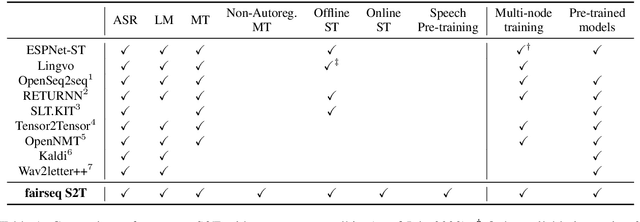
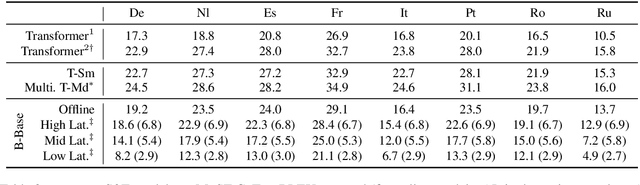
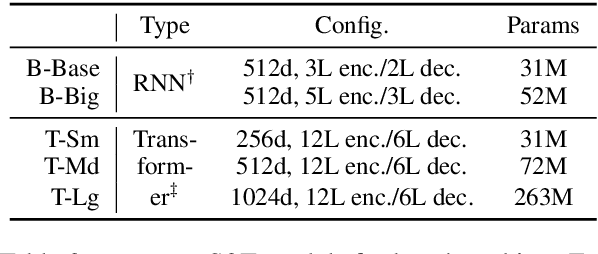
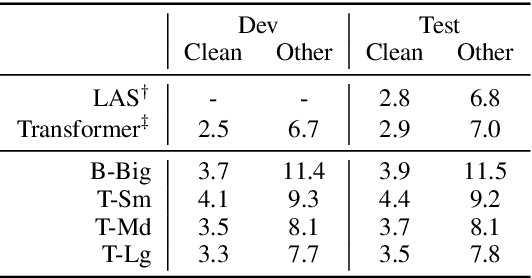
We introduce fairseq S2T, a fairseq extension for speech-to-text (S2T) modeling tasks such as end-to-end speech recognition and speech-to-text translation. It follows fairseq's careful design for scalability and extensibility. We provide end-to-end workflows from data pre-processing, model training to offline (online) inference. We implement state-of-the-art RNN-based as well as Transformer-based models and open-source detailed training recipes. Fairseq's machine translation models and language models can be seamlessly integrated into S2T workflows for multi-task learning or transfer learning. Fairseq S2T documentation and examples are available at https://github.com/pytorch/fairseq/tree/master/examples/speech_to_text.