 Add to Chrome
 Add to Firefox
 Add to Edge
Improving low-resource ASR using bilingual fine-tuning with language identification: a cross-linguistic evaluation
Jun 16, 2026
This study explores how bilingual fine-tuning affects automatic speech recognition (ASR) in low-resource languages. We evaluate this method across nine linguistically and geographically diverse language pairs, covering a range of language families and writing systems. To distinguish the two languages, during training, we pre-pend each input text with a language identification token. At inference, the model jointly predicts both the language and transcription from the speech input alone. As texts for which the language is incorrectly determined show low ASR performance, we also conduct a follow-up experiment in which the language identification token is provided both during training and inference. Our results show that bilingual fine-tuning can be beneficial when language identification accuracy is high, and that in cases where language identification performance is low, including the language identification token at inference helps to improve ASR performance.

Can Large Language Models Reliably Correct Errors in Low-Resource ASR? A Contamination-Aware Case Study on West Frisian
May 19, 2026Automatic speech recognition (ASR) has improved substantially in recent years, yet performance remains limited for low-resource languages. Large language models (LLMs) have shown promise for improving ASR through generative error correction (GER), but their effectiveness in low-resource settings remains underexplored. In addition, it remains unclear to what extent data contamination influences the reported improvements in LLM-based GER. This study investigates LLM-based GER for low-resource Frisian. In addition to a public corpus, we construct and use a Frisian offline dataset with non-public texts for evaluation to control for potential data contamination. Results show that GER improves ASR performance in most settings, with the best GPT-5.1 results surpassing oracle WERs. Comparable gains on the offline dataset indicate that improvements reflect true correction ability. We further provide a detailed error analysis revealing model correction patterns.
Evaluating Standard and Dialectal Frisian ASR: Multilingual Fine-tuning and Language Identification for Improved Low-resource Performance
Feb 07, 2025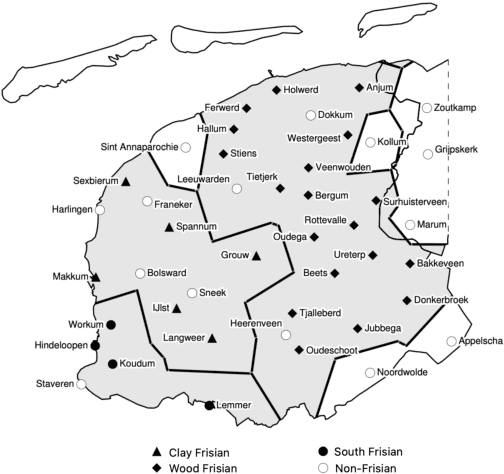
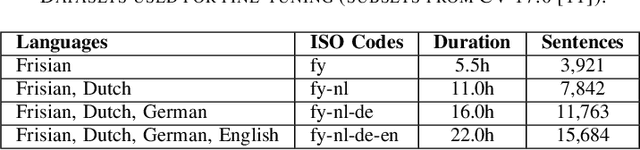
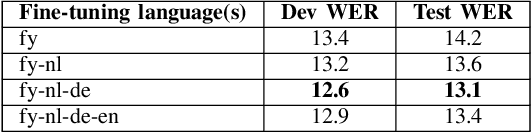
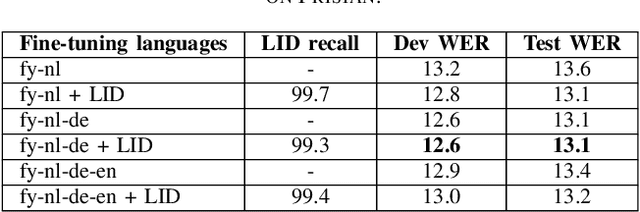
Automatic Speech Recognition (ASR) performance for low-resource languages is still far behind that of higher-resource languages such as English, due to a lack of sufficient labeled data. State-of-the-art methods deploy self-supervised transfer learning where a model pre-trained on large amounts of data is fine-tuned using little labeled data in a target low-resource language. In this paper, we present and examine a method for fine-tuning an SSL-based model in order to improve the performance for Frisian and its regional dialects (Clay Frisian, Wood Frisian, and South Frisian). We show that Frisian ASR performance can be improved by using multilingual (Frisian, Dutch, English and German) fine-tuning data and an auxiliary language identification task. In addition, our findings show that performance on dialectal speech suffers substantially, and, importantly, that this effect is moderated by the elicitation approach used to collect the dialectal data. Our findings also particularly suggest that relying solely on standard language data for ASR evaluation may underestimate real-world performance, particularly in languages with substantial dialectal variation.