 Add to Chrome
 Add to Firefox
 Add to Edge
Graph-Based Discovery of Mathematical Software Communities and Publication-to-Community Prediction
Aug 17, 2026
Research software forms distinct co-usage communities that span traditional disciplinary boundaries, yet the structure of these communities remains largely unexplored. We present a graph-based framework for discovering mathematical software communities and predicting their association with research publications. We construct a software co-usage network from publication-software relationships using a curated swMATH dataset and subsequently apply community detection method, revealing a heterogeneous landscape of mathematical software communities. We formulate publication-to-community mapping as a multi-label classification task and further investigate whether community membership can be predicted from lightweight scholarly metadata. Specifically, we compare two feature representations of scientific publications: Mathematics Subject Classification (MSC) and title-based embeddings. Across a range of models, structured MSC representation consistently provides a stronger precision-recall trade-off, demonstrating that structured domain metadata captures software-community structure more effectively than compressed title-only semantics in this setting. This work highlights the continuing value of structured scholarly metadata for large-scale research software discovery, classification and recommendation.

Syntax Meets Semantics: Understanding Scientific Formulae
Aug 03, 2026Scientific formulae are a fundamental component of scholarly communication, yet their dual nature -- as structured syntax and carriers of semantics -- remains underexplored in scholarly information retrieval. Although prior studies show that jointly modeling syntactic and semantic modalities improves retrieval performance, the relationship between their underlying representations has not been systematically investigated. In this work, we empirically study cross-modal correspondence between formula syntax and semantics. We find that their native representation spaces exhibit extremely weak observable correspondence despite strong latent correlation, indicating a substantial representation mismatch between the two modalities. We further evaluate whether this mismatch can be reduced using standard representation learning and alignment techniques. We represent syntactic structure using graph-based encoders and semantic information using text-based encoders, then apply contrastive learning to induce a shared representation space. Results show that the learned alignment substantially improves cross-modal retrieval, suggesting that explicit representation learning can recover correspondence absent from the original representation spaces.
Aspect-Aware Content-Based Recommendations for Mathematical Research Papers
May 05, 2026Content-based research paper recommendation (CbRPR) has seen advances in computer science and biomedicine, but remains unexplored for mathematics, where paper relatedness is more conceptual than explicit textual or citation-based similarity. Mathematics papers may be connected through shared proof techniques, logical implications, or natural generalizations, yet exhibit minimal textual or citation overlap, rendering existing CbRPR ineffective. To address this gap, we first conduct an expert-driven study characterizing mathematical recommendations, revealing that relevance is inherently \textit{aspect}-driven. Grounded in this insight, we introduce GoldRiM (small, expert-annotated) and SilverRiM (large, automatically derived), the first datasets for \textit{aspect}-aware CbRPR in mathematics. Recognizing that LLM embeddings of mathematical content alone yield suboptimal representation, we propose AchGNN, an \textit{aspect}-conditioned heterogeneous GNN that jointly models textual semantics, citation structure, and author lineage. Across GoldRiM and SilverRiM, AchGNN consistently outperforms prior \textit{aspect}-based CbRPR methods, achieving substantial gains across all evaluated \textit{aspects}. We conduct ablation studies to analyze the contributions of individual \textit{aspect} supervision, authorship lineage, and graph-structural signals to AchGNN's performance. To assess domain generality, we further evaluate AchGNN on the \textit{Papers with Code} dataset of machine learning publications, demonstrating that our \textit{aspect}-aware approach effectively transfers beyond mathematics. We deploy our system on the MaRDI platform to help mathematicians with recommendations and release datasets and code publicly for reproducibility.
An Overview of zbMATH Open Digital Library
Oct 09, 2024

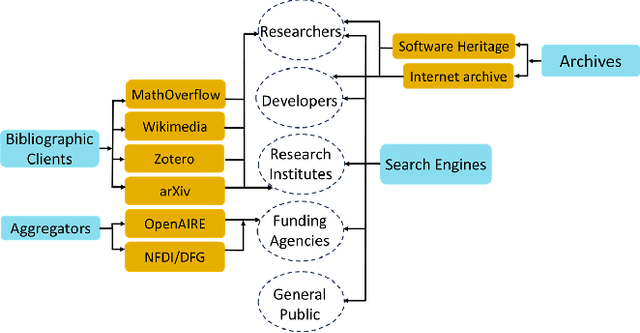
Mathematical research thrives on the effective dissemination and discovery of knowledge. zbMATH Open has emerged as a pivotal platform in this landscape, offering a comprehensive repository of mathematical literature. Beyond indexing and abstracting, it serves as a unified quality-assured infrastructure for finding, evaluating, and connecting mathematical information that advances mathematical research as well as interdisciplinary exploration. zbMATH Open enables scientific quality control by post-publication reviews and promotes connections between researchers, institutions, and research outputs. This paper represents the functionalities of the most significant features of this open-access service, highlighting its role in shaping the future of mathematical information retrieval.
Reducing the climate impact of data portals: a case study
Jun 06, 2024The carbon footprint share of the information and communication technology (ICT) sector has steadily increased in the past decade and is predicted to make up as much as 23 \% of global emissions in 2030. This shows a pressing need for developers, including the information retrieval community, to make their code more energy-efficient. In this project proposal, we discuss techniques to reduce the energy footprint of the MaRDI (Mathematical Research Data Initiative) Portal, a MediaWiki-based knowledge base. In future work, we plan to implement these changes and provide concrete measurements on the gain in energy efficiency. Researchers developing similar knowledge bases can adapt our measures to reduce their environmental footprint. In this way, we are working on mitigating the climate impact of Information Retrieval research.
Can LLMs Master Math? Investigating Large Language Models on Math Stack Exchange
Mar 30, 2024
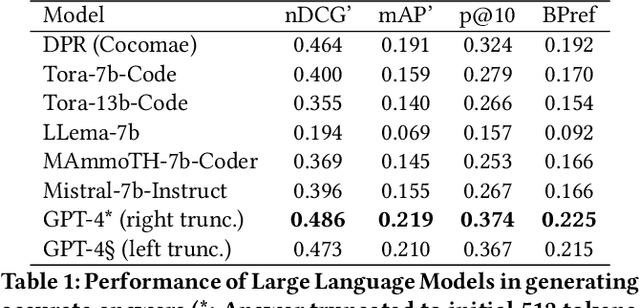
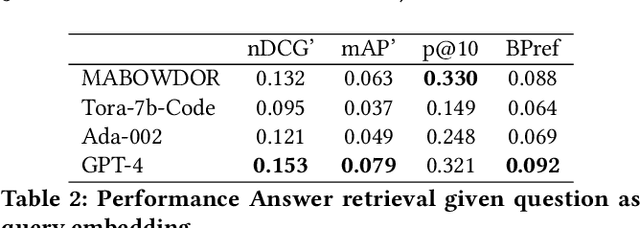
Large Language Models (LLMs) have demonstrated exceptional capabilities in various natural language tasks, often achieving performances that surpass those of humans. Despite these advancements, the domain of mathematics presents a distinctive challenge, primarily due to its specialized structure and the precision it demands. In this study, we adopted a two-step approach for investigating the proficiency of LLMs in answering mathematical questions. First, we employ the most effective LLMs, as identified by their performance on math question-answer benchmarks, to generate answers to 78 questions from the Math Stack Exchange (MSE). Second, a case analysis is conducted on the LLM that showed the highest performance, focusing on the quality and accuracy of its answers through manual evaluation. We found that GPT-4 performs best (nDCG of 0.48 and P@10 of 0.37) amongst existing LLMs fine-tuned for answering mathematics questions and outperforms the current best approach on ArqMATH3 Task1, considering P@10. Our Case analysis indicates that while the GPT-4 can generate relevant responses in certain instances, it does not consistently answer all questions accurately. This paper explores the current limitations of LLMs in navigating complex mathematical problem-solving. Through case analysis, we shed light on the gaps in LLM capabilities within mathematics, thereby setting the stage for future research and advancements in AI-driven mathematical reasoning. We make our code and findings publicly available for research: \url{https://github.com/gipplab/LLM-Investig-MathStackExchange}
Taxonomy of Mathematical Plagiarism
Jan 30, 2024Plagiarism is a pressing concern, even more so with the availability of large language models. Existing plagiarism detection systems reliably find copied and moderately reworded text but fail for idea plagiarism, especially in mathematical science, which heavily uses formal mathematical notation. We make two contributions. First, we establish a taxonomy of mathematical content reuse by annotating potentially plagiarised 122 scientific document pairs. Second, we analyze the best-performing approaches to detect plagiarism and mathematical content similarity on the newly established taxonomy. We found that the best-performing methods for plagiarism and math content similarity achieve an overall detection score (PlagDet) of 0.06 and 0.16, respectively. The best-performing methods failed to detect most cases from all seven newly established math similarity types. Outlined contributions will benefit research in plagiarism detection systems, recommender systems, question-answering systems, and search engines. We make our experiment's code and annotated dataset available to the community: https://github.com/gipplab/Taxonomy-of-Mathematical-Plagiarism
Bravo MaRDI: A Wikibase Powered Knowledge Graph on Mathematics
Sep 20, 2023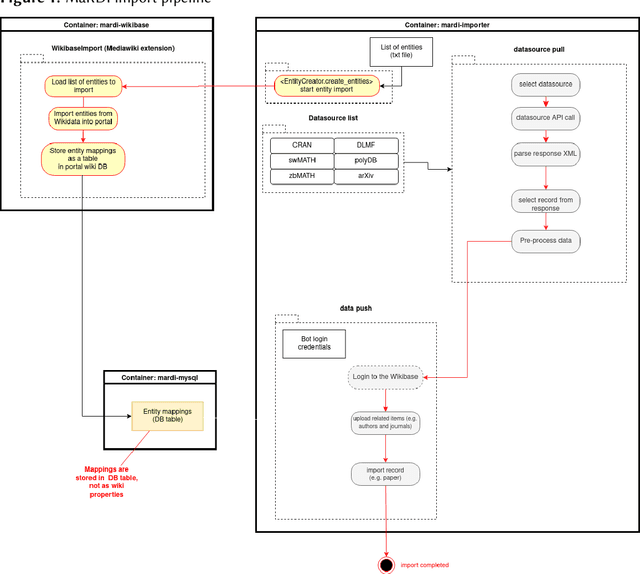
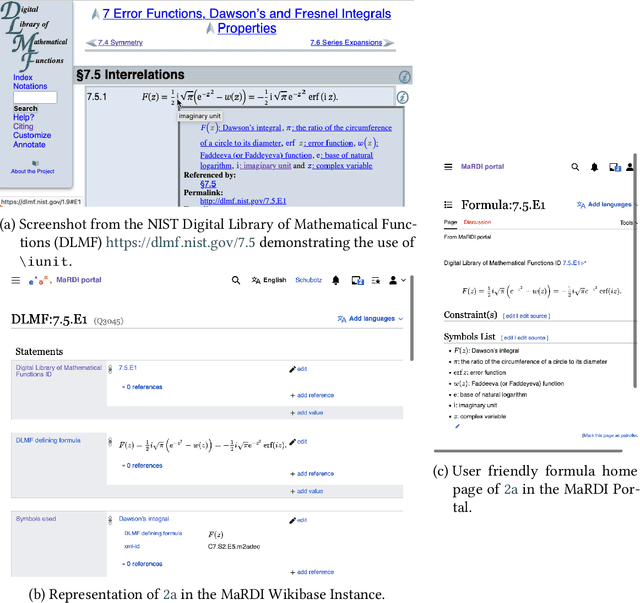
Mathematical world knowledge is a fundamental component of Wikidata. However, to date, no expertly curated knowledge graph has focused specifically on contemporary mathematics. Addressing this gap, the Mathematical Research Data Initiative (MaRDI) has developed a comprehensive knowledge graph that links multimodal research data in mathematics. This encompasses traditional research data items like datasets, software, and publications and includes semantically advanced objects such as mathematical formulas and hypotheses. This paper details the abilities of the MaRDI knowledge graph, which is based on Wikibase, leading up to its inaugural public release, codenamed Bravo, available on https://portal.mardi4nfdi.de.
Neural Machine Translation for Mathematical Formulae
May 25, 2023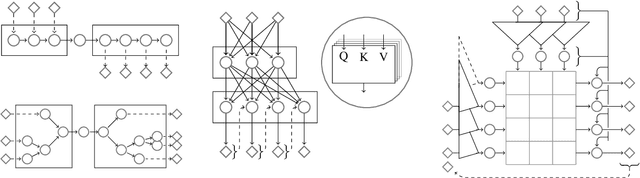

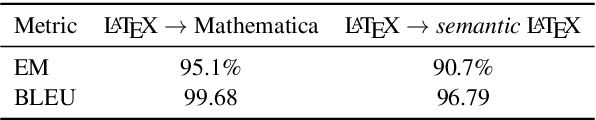
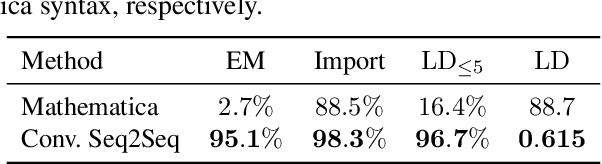
We tackle the problem of neural machine translation of mathematical formulae between ambiguous presentation languages and unambiguous content languages. Compared to neural machine translation on natural language, mathematical formulae have a much smaller vocabulary and much longer sequences of symbols, while their translation requires extreme precision to satisfy mathematical information needs. In this work, we perform the tasks of translating from LaTeX to Mathematica as well as from LaTeX to semantic LaTeX. While recurrent, recursive, and transformer networks struggle with preserving all contained information, we find that convolutional sequence-to-sequence networks achieve 95.1% and 90.7% exact matches, respectively.
TEIMMA: The First Content Reuse Annotator for Text, Images, and Math
May 22, 2023This demo paper presents the first tool to annotate the reuse of text, images, and mathematical formulae in a document pair -- TEIMMA. Annotating content reuse is particularly useful to develop plagiarism detection algorithms. Real-world content reuse is often obfuscated, which makes it challenging to identify such cases. TEIMMA allows entering the obfuscation type to enable novel classifications for confirmed cases of plagiarism. It enables recording different reuse types for text, images, and mathematical formulae in HTML and supports users by visualizing the content reuse in a document pair using similarity detection methods for text and math.