 Add to Chrome
 Add to Firefox
 Add to Edge
UAV-CB: A Complex-Background RGB-T Dataset and Local Frequency Bridge Network for UAV Detection
Mar 18, 2026
Detecting Unmanned Aerial Vehicles (UAVs) in low-altitude environments is essential for perception and defense systems but remains highly challenging due to complex backgrounds, camouflage, and multimodal interference. In real-world scenarios, UAVs are frequently visually blended with surrounding structures such as buildings, vegetation, and power lines, resulting in low contrast, weak boundaries, and strong confusion with cluttered background textures. Existing UAV detection datasets, though diverse, are not specifically designed to capture these camouflage and complex-background challenges, which limits progress toward robust real-world perception. To fill this gap, we construct UAV-CB, a new RGB-T UAV detection dataset deliberately curated to emphasize complex low-altitude backgrounds and camouflage characteristics. Furthermore, we propose the Local Frequency Bridge Network (LFBNet), which models features in localized frequency space to bridge both the frequency-spatial fusion gap and the cross-modality discrepancy gap in RGB-T fusion. Extensive experiments on UAV-CB and public benchmarks demonstrate that LFBNet achieves state-of-the-art detection performance and strong robustness under camouflaged and cluttered conditions, offering a frequency-aware perspective on multimodal UAV perception in real-world applications.

A Robust Ensemble Model for Patasitic Egg Detection and Classification
Jul 04, 2022
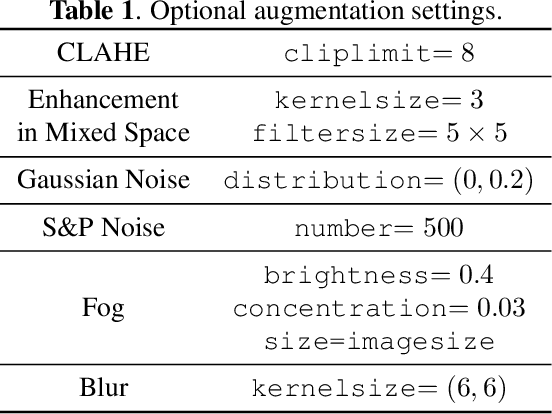
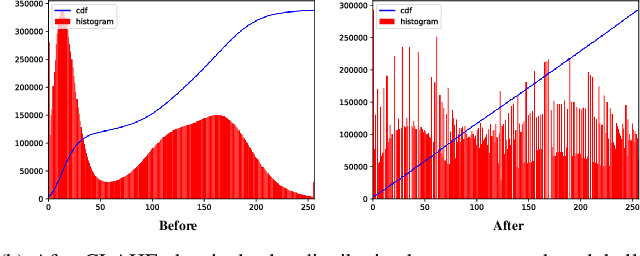
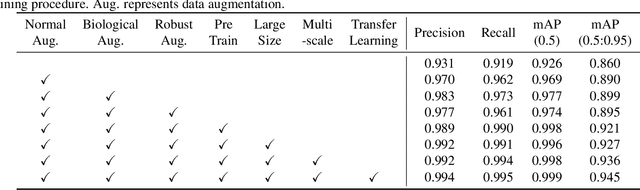
Intestinal parasitic infections, as a leading causes of morbidity worldwide, still lacks time-saving, high-sensitivity and user-friendly examination method. The development of deep learning technique reveals its broad application potential in biological image. In this paper, we apply several object detectors such as YOLOv5 and variant cascadeRCNNs to automatically discriminate parasitic eggs in microscope images. Through specially-designed optimization including raw data augmentation, model ensemble, transfer learning and test time augmentation, our model achieves excellent performance on challenge dataset. In addition, our model trained with added noise gains a high robustness against polluted input, which further broaden its applicability in practice.