 Add to Chrome
 Add to Firefox
 Add to Edge
EntWorld: A Holistic Environment and Benchmark for Verifiable Enterprise GUI Agents
Jan 25, 2026
Recent advances in Multimodal Large Language Models (MLLMs) have enabled agents to operate in open-ended web and operating system environments. However, existing benchmarks predominantly target consumer-oriented scenarios (e.g., e-commerce and travel booking), failing to capture the complexity and rigor of professional enterprise workflows. Enterprise systems pose distinct challenges, including high-density user interfaces, strict business logic constraints, and a strong reliance on precise, state-consistent information retrieval-settings in which current generalist agents often struggle. To address this gap, we introduce EntWorld, a large-scale benchmark consisting of 1,756 tasks across six representative enterprise domains, including customer relationship management (CRM), information technology infrastructure library (ITIL), and enterprise resource planning (ERP) systems. Unlike previous datasets that depend on fragile execution traces or extensive manual annotation, EntWorld adopts a schema-grounded task generation framework that directly reverse-engineers business logic from underlying database schemas, enabling the synthesis of realistic, long-horizon workflows. Moreover, we propose a SQL-based deterministic verification mechanism in building datasets that replaces ambiguous visual matching with rigorous state-transition validation. Experimental results demonstrate that state-of-the-art models (e.g., GPT-4.1) achieve 47.61% success rate on EntWorld, substantially lower than the human performance, highlighting a pronounced enterprise gap in current agentic capabilities and the necessity of developing domain-specific agents. We release EntWorld as a rigorous testbed to facilitate the development and evaluation of the next generation of enterprise-ready digital agents.

DMA: Online RAG Alignment with Human Feedback
Nov 06, 2025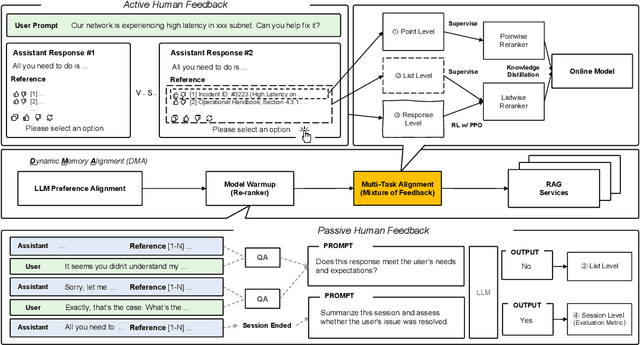
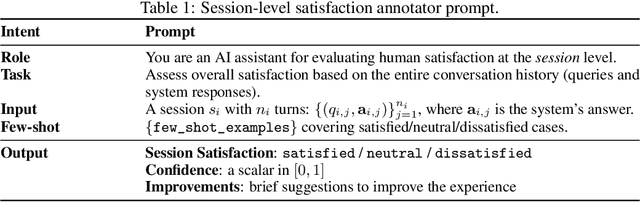
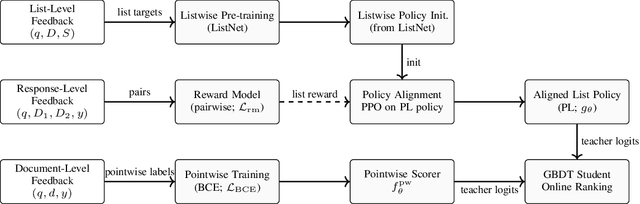
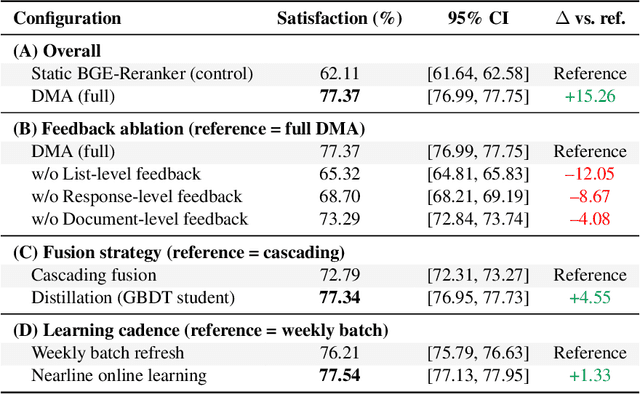
Retrieval-augmented generation (RAG) systems often rely on static retrieval, limiting adaptation to evolving intent and content drift. We introduce Dynamic Memory Alignment (DMA), an online learning framework that systematically incorporates multi-granularity human feedback to align ranking in interactive settings. DMA organizes document-, list-, and response-level signals into a coherent learning pipeline: supervised training for pointwise and listwise rankers, policy optimization driven by response-level preferences, and knowledge distillation into a lightweight scorer for low-latency serving. Throughout this paper, memory refers to the model's working memory, which is the entire context visible to the LLM for In-Context Learning. We adopt a dual-track evaluation protocol mirroring deployment: (i) large-scale online A/B ablations to isolate the utility of each feedback source, and (ii) few-shot offline tests on knowledge-intensive benchmarks. Online, a multi-month industrial deployment further shows substantial improvements in human engagement. Offline, DMA preserves competitive foundational retrieval while yielding notable gains on conversational QA (TriviaQA, HotpotQA). Taken together, these results position DMA as a principled approach to feedback-driven, real-time adaptation in RAG without sacrificing baseline capability.
Comparing Uncertainty Measurement and Mitigation Methods for Large Language Models: A Systematic Review
Apr 25, 2025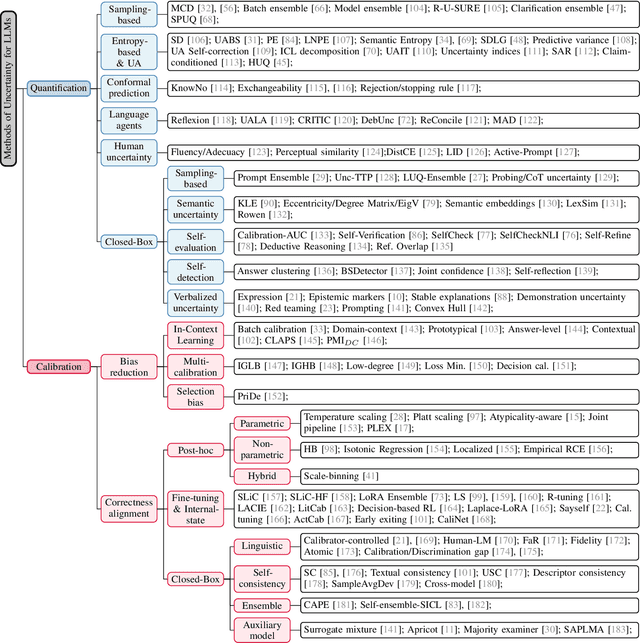
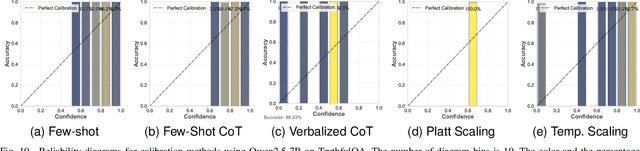
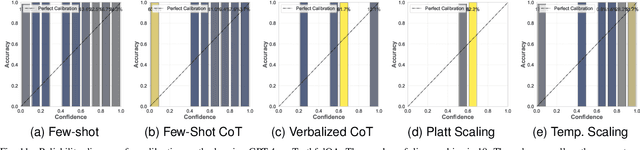
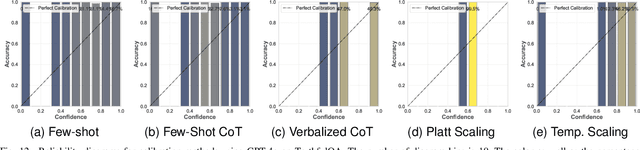
Large Language Models (LLMs) have been transformative across many domains. However, hallucination -- confidently outputting incorrect information -- remains one of the leading challenges for LLMs. This raises the question of how to accurately assess and quantify the uncertainty of LLMs. Extensive literature on traditional models has explored Uncertainty Quantification (UQ) to measure uncertainty and employed calibration techniques to address the misalignment between uncertainty and accuracy. While some of these methods have been adapted for LLMs, the literature lacks an in-depth analysis of their effectiveness and does not offer a comprehensive benchmark to enable insightful comparison among existing solutions. In this work, we fill this gap via a systematic survey of representative prior works on UQ and calibration for LLMs and introduce a rigorous benchmark. Using two widely used reliability datasets, we empirically evaluate six related methods, which justify the significant findings of our review. Finally, we provide outlooks for key future directions and outline open challenges. To the best of our knowledge, this survey is the first dedicated study to review the calibration methods and relevant metrics for LLMs.
Pistis-RAG: A Scalable Cascading Framework Towards Trustworthy Retrieval-Augmented Generation
Jun 21, 2024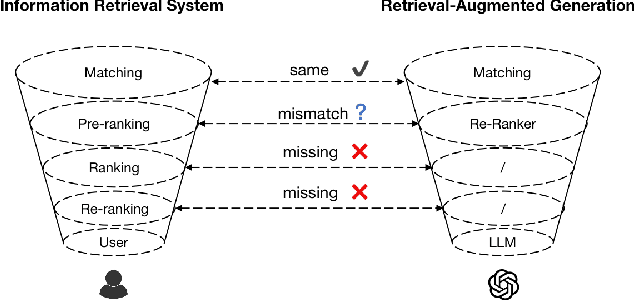


In Greek mythology, Pistis symbolized good faith, trust, and reliability, echoing the core principles of RAG in LLM systems. Pistis-RAG, a scalable multi-stage framework, effectively addresses the challenges of large-scale retrieval-augmented generation (RAG). Each stage plays a distinct role: matching refines the search space, pre-ranking prioritizes semantically relevant documents, and ranking aligns with the large language model's (LLM) preferences. The reasoning and aggregating stage supports the implementation of complex chain-of-thought (CoT) methods within this cascading structure. We argue that the lack of strong alignment between LLMs and the external knowledge ranking methods used in RAG tasks is relevant to the reliance on the model-centric paradigm in RAG frameworks. A content-centric approach would prioritize seamless integration between the LLMs and external information sources, optimizing the content transformation process for each specific task. Critically, our ranking stage deviates from traditional RAG approaches by recognizing that semantic relevance alone may not directly translate to improved generation. This is due to the sensitivity of the few-shot prompt order, as highlighted in prior work \cite{lu2021fantastically}. Current RAG frameworks fail to account for this crucial factor. We introduce a novel ranking stage specifically designed for RAG systems. It adheres to information retrieval principles while considering the unique business scenario captured by LLM preferences and user feedback. Our approach integrates in-context learning (ICL) methods and reasoning steps to incorporate user feedback, ensuring efficient alignment. Experiments on the MMLU benchmark demonstrate a 9.3\% performance improvement. The model and code will be open-sourced on GitHub. Experiments on real-world, large-scale data validate our framework's scalability.
BClean: A Bayesian Data Cleaning System
Nov 11, 2023There is a considerable body of work on data cleaning which employs various principles to rectify erroneous data and transform a dirty dataset into a cleaner one. One of prevalent approaches is probabilistic methods, including Bayesian methods. However, existing probabilistic methods often assume a simplistic distribution (e.g., Gaussian distribution), which is frequently underfitted in practice, or they necessitate experts to provide a complex prior distribution (e.g., via a programming language). This requirement is both labor-intensive and costly, rendering these methods less suitable for real-world applications. In this paper, we propose BClean, a Bayesian Cleaning system that features automatic Bayesian network construction and user interaction. We recast the data cleaning problem as a Bayesian inference that fully exploits the relationships between attributes in the observed dataset and any prior information provided by users. To this end, we present an automatic Bayesian network construction method that extends a structure learning-based functional dependency discovery method with similarity functions to capture the relationships between attributes. Furthermore, our system allows users to modify the generated Bayesian network in order to specify prior information or correct inaccuracies identified by the automatic generation process. We also design an effective scoring model (called the compensative scoring model) necessary for the Bayesian inference. To enhance the efficiency of data cleaning, we propose several approximation strategies for the Bayesian inference, including graph partitioning, domain pruning, and pre-detection. By evaluating on both real-world and synthetic datasets, we demonstrate that BClean is capable of achieving an F-measure of up to 0.9 in data cleaning, outperforming existing Bayesian methods by 2% and other data cleaning methods by 15%.
An Empirical Study of NetOps Capability of Pre-Trained Large Language Models
Sep 19, 2023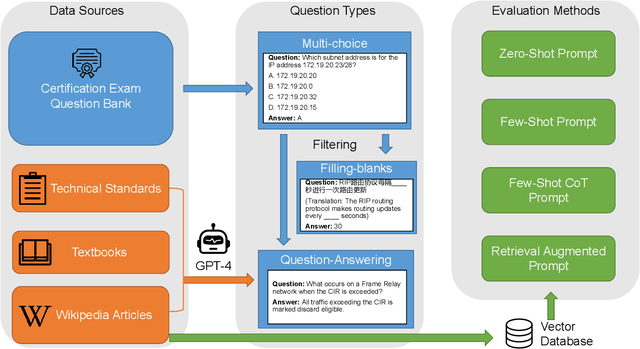
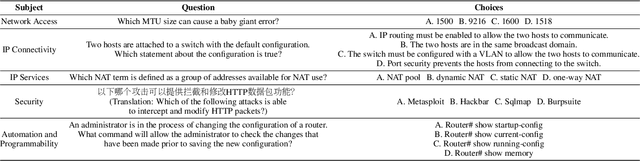
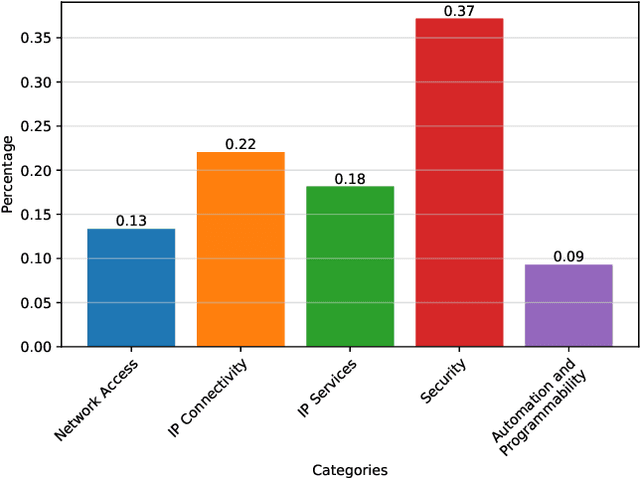
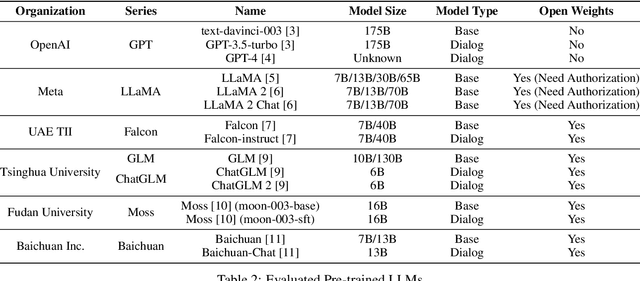
Nowadays, the versatile capabilities of Pre-trained Large Language Models (LLMs) have attracted much attention from the industry. However, some vertical domains are more interested in the in-domain capabilities of LLMs. For the Networks domain, we present NetEval, an evaluation set for measuring the comprehensive capabilities of LLMs in Network Operations (NetOps). NetEval is designed for evaluating the commonsense knowledge and inference ability in NetOps in a multi-lingual context. NetEval consists of 5,732 questions about NetOps, covering five different sub-domains of NetOps. With NetEval, we systematically evaluate the NetOps capability of 26 publicly available LLMs. The results show that only GPT-4 can achieve a performance competitive to humans. However, some open models like LLaMA 2 demonstrate significant potential.