 Add to Chrome
 Add to Firefox
 Add to Edge
One-Eval: An Agentic System for Automated and Traceable LLM Evaluation
Mar 10, 2026
Reliable evaluation is essential for developing and deploying large language models, yet in practice it often requires substantial manual effort: practitioners must identify appropriate benchmarks, reproduce heterogeneous evaluation codebases, configure dataset schema mappings, and interpret aggregated metrics. To address these challenges, we present One-Eval, an agentic evaluation system that converts natural-language evaluation requests into executable, traceable, and customizable evaluation workflows. One-Eval integrates (i) NL2Bench for intent structuring and personalized benchmark planning, (ii) BenchResolve for benchmark resolution, automatic dataset acquisition, and schema normalization to ensure executability, and (iii) Metrics \& Reporting for task-aware metric selection and decision-oriented reporting beyond scalar scores. The system further incorporates human-in-the-loop checkpoints for review, editing, and rollback, while preserving sample evidence trails for debugging and auditability. Experiments show that One-Eval can execute end-to-end evaluations from diverse natural-language requests with minimal user effort, supporting more efficient and reproducible evaluation in industrial settings. Our framework is publicly available at https://github.com/OpenDCAI/One-Eval.

HIAL: A New Paradigm for Hypergraph Active Learning via Influence Maximization
Jul 28, 2025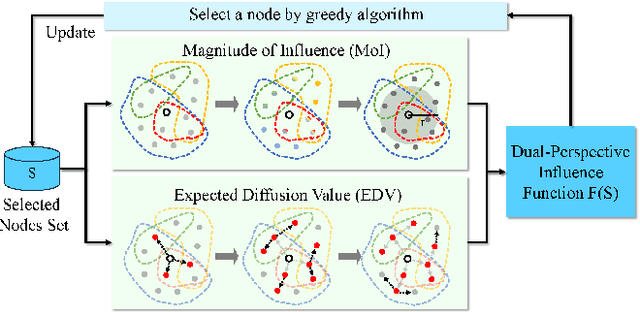
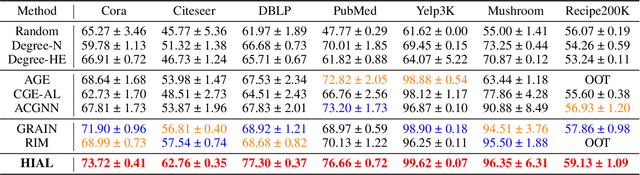
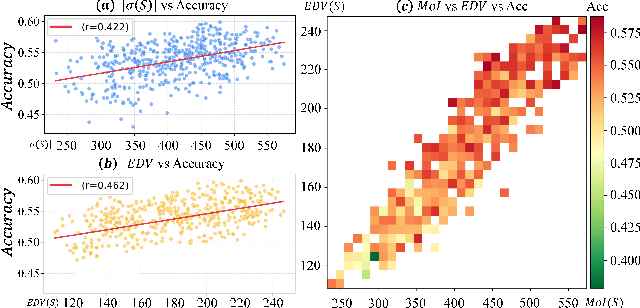

In recent years, Hypergraph Neural Networks (HNNs) have demonstrated immense potential in handling complex systems with high-order interactions. However, acquiring large-scale, high-quality labeled data for these models is costly, making Active Learning (AL) a critical technique. Existing Graph Active Learning (GAL) methods, when applied to hypergraphs, often rely on techniques like "clique expansion," which destroys the high-order structural information crucial to a hypergraph's success, thereby leading to suboptimal performance. To address this challenge, we introduce HIAL (Hypergraph Active Learning), a native active learning framework designed specifically for hypergraphs. We innovatively reformulate the Hypergraph Active Learning (HAL) problem as an Influence Maximization task. The core of HIAL is a dual-perspective influence function that, based on our novel "High-Order Interaction-Aware (HOI-Aware)" propagation mechanism, synergistically evaluates a node's feature-space coverage (via Magnitude of Influence, MoI) and its topological influence (via Expected Diffusion Value, EDV). We prove that this objective function is monotone and submodular, thus enabling the use of an efficient greedy algorithm with a formal (1-1/e) approximation guarantee. Extensive experiments on seven public datasets demonstrate that HIAL significantly outperforms state-of-the-art baselines in terms of performance, efficiency, generality, and robustness, establishing an efficient and powerful new paradigm for active learning on hypergraphs.