 Add to Chrome
 Add to Firefox
 Add to Edge
Knowledge-Geometry Decoupling: Refreshable Pretrained Transfer for Streaming Recommendation
Aug 06, 2026
Industrial recommenders increasingly adopt the pretrain-then-transfer paradigm, yet behavioral distribution drift raises two questions: what to learn from behavior sequences, and how to transfer the learned knowledge while the pretrained model is continually refreshed. To resolve them, we propose Knowledge-Geometry Decoupling (KGD). For what to learn, conventional next-token prediction treats adjacency as dependency and may encode spurious transitions across unrelated sessions. We introduce Behavioral Multi-Token Prediction (BMTP) to retain only collaboratively or semantically related future items as supervision, yielding cleaner and more transferable behavioral knowledge. For how to transfer, pretrained knowledge and task-specific geometry impose conflicting optimization demands on shared parameters. To handle it, KGD assigns them to separate parameter sets: a refreshable encoder owns behavioral knowledge, while a task learner reads contextualized encoder states through read-only cross-attention and writes task-specific geometry through Anchored Calibration Residual (ACR) orthogonal to the pretrained embedding. The decoupled ownership enables continual knowledge refresh without task-gradient interference or invalidating downstream adaptation. KGD improves over strong pretrain-transfer baselines by 4-12% on eight public benchmarks and sustains its advantage over a 90-day production stream where baselines show no gains. KGD has been fully deployed in Shopee. In a live A/B test on Shopee Homepage Search, it increases GMV per user by 1.75% and advertising revenue by 1.53%, demonstrating its high practical value. We provide the core implementation of KGD at https://github.com/FuCongResearchSquad/KGD4REC.

Edge-Aware Curvature Modeling for Graph Understanding in Large Language Models
Jun 04, 2026Recently, graph-aware Large Language Models (LLMs) have shown promising capabilities in jointly modeling graph-structured data and textual information. Existing approaches typically employ a graph encoder and a frozen LLM to obtain node representations from graph and textual views, followed by node-level alignment to bridge the two modalities. However, such alignment mechanisms primarily focus on node information while overlooking edge-level structures, leading to suboptimal information propagation across views. In this work, we conduct a comprehensive theoretical analysis to uncover why node-level alignment is insufficient for aligning textual and graph representations. Specifically, we prove theoretically for the first time that neglecting edge information leads to suboptimal solutions and negatively curved edges induce bottlenecked information flow, giving rise to the over-squashing phenomenon between graph and textual views. To address the two challenges, we innovatively proposed a CureLLM framework of Curvature-enhanced Graph Representations for Large Language Model whose goal is to inject the signals of edge information into the existing LLMs. Specifically, CureLLM first introduces the training-free textual prompt mechanism to make the LLM model generate the output directly based on the edge-aware prompt without learnable parameter costs. Furthermore, a novel curvature-aware graph representation learning is designed to capture the edge structure information to enhance the downstream tasks, where the message passing between text and graph representations only depends on edges with positive curvature. Finally, we conduct evaluations with 20 different compared methods on 11 real world datasets from various domains and the experiment results demonstrate the superiority of our proposed CureLLM framework.
SWE-AGILE: A Software Agent Framework for Efficiently Managing Dynamic Reasoning Context
Apr 13, 2026Prior representative ReAct-style approaches in autonomous Software Engineering (SWE) typically lack the explicit System-2 reasoning required for deep analysis and handling complex edge cases. While recent reasoning models demonstrate the potential of extended Chain-of-Thought (CoT), applying them to the multi-turn SWE task creates a fundamental dilemma: retaining full reasoning history leads to context explosion and ``Lost-in-the-Middle'' degradation, while discarding it would force the agent to redundantly re-reason at every step. To address these challenges, we propose SWE-AGILE, a novel software agent framework designed to bridge the gap between reasoning depth, efficiency, and context constraints. SWE-AGILE introduces a Dynamic Reasoning Context strategy, maintaining a ``sliding window'' of detailed reasoning for immediate continuity to prevent redundant re-analyzing, while compressing historical reasoning content into concise Reasoning Digests. Empirically, SWE-AGILE sets a new standard for 7B-8B models on SWE-Bench-Verified using only 2.2k trajectories and 896 tasks. Code is available at https://github.com/KDEGroup/SWE-AGILE.
Multi-View Incremental Learning with Structured Hebbian Plasticity for Enhanced Fusion Efficiency
Dec 17, 2024
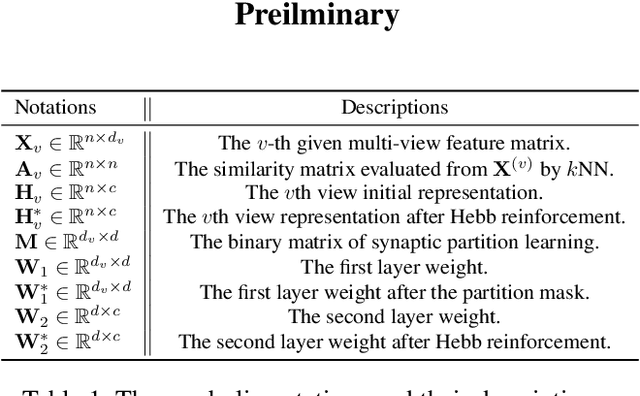


The rapid evolution of multimedia technology has revolutionized human perception, paving the way for multi-view learning. However, traditional multi-view learning approaches are tailored for scenarios with fixed data views, falling short of emulating the intricate cognitive procedures of the human brain processing signals sequentially. Our cerebral architecture seamlessly integrates sequential data through intricate feed-forward and feedback mechanisms. In stark contrast, traditional methods struggle to generalize effectively when confronted with data spanning diverse domains, highlighting the need for innovative strategies that can mimic the brain's adaptability and dynamic integration capabilities. In this paper, we propose a bio-neurologically inspired multi-view incremental framework named MVIL aimed at emulating the brain's fine-grained fusion of sequentially arriving views. MVIL lies two fundamental modules: structured Hebbian plasticity and synaptic partition learning. The structured Hebbian plasticity reshapes the structure of weights to express the high correlation between view representations, facilitating a fine-grained fusion of view representations. Moreover, synaptic partition learning is efficient in alleviating drastic changes in weights and also retaining old knowledge by inhibiting partial synapses. These modules bionically play a central role in reinforcing crucial associations between newly acquired information and existing knowledge repositories, thereby enhancing the network's capacity for generalization. Experimental results on six benchmark datasets show MVIL's effectiveness over state-of-the-art methods.
SCP: Scene Completion Pre-training for 3D Object Detection
Sep 12, 20233D object detection using LiDAR point clouds is a fundamental task in the fields of computer vision, robotics, and autonomous driving. However, existing 3D detectors heavily rely on annotated datasets, which are both time-consuming and prone to errors during the process of labeling 3D bounding boxes. In this paper, we propose a Scene Completion Pre-training (SCP) method to enhance the performance of 3D object detectors with less labeled data. SCP offers three key advantages: (1) Improved initialization of the point cloud model. By completing the scene point clouds, SCP effectively captures the spatial and semantic relationships among objects within urban environments. (2) Elimination of the need for additional datasets. SCP serves as a valuable auxiliary network that does not impose any additional efforts or data requirements on the 3D detectors. (3) Reduction of the amount of labeled data for detection. With the help of SCP, the existing state-of-the-art 3D detectors can achieve comparable performance while only relying on 20% labeled data.
Beyond Graph Convolutional Network: An Interpretable Regularizer-centered Optimization Framework
Jan 11, 2023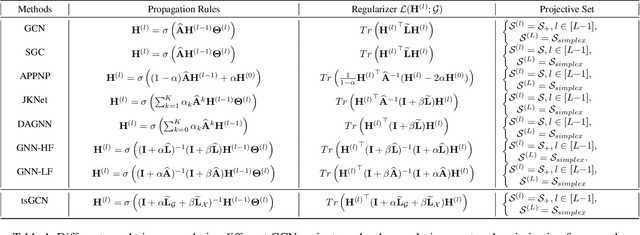
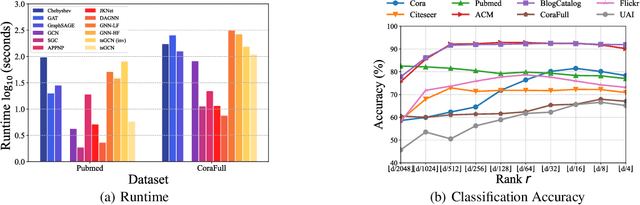
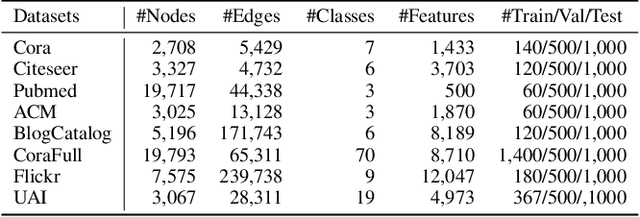
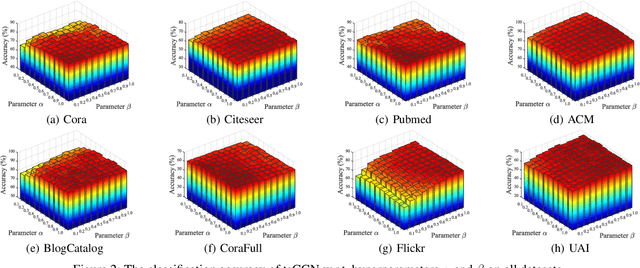
Graph convolutional networks (GCNs) have been attracting widespread attentions due to their encouraging performance and powerful generalizations. However, few work provide a general view to interpret various GCNs and guide GCNs' designs. In this paper, by revisiting the original GCN, we induce an interpretable regularizer-centerd optimization framework, in which by building appropriate regularizers we can interpret most GCNs, such as APPNP, JKNet, DAGNN, and GNN-LF/HF. Further, under the proposed framework, we devise a dual-regularizer graph convolutional network (dubbed tsGCN) to capture topological and semantic structures from graph data. Since the derived learning rule for tsGCN contains an inverse of a large matrix and thus is time-consuming, we leverage the Woodbury matrix identity and low-rank approximation tricks to successfully decrease the high computational complexity of computing infinite-order graph convolutions. Extensive experiments on eight public datasets demonstrate that tsGCN achieves superior performance against quite a few state-of-the-art competitors w.r.t. classification tasks.