 Add to Chrome
 Add to Firefox
 Add to Edge
Evaluating Investment Logic in Large Language Models: A Real-World Benchmark Towards Personalzied Financial Agents
Aug 06, 2026
Investment competence is inherently personalized: the same market evidence can justify different actions for investors with different goals, horizons, portfolios, and risk boundaries. Yet financial LLMs are evaluated either by static question answering or by terminal profit and loss. The former omits agency; the latter cannot reveal whether a profitable action was grounded, profile-consistent, or merely lucky. We ask whether the community is using the wrong ruler for consequential agents. We introduce \textsc{InvestLogicBench}, a process-native benchmark containing 201,247 documented decisions from 151 real-world investors. Each episode instantiates a \textbf{P$\rightarrow$E$\rightarrow$R$\rightarrow$D$\rightarrow$O} trace: investor \textit{Profile}, observable market \textit{Events}, investment \textit{Reasoning}, executable \textit{Decision}, and delayed \textit{Outcome}. The release includes profile construction, point-in-time event binding, structured logic, horizons, outcomes, and post-mortems, and supports comprehension, profile-conditioned generation, and end-to-end replay. Across four leading LLMs, logical plausibility remains near 4/5 while event grounding is only 0.8--2.8/5; return and process quality also disagree. These results expose polished but weakly grounded reasoning that outcome-only evaluation hides. We further argue that P$\rightarrow$E$\rightarrow$R$\rightarrow$D$\rightarrow$O should be a data-system interface, requiring versioned profiles, temporal provenance, inspectable retrieval, decision ledgers, and replayable outcomes. Finance is our stress test for a broader class of personalized, consequential agents.

Edge-Aware Curvature Modeling for Graph Understanding in Large Language Models
Jun 04, 2026Recently, graph-aware Large Language Models (LLMs) have shown promising capabilities in jointly modeling graph-structured data and textual information. Existing approaches typically employ a graph encoder and a frozen LLM to obtain node representations from graph and textual views, followed by node-level alignment to bridge the two modalities. However, such alignment mechanisms primarily focus on node information while overlooking edge-level structures, leading to suboptimal information propagation across views. In this work, we conduct a comprehensive theoretical analysis to uncover why node-level alignment is insufficient for aligning textual and graph representations. Specifically, we prove theoretically for the first time that neglecting edge information leads to suboptimal solutions and negatively curved edges induce bottlenecked information flow, giving rise to the over-squashing phenomenon between graph and textual views. To address the two challenges, we innovatively proposed a CureLLM framework of Curvature-enhanced Graph Representations for Large Language Model whose goal is to inject the signals of edge information into the existing LLMs. Specifically, CureLLM first introduces the training-free textual prompt mechanism to make the LLM model generate the output directly based on the edge-aware prompt without learnable parameter costs. Furthermore, a novel curvature-aware graph representation learning is designed to capture the edge structure information to enhance the downstream tasks, where the message passing between text and graph representations only depends on edges with positive curvature. Finally, we conduct evaluations with 20 different compared methods on 11 real world datasets from various domains and the experiment results demonstrate the superiority of our proposed CureLLM framework.
BenchBench: Benchmarking Automated Benchmark Generation
Mar 21, 2026Benchmarks are the de facto standard for tracking progress in large language models (LLMs), yet static test sets can rapidly saturate, become vulnerable to contamination, and are costly to refresh. Scalable evaluation of open-ended items often relies on LLM judges, introducing additional sources of bias and prompt sensitivity. We argue that evaluation must extend beyond how well models answer benchmarks to how well models design them. We introduce BenchBench, a three-stage pipeline and dataset for benchmarking automated benchmark generation: (i) extract structured domain cards from seed benchmarks, (ii) prompt multiple designer LLMs to generate quota-controlled suites, and (iii) validate items with a multi-model answerer panel using exact/numeric/symbolic verifiers when possible and rubric-guided judging otherwise, yielding designer--answerer matrices with item-level quality flags and psychometric diagnostics. Across nine variants spanning computer science, mathematics, medicine, and theory-of-mind reasoning (including multilingual and multimodal settings), we generate 16.7K items, retain ~15K core items post-filtering, and produce ~152K graded model--item responses. BenchBench shows that benchmark-design ability is only moderately correlated with answer-time strength (Spearman rho ~0.37), invalidity is negatively associated with discrimination (Pearson r~0.62), and the resulting designer--answerer matrices enable scalable audits of format/modality/language fidelity and suite-dependent self/family interactions. The project is available at: https://github.com/koanatakiyo/BenchBench.
QIME: Constructing Interpretable Medical Text Embeddings via Ontology-Grounded Questions
Mar 03, 2026While dense biomedical embeddings achieve strong performance, their black-box nature limits their utility in clinical decision-making. Recent question-based interpretable embeddings represent text as binary answers to natural-language questions, but these approaches often rely on heuristic or surface-level contrastive signals and overlook specialized domain knowledge. We propose QIME, an ontology-grounded framework for constructing interpretable medical text embeddings in which each dimension corresponds to a clinically meaningful yes/no question. By conditioning on cluster-specific medical concept signatures, QIME generates semantically atomic questions that capture fine-grained distinctions in biomedical text. Furthermore, QIME supports a training-free embedding construction strategy that eliminates per-question classifier training while further improving performance. Experiments across biomedical semantic similarity, clustering, and retrieval benchmarks show that QIME consistently outperforms prior interpretable embedding methods and substantially narrows the gap to strong black-box biomedical encoders, while providing concise and clinically informative explanations.
OrchMAS: Orchestrated Reasoning with Multi Collaborative Heterogeneous Scientific Expert Structured Agents
Mar 03, 2026Multi-agent large language model frameworks are promising for complex multi step reasoning, yet existing systems remain weak for scientific and knowledge intensive domains due to static prompts and agent roles, rigid workflows, and homogeneous model reliance, leading to poor domain adaptation, limited reasoning flexibility, and high latency on heterogeneous or long-horizon scientific tasks. They also struggle to revise earlier decisions when intermediate reasoning diverges, reducing reliability in structured and calculation heavy settings. To address these limitations, we propose a scientific domain oriented interactive two tier multi model orchestration framework. A dedicated orchestration model analyzes each task, dynamically constructs a domain aware reasoning pipeline, and instantiates specialized expert agents with tailored prompts, while an execution model performs each step under generated role and instruction specifications. The orchestrator iteratively updates the pipeline based on intermediate feedback, enabling dynamic replanning, role reallocation, and prompt refinement across multi turn interactions, strengthening robustness and specialization for scientific reasoning through structured heterogeneous model collaboration. The framework is model agnostic and supports heterogeneous LLM integration with different capacities or costs, enabling flexible performance efficiency trade offs in practical scientific deployments. Experiments show consistent improvements over existing multi agent systems and strong baselines across diverse reasoning and scientific style benchmarks.
Rethinking Scientific Modeling: Toward Physically Consistent and Simulation-Executable Programmatic Generation
Feb 06, 2026Structural modeling is a fundamental component of computational engineering science, in which even minor physical inconsistencies or specification violations may invalidate downstream simulations. The potential of large language models (LLMs) for automatic generation of modeling code has been demonstrated. However, non-executable or physically inconsistent outputs remain prevalent under stringent engineering constraints. A framework for physics-consistent automatic building modeling is therefore proposed, integrating domain knowledge construction, constraint-oriented model alignment, and verification-driven evaluation. CivilInstruct is introduced as a domain-specific dataset that formalizes structural engineering knowledge and constraint reasoning to enable simulation-ready model generation. A two-stage fine-tuning strategy is further employed to enforce constraint satisfaction and application programming interface compliance, substantially reducing hallucinated and non-conforming outputs. MBEval is presented as a verification-driven benchmark that evaluates executability and structural dynamics consistency through closed-loop validation. Experimental results show consistent improvements over baselines across rigorous verification metrics. Our code is available at https://github.com/Jovanqing/AutoBM.
AGNN: Alternating Graph-Regularized Neural Networks to Alleviate Over-Smoothing
Apr 14, 2023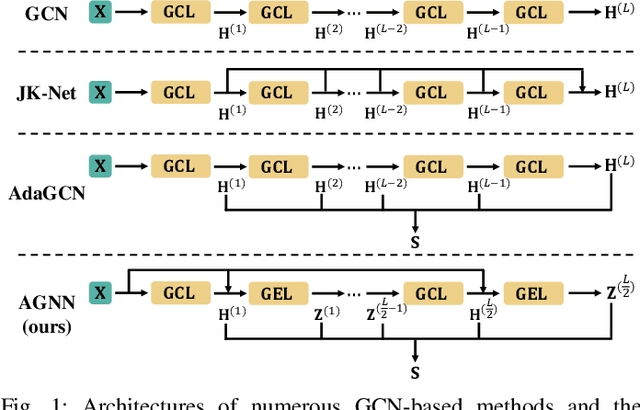
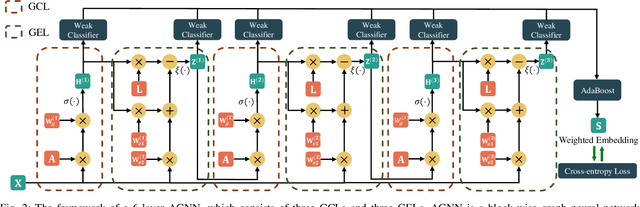
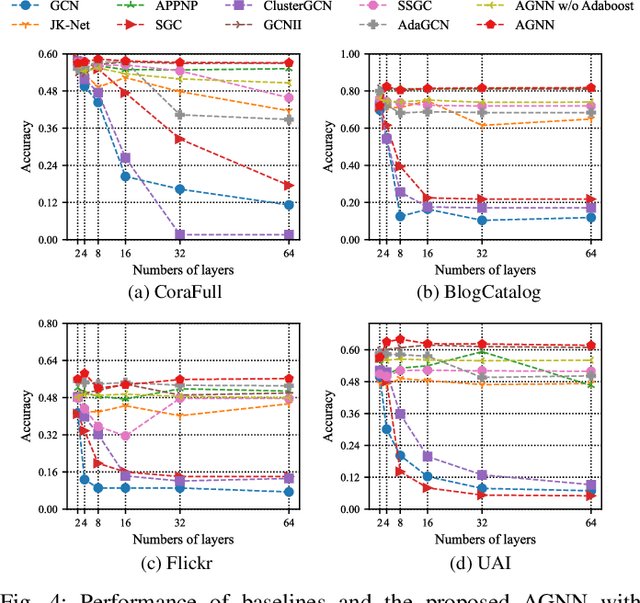
Graph Convolutional Network (GCN) with the powerful capacity to explore graph-structural data has gained noticeable success in recent years. Nonetheless, most of the existing GCN-based models suffer from the notorious over-smoothing issue, owing to which shallow networks are extensively adopted. This may be problematic for complex graph datasets because a deeper GCN should be beneficial to propagating information across remote neighbors. Recent works have devoted effort to addressing over-smoothing problems, including establishing residual connection structure or fusing predictions from multi-layer models. Because of the indistinguishable embeddings from deep layers, it is reasonable to generate more reliable predictions before conducting the combination of outputs from various layers. In light of this, we propose an Alternating Graph-regularized Neural Network (AGNN) composed of Graph Convolutional Layer (GCL) and Graph Embedding Layer (GEL). GEL is derived from the graph-regularized optimization containing Laplacian embedding term, which can alleviate the over-smoothing problem by periodic projection from the low-order feature space onto the high-order space. With more distinguishable features of distinct layers, an improved Adaboost strategy is utilized to aggregate outputs from each layer, which explores integrated embeddings of multi-hop neighbors. The proposed model is evaluated via a large number of experiments including performance comparison with some multi-layer or multi-order graph neural networks, which reveals the superior performance improvement of AGNN compared with state-of-the-art models.