 Add to Chrome
 Add to Firefox
 Add to Edge
SkyReels-V4: Multi-modal Video-Audio Generation, Inpainting and Editing model
Feb 26, 2026
SkyReels V4 is a unified multi modal video foundation model for joint video audio generation, inpainting, and editing. The model adopts a dual stream Multimodal Diffusion Transformer (MMDiT) architecture, where one branch synthesizes video and the other generates temporally aligned audio, while sharing a powerful text encoder based on the Multimodal Large Language Models (MMLM). SkyReels V4 accepts rich multi modal instructions, including text, images, video clips, masks, and audio references. By combining the MMLMs multi modal instruction following capability with in context learning in the video branch MMDiT, the model can inject fine grained visual guidance under complex conditioning, while the audio branch MMDiT simultaneously leverages audio references to guide sound generation. On the video side, we adopt a channel concatenation formulation that unifies a wide range of inpainting style tasks, such as image to video, video extension, and video editing under a single interface, and naturally extends to vision referenced inpainting and editing via multi modal prompts. SkyReels V4 supports up to 1080p resolution, 32 FPS, and 15 second duration, enabling high fidelity, multi shot, cinema level video generation with synchronized audio. To make such high resolution, long-duration generation computationally feasible, we introduce an efficiency strategy: Joint generation of low resolution full sequences and high-resolution keyframes, followed by dedicated super-resolution and frame interpolation models. To our knowledge, SkyReels V4 is the first video foundation model that simultaneously supports multi-modal input, joint video audio generation, and a unified treatment of generation, inpainting, and editing, while maintaining strong efficiency and quality at cinematic resolutions and durations.

Baichuan4-Finance Technical Report
Dec 17, 2024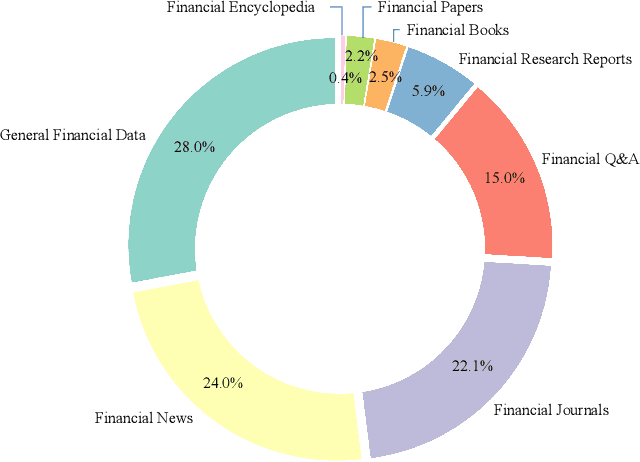
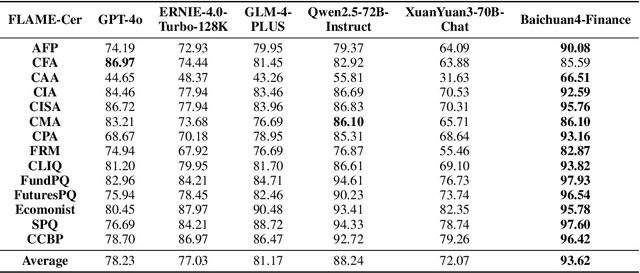
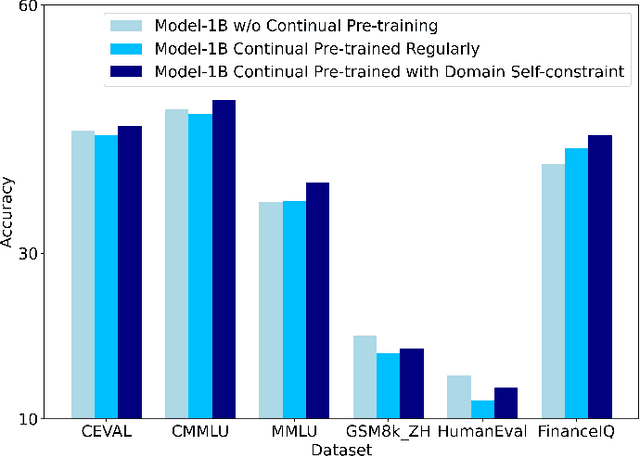
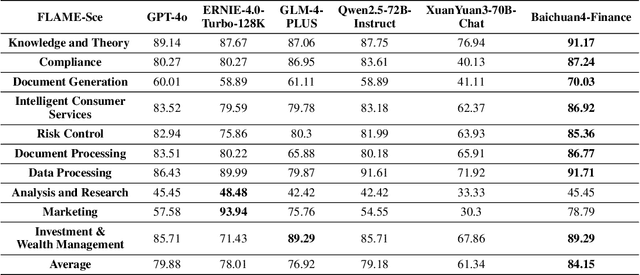
Large language models (LLMs) have demonstrated strong capabilities in language understanding, generation, and reasoning, yet their potential in finance remains underexplored due to the complexity and specialization of financial knowledge. In this work, we report the development of the Baichuan4-Finance series, including a comprehensive suite of foundational Baichuan4-Finance-Base and an aligned language model Baichuan4-Finance, which are built upon Baichuan4-Turbo base model and tailored for finance domain. Firstly, we have dedicated significant effort to building a detailed pipeline for improving data quality. Moreover, in the continual pre-training phase, we propose a novel domain self-constraint training strategy, which enables Baichuan4-Finance-Base to acquire financial knowledge without losing general capabilities. After Supervised Fine-tuning and Reinforcement Learning from Human Feedback and AI Feedback, the chat model Baichuan4-Finance is able to tackle various financial certification questions and real-world scenario applications. We evaluate Baichuan4-Finance on many widely used general datasets and two holistic financial benchmarks. The evaluation results show that Baichuan4-Finance-Base surpasses almost all competitive baselines on financial tasks by significant margins without sacrificing performance on general LLM benchmarks. At the same time, Baichuan4-Finance demonstrates even more impressive performance on financial application scenarios, showcasing its potential to foster community innovation in the financial LLM field.
Dynamic data sampler for cross-language transfer learning in large language models
May 17, 2024Large Language Models (LLMs) have gained significant attention in the field of natural language processing (NLP) due to their wide range of applications. However, training LLMs for languages other than English poses significant challenges, due to the difficulty in acquiring large-scale corpus and the requisite computing resources. In this paper, we propose ChatFlow, a cross-language transfer-based LLM, to address these challenges and train large Chinese language models in a cost-effective manner. We employ a mix of Chinese, English, and parallel corpus to continuously train the LLaMA2 model, aiming to align cross-language representations and facilitate the knowledge transfer specifically to the Chinese language model. In addition, we use a dynamic data sampler to progressively transition the model from unsupervised pre-training to supervised fine-tuning. Experimental results demonstrate that our approach accelerates model convergence and achieves superior performance. We evaluate ChatFlow on popular Chinese and English benchmarks, the results indicate that it outperforms other Chinese models post-trained on LLaMA-2-7B.