 Add to Chrome
 Add to Firefox
 Add to Edge
VAIC: Vision-Guided Humanoid Agile Object Interaction Control via Decoupled Commands
Jun 08, 2026
Humanoid robots hold immense potential for real-world assistance, yet agile interaction with objects in unstructured environments demands tightly coupled whole-body coordination. Despite recent advancements, current controllers face a critical deployment gap. They rely heavily on dense reference trajectories and perfect state observability, which inherently limits physical generalization. We present Vision Guided Agile Interaction Control (VAIC), a unified framework that bridges this gap by operating exclusively on onboard depth, historical proprioception, and a decoupled user command interface. VAIC employs a two-stage distillation paradigm. First, a privileged teacher policy masters diverse interaction skills using precise object kinematics and exact environmental states. Second, a deployable student policy distills these capabilities by replacing full body tracking with velocity targets across multiple axes and an interaction indicator for each frame. The student utilizes a recurrent object adaptation module to implicitly infer unobservable object dynamics from raw depth streams and proprioception. Evaluations and real-world deployments on the humanoid robot demonstrate that a single VAIC policy successfully executes highly diverse dynamic tasks. These tasks include box carrying, cart interaction, and skateboarding, consistently outperforming baselines and advancing autonomous humanoid deployment.

VEOcc: Voxel-Centric Online Semantic Occupancy Prediction For Embodied Scene Understanding
May 28, 2026Crucial for autonomous exploration, online 3D occupancy prediction and mapping incrementally constructs dense spatial representations on the fly. However, recent Gaussian-centric methods struggle with structural boundary fidelity and rely heavily on predefined scene-size priors, fundamentally limiting their operational efficiency. In this work, we present VEOcc, a voxel-centric framework formulated as a recursive perception-and-assimilation paradigm. By eliminating the need for initial scale estimation, VEOcc enables highly streamlined, open-ended map expansion. Furthermore, to robustly aggregate noisy temporal observations within the discrete voxel space, we propose a Spatio-Temporal-Aware Online Update Strategy. It integrates Cross-Temporal Logit Aggregation (TLA) for temporal consistency, Reliability-Aware Confidence Modulation (RCM) for spatial uncertainty calibration, and Confidence-Driven Incremental State Update (CSU) for robust global state assimilation. % Extensive experiments on Occ-ScanNet and EmbodiedOcc-ScanNet demonstrate that VEOcc establishes new state-of-the-art performance in both local and embodied settings, providing an accurate and efficient solution for real-world exploration. Extensive experiments on Occ-ScanNet and EmbodiedOcc-ScanNet demonstrate that VEOcc establishes new state-of-the-art performance in both local and embodied settings. Notably, zero-shot evaluations on self-collected video sequences further confirm its robust out-of-distribution generalization capability in completely unseen real-world environments. Ultimately, our framework provides an accurate and highly efficient solution for autonomous exploration. Code and supplementary visualizations are available on our project page: https://wryzju.github.io/VEOcc/.
Pro-HOI: Perceptive Root-guided Humanoid-Object Interaction
Mar 01, 2026Executing reliable Humanoid-Object Interaction (HOI) tasks for humanoid robots is hindered by the lack of generalized control interfaces and robust closed-loop perception mechanisms. In this work, we introduce Perceptive Root-guided Humanoid-Object Interaction, Pro-HOI, a generalizable framework for robust humanoid loco-manipulation. First, we collect box-carrying motions that are suitable for real-world deployment and optimize penetration artifacts through a Signed Distance Field loss. Second, we propose a novel training framework that conditions the policy on a desired root-trajectory while utilizing reference motion exclusively as a reward. This design not only eliminates the need for intricate reward tuning but also establishes root trajectory as a universal interface for high-level planners, enabling simultaneous navigation and loco-manipulation. Furthermore, to ensure operational reliability, we incorporate a persistent object estimation module. By fusing real-time detection with Digital Twin, this module allows the robot to autonomously detect slippage and trigger re-grasping maneuvers. Empirical validation on a Unitree G1 robot demonstrates that Pro-HOI significantly outperforms baselines in generalization and robustness, achieving reliable long-horizon execution in complex real-world scenarios.
Learning Soccer Skills for Humanoid Robots: A Progressive Perception-Action Framework
Feb 05, 2026Soccer presents a significant challenge for humanoid robots, demanding tightly integrated perception-action capabilities for tasks like perception-guided kicking and whole-body balance control. Existing approaches suffer from inter-module instability in modular pipelines or conflicting training objectives in end-to-end frameworks. We propose Perception-Action integrated Decision-making (PAiD), a progressive architecture that decomposes soccer skill acquisition into three stages: motion-skill acquisition via human motion tracking, lightweight perception-action integration for positional generalization, and physics-aware sim-to-real transfer. This staged decomposition establishes stable foundational skills, avoids reward conflicts during perception integration, and minimizes sim-to-real gaps. Experiments on the Unitree G1 demonstrate high-fidelity human-like kicking with robust performance under diverse conditions-including static or rolling balls, various positions, and disturbances-while maintaining consistent execution across indoor and outdoor scenarios. Our divide-and-conquer strategy advances robust humanoid soccer capabilities and offers a scalable framework for complex embodied skill acquisition. The project page is available at https://soccer-humanoid.github.io/.
Interpreting Multi-objective Evolutionary Algorithms via Sokoban Level Generation
Jun 15, 2024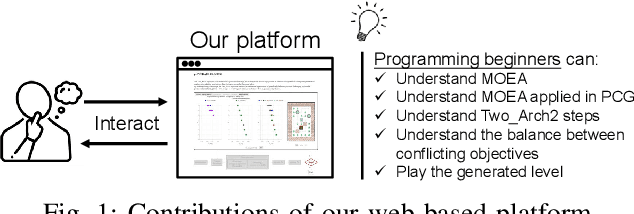
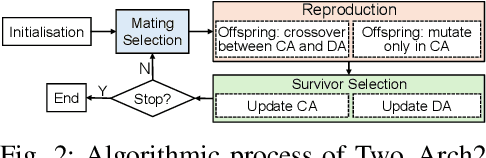
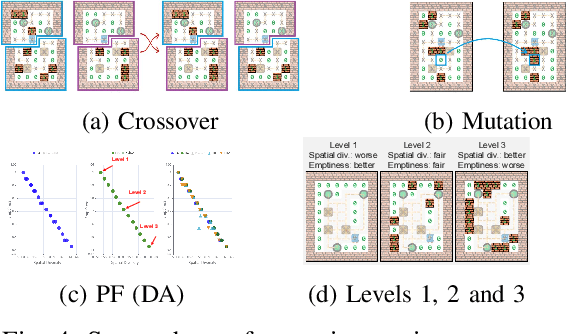
This paper presents an interactive platform to interpret multi-objective evolutionary algorithms. Sokoban level generation is selected as a showcase for its widespread use in procedural content generation. By balancing the emptiness and spatial diversity of Sokoban levels, we illustrate the improved two-archive algorithm, Two_Arch2, a well-known multi-objective evolutionary algorithm. Our web-based platform integrates Two_Arch2 into an interface that visually and interactively demonstrates the evolutionary process in real-time. Designed to bridge theoretical optimisation strategies with practical game generation applications, the interface is also accessible to both researchers and beginners to multi-objective evolutionary algorithms or procedural content generation on a website. Through dynamic visualisations and interactive gameplay demonstrations, this web-based platform also has potential as an educational tool.
A reproducible pipeline for extracting representative signals from wire cuts
May 17, 2024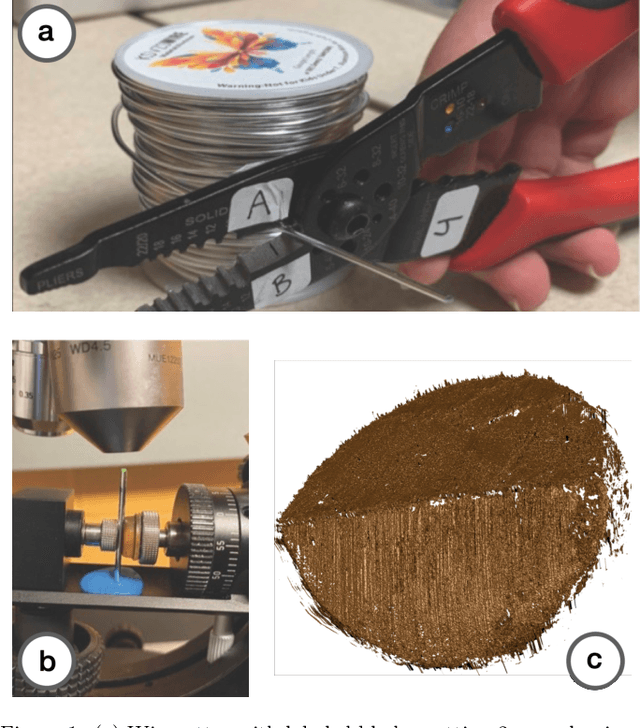

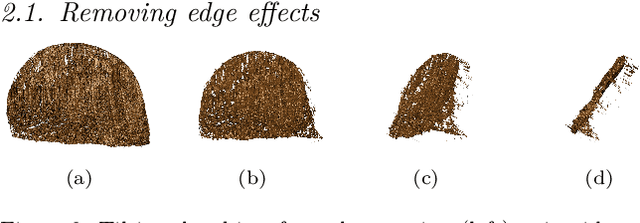
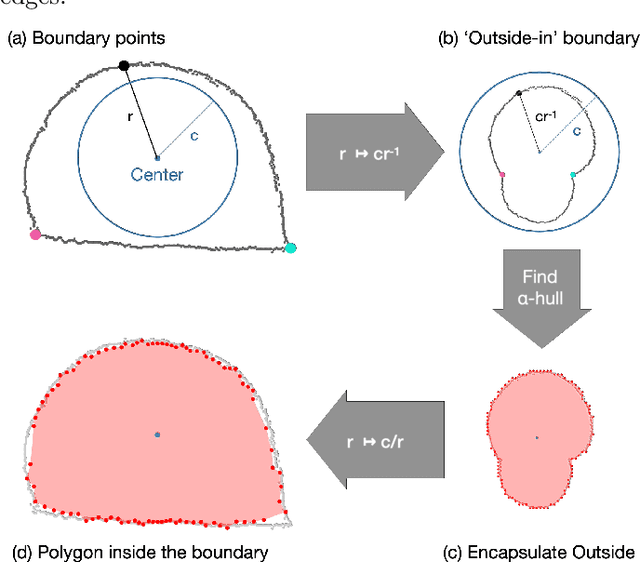
We propose a reproducible pipeline for extracting representative signals from 2D topographic scans of the tips of cut wires. The process fully addresses many potential problems in the quality of wire cuts, including edge effects, extreme values, trends, missing values, angles, and warping. The resulting signals can be further used in source determination, which plays an important role in forensic examinations. With commonly used measurements such as the cross-correlation function, the procedure controls the false positive rate and false negative rate to the desirable values as the manual extraction pipeline but outperforms it with robustness and objectiveness.