 Add to Chrome
 Add to Firefox
 Add to Edge
Dehaze-then-Splat: Generative Dehazing with Physics-Informed 3D Gaussian Splatting for Smoke-Free Novel View Synthesis
Apr 15, 2026
We present Dehaze-then-Splat, a two-stage pipeline for multi-view smoke removal and novel view synthesis developed for Track~2 of the NTIRE 2026 3D Restoration and Reconstruction Challenge. In the first stage, we produce pseudo-clean training images via per-frame generative dehazing using Nano Banana Pro, followed by brightness normalization. In the second stage, we train 3D Gaussian Splatting (3DGS) with physics-informed auxiliary losses -- depth supervision via Pearson correlation with pseudo-depth, dark channel prior regularization, and dual-source gradient matching -- that compensate for cross-view inconsistencies inherent in frame-wise generative processing. We identify a fundamental tension in dehaze-then-reconstruct pipelines: per-image restoration quality does not guarantee multi-view consistency, and such inconsistency manifests as blurred renders and structural instability in downstream 3D reconstruction.Our analysis shows that MCMC-based densification with early stopping, combined with depth and haze-suppression priors, effectively mitigates these artifacts. On the Akikaze validation scene, our pipeline achieves 20.98\,dB PSNR and 0.683 SSIM for novel view synthesis, a +1.50\,dB improvement over the unregularized baseline.

NTIRE 2026 3D Restoration and Reconstruction in Real-world Adverse Conditions: RealX3D Challenge Results
Apr 05, 2026This paper presents a comprehensive review of the NTIRE 2026 3D Restoration and Reconstruction (3DRR) Challenge, detailing the proposed methods and results. The challenge seeks to identify robust reconstruction pipelines that are robust under real-world adverse conditions, specifically extreme low-light and smoke-degraded environments, as captured by our RealX3D benchmark. A total of 279 participants registered for the competition, of whom 33 teams submitted valid results. We thoroughly evaluate the submitted approaches against state-of-the-art baselines, revealing significant progress in 3D reconstruction under adverse conditions. Our analysis highlights shared design principles among top-performing methods and provides insights into effective strategies for handling 3D scene degradation.
PA-CLIP: Enhancing Zero-Shot Anomaly Detection through Pseudo-Anomaly Awareness
Mar 03, 2025In industrial anomaly detection (IAD), accurately identifying defects amidst diverse anomalies and under varying imaging conditions remains a significant challenge. Traditional approaches often struggle with high false-positive rates, frequently misclassifying normal shadows and surface deformations as defects, an issue that becomes particularly pronounced in products with complex and intricate surface features. To address these challenges, we introduce PA-CLIP, a zero-shot anomaly detection method that reduces background noise and enhances defect detection through a pseudo-anomaly-based framework. The proposed method integrates a multiscale feature aggregation strategy for capturing detailed global and local information, two memory banks for distinguishing background information, including normal patterns and pseudo-anomalies, from true anomaly features, and a decision-making module designed to minimize false positives caused by environmental variations while maintaining high defect sensitivity. Demonstrated on the MVTec AD and VisA datasets, PA-CLIP outperforms existing zero-shot methods, providing a robust solution for industrial defect detection.
MoE Jetpack: From Dense Checkpoints to Adaptive Mixture of Experts for Vision Tasks
Jun 07, 2024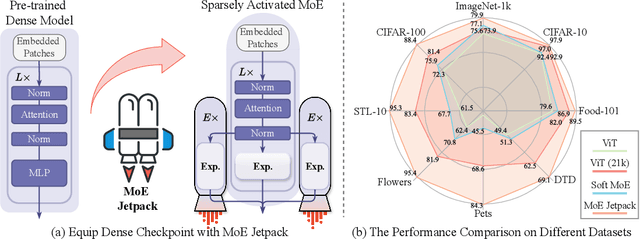
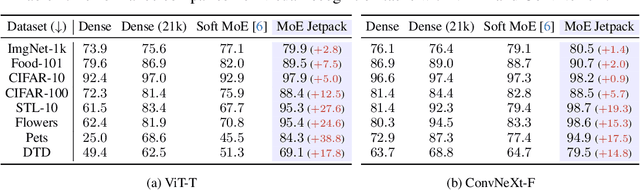
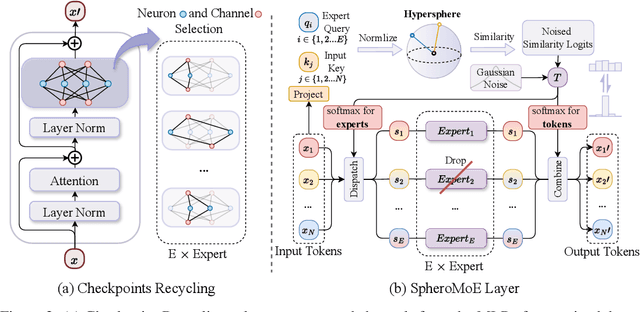

The sparsely activated mixture of experts (MoE) model presents a promising alternative to traditional densely activated (dense) models, enhancing both quality and computational efficiency. However, training MoE models from scratch demands extensive data and computational resources. Moreover, public repositories like timm mainly provide pre-trained dense checkpoints, lacking similar resources for MoE models, hindering their adoption. To bridge this gap, we introduce MoE Jetpack, an effective method for fine-tuning dense checkpoints into MoE models. MoE Jetpack incorporates two key techniques: (1) checkpoint recycling, which repurposes dense checkpoints as initial weights for MoE models, thereby accelerating convergence, enhancing accuracy, and alleviating the computational burden of pre-training; (2) hyperspherical adaptive MoE (SpheroMoE) layer, which optimizes the MoE architecture for better integration of dense checkpoints, enhancing fine-tuning performance. Our experiments on vision tasks demonstrate that MoE Jetpack significantly improves convergence speed and accuracy when fine-tuning dense checkpoints into MoE models. Our code will be publicly available at https://github.com/Adlith/MoE-Jetpack.