 Add to Chrome
 Add to Firefox
 Add to Edge
Toward a mechanistic understanding of inference in visual cortex and diffusion models
Jul 17, 2026
We describe a model of perceptual inference in primary visual cortex (V1) equivalent to a minimal diffusion model whose function can be readily understood from its parameters. The model is based on sparse coding with a non-factorial prior over latent variables in the form of an unconstrained, pairwise interaction matrix, extending standard sparse coding inference to a general recurrent dynamical system. We efficiently train these recurrent dynamics using a denoising score-matching objective and implicit differentiation. After training on natural images, the learned interaction matrix mirrors the structure of horizontal connections in superficial layers of V1 that link neurons of similar orientation tuning. This model exhibits exceptionally good denoising performance, restoring image features such as extended contours amid extreme visual ambiguity, nearly matching the behavior of standard, black-box diffusion architectures in generalization regime. Owing to the model's simplicity, the network's Jacobian can be decomposed directly in terms of the interaction matrix between latent variables, revealing mechanistically how the recurrent dynamics assign high probability over a continuous family of natural structural deformations. Intriguingly, within this circuit, a large fraction of latent variables learn to disconnect from visual input altogether, essentially forming a hierarchical representation that appears to enforce global consistency among image features. Together, the model and results bridge two distinct domains: for neuroscience, it generates concrete, testable hypotheses regarding functional connectivity in recurrent neural circuits during perceptual inference tasks; for machine learning, it elucidates the internal mechanisms learned by diffusion models that allow them to generate infinitely many novel images from a finite training set.

When Does Continual Learning Require Learning
Jul 08, 2026As large language models (LLMs) become increasingly capable, the next question is how can we enable models to continually learn? Today, the field largely frames this as a problem of context management and mitigating forgetting. We argue this framing is incomplete: continual learning is fundamentally about increasing model competence as the world changes. We disentangle this change along two axes -- space, where the model encounters new domains, and time, where the underlying data drifts under a fixed task. This framing lets us study continual learning under realistic conditions: new domains arrive over time, facts drift past their training cutoff, and agentic interactions accumulate state across episodes. To evaluate methods under this setting, we recast widely used LLM benchmarks as sequential problems and introduce a single mechanism-agnostic protocol that compares prompt-based methods (GEPA, ACE), supervised learning (SFT, SDFT), reinforcement learning (GRPO, SDPO), and context compression (Cartridges, In-place TTT). Prompt-based methods fit each new stage quickly but degrade on future tasks. Distillation-based methods accumulate knowledge stably but struggle to update outdated facts. Context compression improves efficiency without substantially improving the ability to learn new tasks. Online reinforcement learning adapts most effectively to knowledge updates but remains sensitive to noisy reward signals. Overall, our results suggest that continual learning is not a single capability: different patterns of environmental change require fundamentally different update behaviors, determining when adaptation must be learned inside model weights and when it can be achieved through external scaffolding. We hope that understanding where each method succeeds and fails will guide the design of stronger continual learning systems.
URLOST: Unsupervised Representation Learning without Stationarity or Topology
Oct 06, 2023Unsupervised representation learning has seen tremendous progress but is constrained by its reliance on data modality-specific stationarity and topology, a limitation not found in biological intelligence systems. For instance, human vision processes visual signals derived from irregular and non-stationary sampling lattices yet accurately perceives the geometry of the world. We introduce a novel framework that learns from high-dimensional data lacking stationarity and topology. Our model combines a learnable self-organizing layer, density adjusted spectral clustering, and masked autoencoders. We evaluate its effectiveness on simulated biological vision data, neural recordings from the primary visual cortex, and gene expression datasets. Compared to state-of-the-art unsupervised learning methods like SimCLR and MAE, our model excels at learning meaningful representations across diverse modalities without depending on stationarity or topology. It also outperforms other methods not dependent on these factors, setting a new benchmark in the field. This work represents a step toward unsupervised learning methods that can generalize across diverse high-dimensional data modalities.
Minimalistic Unsupervised Learning with the Sparse Manifold Transform
Sep 30, 2022



We describe a minimalistic and interpretable method for unsupervised learning, without resorting to data augmentation, hyperparameter tuning, or other engineering designs, that achieves performance close to the SOTA SSL methods. Our approach leverages the sparse manifold transform, which unifies sparse coding, manifold learning, and slow feature analysis. With a one-layer deterministic sparse manifold transform, one can achieve 99.3% KNN top-1 accuracy on MNIST, 81.1% KNN top-1 accuracy on CIFAR-10 and 53.2% on CIFAR-100. With a simple gray-scale augmentation, the model gets 83.2% KNN top-1 accuracy on CIFAR-10 and 57% on CIFAR-100. These results significantly close the gap between simplistic ``white-box'' methods and the SOTA methods. Additionally, we provide visualization to explain how an unsupervised representation transform is formed. The proposed method is closely connected to latent-embedding self-supervised methods and can be treated as the simplest form of VICReg. Though there remains a small performance gap between our simple constructive model and SOTA methods, the evidence points to this as a promising direction for achieving a principled and white-box approach to unsupervised learning.
Transformer visualization via dictionary learning: contextualized embedding as a linear superposition of transformer factors
Mar 29, 2021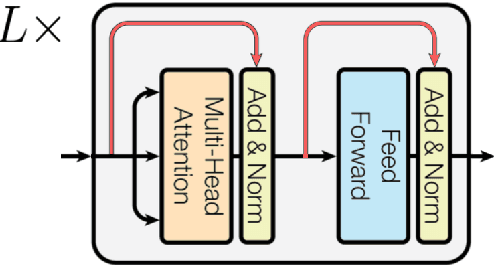
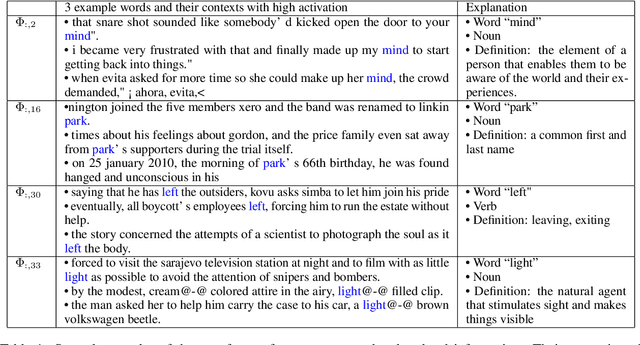
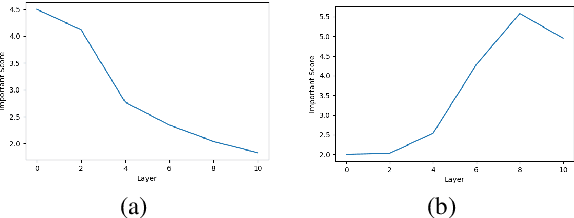
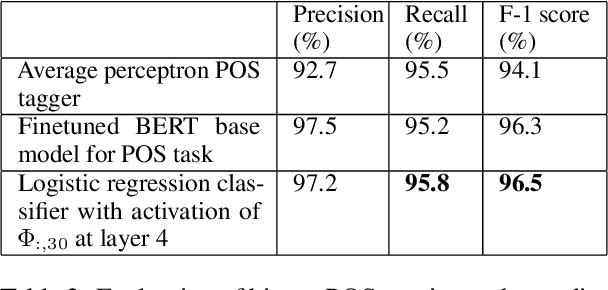
Transformer networks have revolutionized NLP representation learning since they were introduced. Though a great effort has been made to explain the representation in transformers, it is widely recognized that our understanding is not sufficient. One important reason is that there lack enough visualization tools for detailed analysis. In this paper, we propose to use dictionary learning to open up these `black boxes' as linear superpositions of transformer factors. Through visualization, we demonstrate the hierarchical semantic structures captured by the transformer factors, e.g. word-level polysemy disambiguation, sentence-level pattern formation, and long-range dependency. While some of these patterns confirm the conventional prior linguistic knowledge, the rest are relatively unexpected, which may provide new insights. We hope this visualization tool can bring further knowledge and a better understanding of how transformer networks work.