 Add to Chrome
 Add to Firefox
 Add to Edge
Toward a mechanistic understanding of inference in visual cortex and diffusion models
Jul 17, 2026
We describe a model of perceptual inference in primary visual cortex (V1) equivalent to a minimal diffusion model whose function can be readily understood from its parameters. The model is based on sparse coding with a non-factorial prior over latent variables in the form of an unconstrained, pairwise interaction matrix, extending standard sparse coding inference to a general recurrent dynamical system. We efficiently train these recurrent dynamics using a denoising score-matching objective and implicit differentiation. After training on natural images, the learned interaction matrix mirrors the structure of horizontal connections in superficial layers of V1 that link neurons of similar orientation tuning. This model exhibits exceptionally good denoising performance, restoring image features such as extended contours amid extreme visual ambiguity, nearly matching the behavior of standard, black-box diffusion architectures in generalization regime. Owing to the model's simplicity, the network's Jacobian can be decomposed directly in terms of the interaction matrix between latent variables, revealing mechanistically how the recurrent dynamics assign high probability over a continuous family of natural structural deformations. Intriguingly, within this circuit, a large fraction of latent variables learn to disconnect from visual input altogether, essentially forming a hierarchical representation that appears to enforce global consistency among image features. Together, the model and results bridge two distinct domains: for neuroscience, it generates concrete, testable hypotheses regarding functional connectivity in recurrent neural circuits during perceptual inference tasks; for machine learning, it elucidates the internal mechanisms learned by diffusion models that allow them to generate infinitely many novel images from a finite training set.

Cross-Frequency Coupling Increases Memory Capacity in Oscillatory Neural Networks
Apr 05, 2022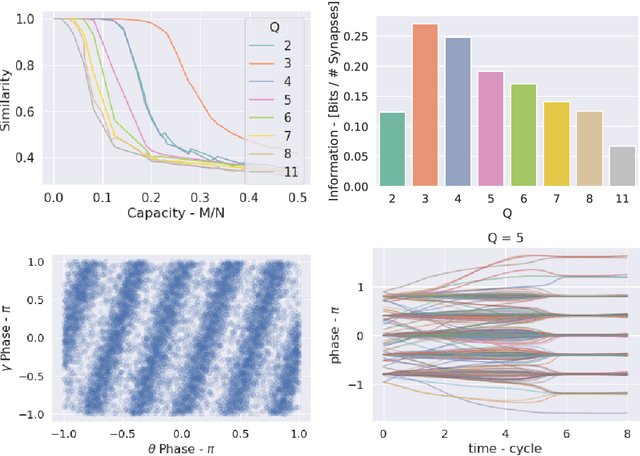
An open problem in neuroscience is to explain the functional role of oscillations in neural networks, contributing, for example, to perception, attention, and memory. Cross-frequency coupling (CFC) is associated with information integration across populations of neurons. Impaired CFC is linked to neurological disease. It is unclear what role CFC has in information processing and brain functional connectivity. We construct a model of CFC which predicts a computational role for observed $\theta - \gamma$ oscillatory circuits in the hippocampus and cortex. Our model predicts that the complex dynamics in recurrent and feedforward networks of coupled oscillators performs robust information storage and pattern retrieval. Based on phasor associative memories (PAM), we present a novel oscillator neural network (ONN) model that includes subharmonic injection locking (SHIL) and which reproduces experimental observations of CFC. We show that the presence of CFC increases the memory capacity of a population of neurons connected by plastic synapses. CFC enables error-free pattern retrieval whereas pattern retrieval fails without CFC. In addition, the trade-offs between sparse connectivity, capacity, and information per connection are identified. The associative memory is based on a complex-valued neural network, or phasor neural network (PNN). We show that for values of $Q$ which are the same as the ratio of $\gamma$ to $\theta$ oscillations observed in the hippocampus and the cortex, the associative memory achieves greater capacity and information storage than previous models. The novel contributions of this work are providing a computational framework based on oscillator dynamics which predicts the functional role of neural oscillations and connecting concepts in neural network theory and dynamical system theory.