 Add to Chrome
 Add to Firefox
 Add to Edge
Understanding Knowledge Transfer Mechanism in Heterogeneous MLLM Fusion: A Simple Linear Approach
Jul 29, 2026
Training-free fusion of heterogeneous multimodal large language models (MLLMs) provides a direct route for cross-scale capability transfer, yet improvements in aggregate performance do not reveal what a smaller model actually inherits. Existing studies are largely designed and evaluated on limited task sets or aggregate metrics; as evaluation expands to broader task collections, whether different capabilities can transfer across scales remains poorly understood. To investigate this question, we introduce Cross-Scale Directional Parameter Injection (CDPI), a simple linear probe to analyze cross-scale knowledge transfer during heterogeneous fusion. A local theoretical analysis indicates that knowledge transfer selectivity is determined at first order by capability-dependent responses to a shared injection direction, while second-order curvature effects constrain the effective transfer regime. Across four Qwen3-VL model pairs and twelve multimodal benchmarks, our experiments reveal a consistent pattern of selectivity: gains concentrate on reasoning, particularly high-level reasoning, whereas perception performance remains close to that of the original target model. Component-wise ablations further show that high-level reasoning gains arise primarily from the language model, while ratio analysis finds that positive selective transfer occurs mainly in the small-ratio regime. These findings recast cross-scale heterogeneous MLLM fusion as selective language-side reasoning transfer within a narrow, low-interference regime, rather than broad capability inheritance.

DIRECTOR: Dynamic Index-based Recommendation with Transport-Optimized Retrieval
Jul 29, 2026Reranking is a combinatorial decision problem that aims to select and order a high-utility slate from a request-specific candidate set. A major line of generative rerankers adopts autoregressive (AR) models, which construct the slate one position at a time to capture inter-position dependencies. However, under practical greedy or bounded-width decoding, prefix-based search may prematurely prune globally promising permutations and incurs inherently sequential latency, restricting the effective search space under a fixed serving budget. Non-autoregressive (NAR) alternatives alleviate this efficiency bottleneck through position-parallel prediction, but naive position-wise factorization treats different positions too independently, leading to insufficient cross-position coordination and potentially duplicate or conflicting item selections. To retain parallel efficiency while introducing global structural coordination, we propose Dynamic Index-based RECommendation with Transport-Optimized Retrieval (DIRECTOR), a transport-guided parallel reranking framework. DIRECTOR maps candidate items into a continuous latent space and generates request-conditioned dynamic retrieval indices for all target positions in parallel. During training, it uses entropy-regularized OT to provide conflict-aware supervision; at inference, it directly performs global hard matching on similarity matrix, producing duplicate-free slates without iterative transport. To further align the generator with an opaque list-wise evaluator that returns only a scalar utility, we introduce a prefix-anchored credit assignment mechanism that converts the global reward into position-specific training signals. Extensive offline and online experiments demonstrate that DIRECTOR consistently outperforms strong reranking baselines, achieving significant improvement in large-scale industrial recommendation scenarios.
PSG: Pair-Space Generation for Efficient Generative Reranking
Jul 29, 2026Modern recommender systems adopt Generator-Evaluator (G-E) for list-wise reranking: a generator produces sequences from candidates and an evaluator scores them at sequence-level to filter out the optimal one for exposure. Auto-Regressive(AR), working as the backbone for generative recommendation, suffers two limitations. First, its complexity grows linearly with list length, forcing the system to generate fewer lists under rigorous latency constraints and thus limiting exploration. Second, teacher-forcing creates a train-test mismatch; cumulative errors worsen with length and degrade quality. To address these problems, we propose Pair-Space Generation (PSG), a reformulation that elevates the generation atom from individual items to ordered item pairs. Given $n$ candidate items, PSG operates over pair vocabulary of size $n(n-1)$ per request, generates only $L/2$ tokens. Pair token representations are produced on-the-fly by a pretrained pair-token representation module optimized over large scale exposure logs, eliminating the data sparsity that would otherwise plague a quadratic sized vocabulary. We establish three theoretical guarantees: (i) PSG is bijective with item-space generation and induces an equivalent family of sequence distributions, thus incurring no loss of expressiveness; (ii) generation in pair-token space achieves approximately a $2\times$ to $4\times$ speedup theoretically under moderate settings and $1.83\times$ in the real industrial environmental settings; and (iii) under outcome-only rewards, the worst-case suboptimality of PSG is bounded by $O((L/2)^2 \barε)$, representing a nearly $4\times$ improvement over item-space generation. Beyond benchmark-based validation, PSG has also been deployed on Kuaishou, delivering a 0.178\% lift in per-user stay time on the platform, which serves over 400 million daily active users.
Beyond Surrogates: A Quantitative Analysis for Inter-Metric Relationships
Mar 08, 2026The Consistency property between surrogate losses and evaluation metrics has been extensively studied to ensure that minimizing a loss leads to metric optimality. However, the direct relationship between different evaluation metrics remains significantly underexplored. This theoretical gap results in the "Metric Mismatch" frequently observed in industrial applications, where gains in offline validation metrics fail to translate into online performance. To bridge this disconnection, this paper proposes a unified theoretical framework designed to quantify the relationships between metrics. We categorize metrics into different classes to facilitate a comparative analysis across different mathematical forms and interrogates these relationships through Bayes-Optimal Set and Regret Transfer. Through this framework, we provide a new perspective on identifying the structural asymmetry in regret transfer, enabling the design of evaluation systems that are theoretically guaranteed to align offline improvements with online objectives.
SOLAR: SVD-Optimized Lifelong Attention for Recommendation
Mar 03, 2026Attention mechanism remains the defining operator in Transformers since it provides expressive global credit assignment, yet its $O(N^2 d)$ time and memory cost in sequence length $N$ makes long-context modeling expensive and often forces truncation or other heuristics. Linear attention reduces complexity to $O(N d^2)$ by reordering computation through kernel feature maps, but this reformulation drops the softmax mechanism and shifts the attention score distribution. In recommender systems, low-rank structure in matrices is not a rare case, but rather the default inductive bias in its representation learning, particularly explicit in the user behavior sequence modeling. Leveraging this structure, we introduce SVD-Attention, which is theoretically lossless on low-rank matrices and preserves softmax while reducing attention complexity from $O(N^2 d)$ to $O(Ndr)$. With SVD-Attention, we propose SOLAR, SVD-Optimized Lifelong Attention for Recommendation, a sequence modeling framework that supports behavior sequences of ten-thousand scale and candidate sets of several thousand items in cascading process without any filtering. In Kuaishou's online recommendation scenario, SOLAR delivers a 0.68\% Video Views gain together with additional business metrics improvements.
FlashEvaluator: Expanding Search Space with Parallel Evaluation
Mar 03, 2026The Generator-Evaluator (G-E) framework, i.e., evaluating K sequences from a generator and selecting the top-ranked one according to evaluator scores, is a foundational paradigm in tasks such as Recommender Systems (RecSys) and Natural Language Processing (NLP). Traditional evaluators process sequences independently, suffering from two major limitations: (1) lack of explicit cross-sequence comparison, leading to suboptimal accuracy; (2) poor parallelization with linear complexity of O(K), resulting in inefficient resource utilization and negative impact on both throughput and latency. To address these challenges, we propose FlashEvaluator, which enables cross-sequence token information sharing and processes all sequences in a single forward pass. This yields sublinear computational complexity that improves the system's efficiency and supports direct inter-sequence comparisons that improve selection accuracy. The paper also provides theoretical proofs and extensive experiments on recommendation and NLP tasks, demonstrating clear advantages over conventional methods. Notably, FlashEvaluator has been deployed in online recommender system of Kuaishou, delivering substantial and sustained revenue gains in practice.
Is Softmax Loss All You Need? A Principled Analysis of Softmax-family Loss
Jan 30, 2026The Softmax loss is one of the most widely employed surrogate objectives for classification and ranking tasks. To elucidate its theoretical properties, the Fenchel-Young framework situates it as a canonical instance within a broad family of surrogates. Concurrently, another line of research has addressed scalability when the number of classes is exceedingly large, in which numerous approximations have been proposed to retain the benefits of the exact objective while improving efficiency. Building on these two perspectives, we present a principled investigation of the Softmax-family losses. We examine whether different surrogates achieve consistency with classification and ranking metrics, and analyze their gradient dynamics to reveal distinct convergence behaviors. We also introduce a systematic bias-variance decomposition for approximate methods that provides convergence guarantees, and further derive a per-epoch complexity analysis, showing explicit trade-offs between effectiveness and efficiency. Extensive experiments on a representative task demonstrate a strong alignment between consistency, convergence, and empirical performance. Together, these results establish a principled foundation and offer practical guidance for loss selections in large-class machine learning applications.
NDCG-Consistent Softmax Approximation with Accelerated Convergence
Jun 11, 2025
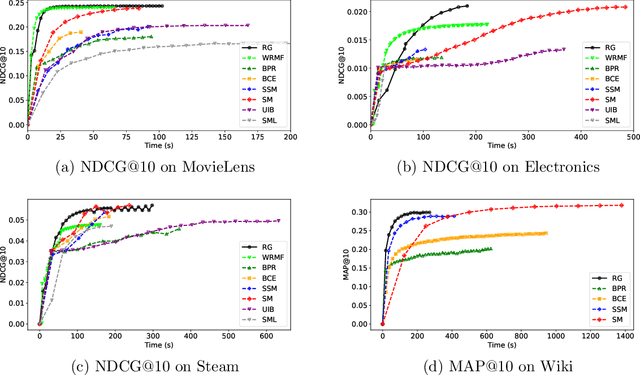
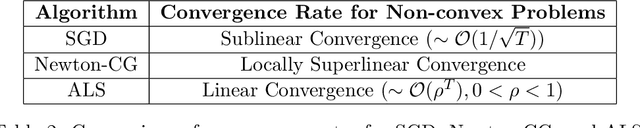
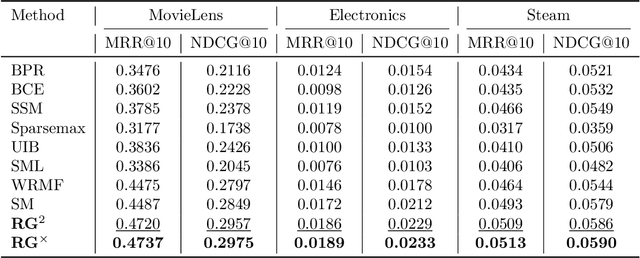
Ranking tasks constitute fundamental components of extreme similarity learning frameworks, where extremely large corpora of objects are modeled through relative similarity relationships adhering to predefined ordinal structures. Among various ranking surrogates, Softmax (SM) Loss has been widely adopted due to its natural capability to handle listwise ranking via global negative comparisons, along with its flexibility across diverse application scenarios. However, despite its effectiveness, SM Loss often suffers from significant computational overhead and scalability limitations when applied to large-scale object spaces. To address this challenge, we propose novel loss formulations that align directly with ranking metrics: the Ranking-Generalizable \textbf{squared} (RG$^2$) Loss and the Ranking-Generalizable interactive (RG$^\times$) Loss, both derived through Taylor expansions of the SM Loss. Notably, RG$^2$ reveals the intrinsic mechanisms underlying weighted squared losses (WSL) in ranking methods and uncovers fundamental connections between sampling-based and non-sampling-based loss paradigms. Furthermore, we integrate the proposed RG losses with the highly efficient Alternating Least Squares (ALS) optimization method, providing both generalization guarantees and convergence rate analyses. Empirical evaluations on real-world datasets demonstrate that our approach achieves comparable or superior ranking performance relative to SM Loss, while significantly accelerating convergence. This framework offers the similarity learning community both theoretical insights and practically efficient tools, with methodologies applicable to a broad range of tasks where balancing ranking quality and computational efficiency is essential.
Efficient Transfer Learning Framework for Cross-Domain Click-Through Rate Prediction
Aug 29, 2024
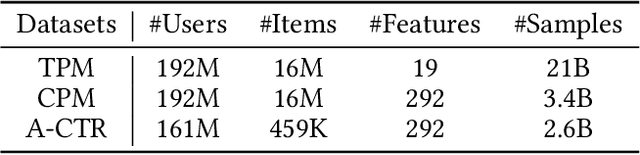
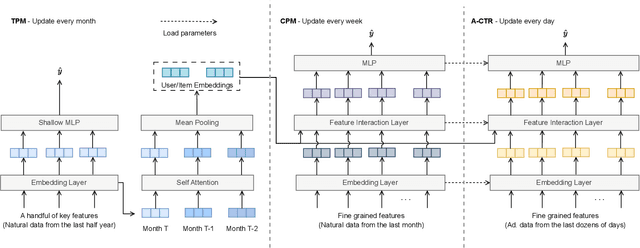
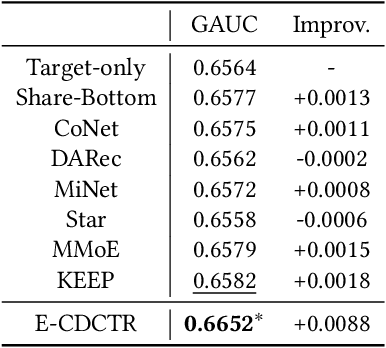
Natural content and advertisement coexist in industrial recommendation systems but differ in data distribution. Concretely, traffic related to the advertisement is considerably sparser compared to that of natural content, which motivates the development of transferring knowledge from the richer source natural content domain to the sparser advertising domain. The challenges include the inefficiencies arising from the management of extensive source data and the problem of 'catastrophic forgetting' that results from the CTR model's daily updating. To this end, we propose a novel tri-level asynchronous framework, i.e., Efficient Transfer Learning Framework for Cross-Domain Click-Through Rate Prediction (E-CDCTR), to transfer comprehensive knowledge of natural content to advertisement CTR models. This framework consists of three key components: Tiny Pre-training Model ((TPM), which trains a tiny CTR model with several basic features on long-term natural data; Complete Pre-training Model (CPM), which trains a CTR model holding network structure and input features the same as target advertisement on short-term natural data; Advertisement CTR model (A-CTR), which derives its parameter initialization from CPM together with multiple historical embeddings from TPM as extra feature and then fine-tunes on advertisement data. TPM provides richer representations of user and item for both the CPM and A-CTR, effectively alleviating the forgetting problem inherent in the daily updates. CPM further enhances the advertisement model by providing knowledgeable initialization, thereby alleviating the data sparsity challenges typically encountered by advertising CTR models. Such a tri-level cross-domain transfer learning framework offers an efficient solution to address both data sparsity and `catastrophic forgetting', yielding remarkable improvements.
Invariant Representation Learning via Decoupling Style and Spurious Features
Dec 11, 2023


This paper considers the out-of-distribution (OOD) generalization problem under the setting that both style distribution shift and spurious features exist and domain labels are missing. This setting frequently arises in real-world applications and is underlooked because previous approaches mainly handle either of these two factors. The critical challenge is decoupling style and spurious features in the absence of domain labels. To address this challenge, we first propose a structural causal model (SCM) for the image generation process, which captures both style distribution shift and spurious features. The proposed SCM enables us to design a new framework called IRSS, which can gradually separate style distribution and spurious features from images by introducing adversarial neural networks and multi-environment optimization, thus achieving OOD generalization. Moreover, it does not require additional supervision (e.g., domain labels) other than the images and their corresponding labels. Experiments on benchmark datasets demonstrate that IRSS outperforms traditional OOD methods and solves the problem of Invariant risk minimization (IRM) degradation, enabling the extraction of invariant features under distribution shift.