 Add to Chrome
 Add to Firefox
 Add to Edge
ClawMark: A Living-World Benchmark for Multi-Turn, Multi-Day, Multimodal Coworker Agents
Apr 26, 2026
Language-model agents are increasingly used as persistent coworkers that assist users across multiple working days. During such workflows, the surrounding environment may change independently of the agent: new emails arrive, calendar entries shift, knowledge-base records are updated, and evidence appears across images, scanned PDFs, audio, video, and spreadsheets. Existing benchmarks do not adequately evaluate this setting because they typically run within a single static episode and remain largely text-centric. We introduce \bench{}, a benchmark for coworker agents built around multi-turn multi-day tasks, a stateful sandboxed service environment whose state evolves between turns, and rule-based verification. The current release contains 100 tasks across 13 professional scenarios, executed against five stateful sandboxed services (filesystem, email, calendar, knowledge base, spreadsheet) and scored by 1537 deterministic Python checkers over post-execution service state; no LLM-as-judge is invoked during scoring. We benchmark seven frontier agent systems. The strongest model reaches 75.8 weighted score, but the best strict Task Success is only 20.0\%, indicating that partial progress is common while complete end-to-end workflow completion remains rare. Turn-level analysis shows that performance drops after the first exogenous environment update, highlighting adaptation to changing state as a key open challenge. We release the benchmark, evaluation harness, and construction pipeline to support reproducible coworker-agent evaluation.

On Representation Redundancy in Large-Scale Instruction Tuning Data Selection
Feb 14, 2026Data quality is a crucial factor in large language models training. While prior work has shown that models trained on smaller, high-quality datasets can outperform those trained on much larger but noisy or low-quality corpora, systematic methods for industrial-scale data selection in instruction tuning remain underexplored. In this work, we study instruction-tuning data selection through the lens of semantic representation similarity and identify a key limitation of state-of-the-art LLM encoders: they produce highly redundant semantic embeddings. To mitigate this redundancy, we propose Compressed Representation Data Selection (CRDS), a novel framework with two variants. CRDS-R applies Rademacher random projection followed by concatenation of transformer hidden-layer representations, while CRDS-W employs whitening-based dimensionality reduction to improve representational quality. Experimental results demonstrate that both variants substantially enhance data quality and consistently outperform state-of-the-art representation-based selection methods. Notably, CRDS-W achieves strong performance using only 3.5% of the data, surpassing the full-data baseline by an average of 0.71% across four datasets. Our code is available at https://github.com/tdano1/CRDS.
Effects of Exponential Gaussian Distribution on (Double Sampling) Randomized Smoothing
Jun 04, 2024
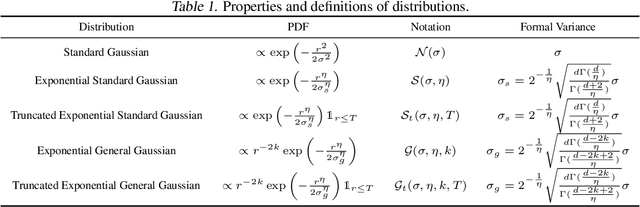


Randomized Smoothing (RS) is currently a scalable certified defense method providing robustness certification against adversarial examples. Although significant progress has been achieved in providing defenses against $\ell_p$ adversaries, the interaction between the smoothing distribution and the robustness certification still remains vague. In this work, we comprehensively study the effect of two families of distributions, named Exponential Standard Gaussian (ESG) and Exponential General Gaussian (EGG) distributions, on Randomized Smoothing and Double Sampling Randomized Smoothing (DSRS). We derive an analytic formula for ESG's certified radius, which converges to the origin formula of RS as the dimension $d$ increases. Additionally, we prove that EGG can provide tighter constant factors than DSRS in providing $\Omega(\sqrt{d})$ lower bounds of $\ell_2$ certified radius, and thus further addresses the curse of dimensionality in RS. Our experiments on real-world datasets confirm our theoretical analysis of the ESG distributions, that they provide almost the same certification under different exponents $\eta$ for both RS and DSRS. In addition, EGG