 Add to Chrome
 Add to Firefox
 Add to Edge
CausalMix: Data Mixture as Causal Inference for Language Model Training
Jul 01, 2026
In Large Language Model (LLM) training, data mixing plays a pivotal role in determining model performance. Recent methods optimize mixture weights via proxy models, but they rely on the assumption of static data distributions. As a result, when the underlying data pool shifts, these methods require costly retraining from scratch. This limitation restricts their ability to scale seamlessly from small settings to larger data pools and model sizes. In this paper, we propose CausalMix to address this limitation by casting data mixture optimization as a causal inference problem. We formulate the statistical features of the data pool as covariates and the domain mixture as the treatment. After fitting a causal model on 512 runs of Qwen2.5-0.5B to estimate the Conditional Average Treatment Effect (CATE), we extrapolate the optimal mixture for an 800K data pool and apply it to train a 7B model. Furthermore, we successfully generalize the framework to long chain-of-thought data on Qwen3-4B-Base. By leveraging causal modeling to isolate confounding biases, CausalMix dynamically infers state-dependent optimal data mixtures. Extensive experiments show that the mixture guided by CausalMix consistently improves performance across multiple downstream tasks, outperforming RegMix and other baselines. In addition, we use the CATE Interpreter to provide visual analysis of the learned mixing strategy. Overall, CausalMix offers a causal and interpretable framework for optimizing LLM data mixtures.

Ling and Ring 2.6 Technical Report: Efficient and Instant Agentic Intelligence at Trillion-Parameter Scale
Jun 13, 2026Efficient and scalable agentic intelligence requires models that can deliver both low-latency responses and strong reasoning capabilities while remaining practical to train, serve, and deploy. In this report, we present Ling-2.6 and Ring-2.6, a family of models designed to address this challenge at scale. Ling-2.6 is optimized for instant response generation and high capability per output token, whereas Ring-2.6 is tailored for deeper reasoning and more advanced agentic workflows. Instead of training from scratch, we upgrade the Ling-2.0 base model through architectural migration pre-training and large-scale post-training. This upgrade is guided by a unified co-design of model architecture, optimization objectives, serving systems, and agent training environments, enabling improvements in both model capability and deployment efficiency. At the architectural level, we introduce a hybrid linear attention design that integrates Lightning Attention with MLA, improving the efficiency of long-context training and decoding. To further enhance token efficiency, we optimize capability per output token through Evolutionary Chain-of-Thought, Linguistic Unit Policy Optimization, bidirectional preference alignment, and shortest-correct-response distillation. For agentic capabilities, we propose KPop, a reinforcement learning framework designed to support stable training of Ring-2.6-1T on large-scale environment-grounded data. KPop improves training efficiency through asynchronous scheduling across coding, search, tool use, and workflow execution, enabling scalable learning from complex agent-environment interactions. Together, Ling-2.6 and Ring-2.6 provide a practical pathway toward efficient, scalable, and open agentic systems. We open-source all checkpoints in the 2.6 family to support further research and development in practical agentic intelligence.
Improving Cross-Format Robustness in Language Models with Multi-Format Training
Jun 10, 2026Large language models often remain sensitive to answer format: a question solved correctly in one form may fail in another semantically equivalent form. To study this gap, we define cross-format robustness as the extent to which a model answers the same underlying question consistently across formats. We then compare full-format training with FormatMix, which expands only a subset of training items into multiple equivalent formats using either random or targeted selection. Across GLM4 and Llama-3.1, multi-format supervision consistently improves both task performance and cross-format robustness, whereas Multiple-choice question (MCQ)-only supervision alone brings little benefit and can even reduce robustness. We further find that expanding only about 30% of the training set into multiple formats often recovers most of the gain from full-format training, and this effect appears across the model families and sizes we study. These results suggest that format diversity, rather than additional supervision alone, is the key driver of robustness. That lightweight multi-format augmentation is a practical way to make LLMs less sensitive to answer format without changing the base model.
On Representation Redundancy in Large-Scale Instruction Tuning Data Selection
Feb 14, 2026Data quality is a crucial factor in large language models training. While prior work has shown that models trained on smaller, high-quality datasets can outperform those trained on much larger but noisy or low-quality corpora, systematic methods for industrial-scale data selection in instruction tuning remain underexplored. In this work, we study instruction-tuning data selection through the lens of semantic representation similarity and identify a key limitation of state-of-the-art LLM encoders: they produce highly redundant semantic embeddings. To mitigate this redundancy, we propose Compressed Representation Data Selection (CRDS), a novel framework with two variants. CRDS-R applies Rademacher random projection followed by concatenation of transformer hidden-layer representations, while CRDS-W employs whitening-based dimensionality reduction to improve representational quality. Experimental results demonstrate that both variants substantially enhance data quality and consistently outperform state-of-the-art representation-based selection methods. Notably, CRDS-W achieves strong performance using only 3.5% of the data, surpassing the full-data baseline by an average of 0.71% across four datasets. Our code is available at https://github.com/tdano1/CRDS.
Every Step Evolves: Scaling Reinforcement Learning for Trillion-Scale Thinking Model
Oct 21, 2025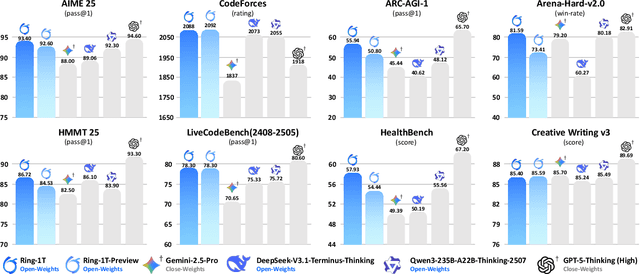
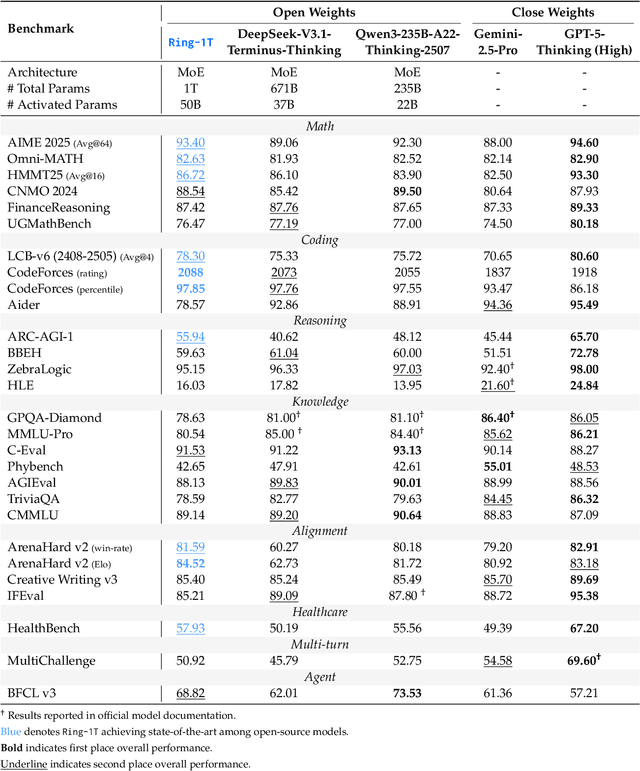
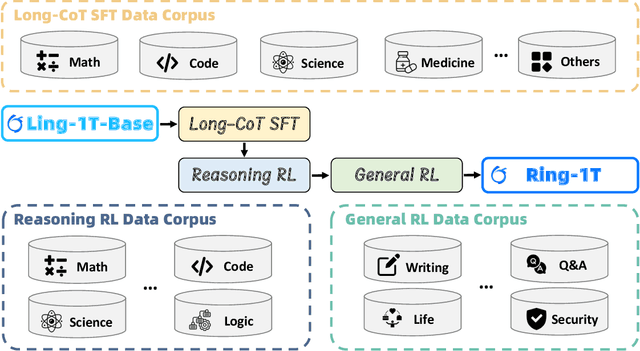
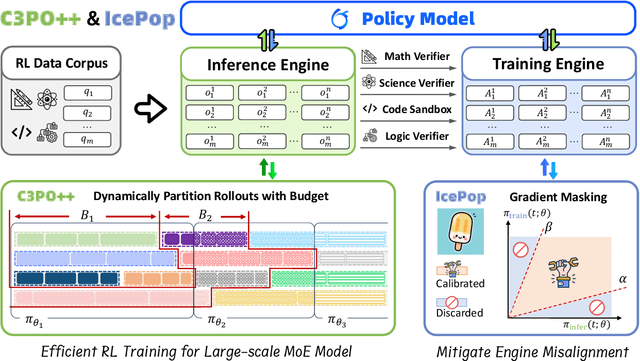
We present Ring-1T, the first open-source, state-of-the-art thinking model with a trillion-scale parameter. It features 1 trillion total parameters and activates approximately 50 billion per token. Training such models at a trillion-parameter scale introduces unprecedented challenges, including train-inference misalignment, inefficiencies in rollout processing, and bottlenecks in the RL system. To address these, we pioneer three interconnected innovations: (1) IcePop stabilizes RL training via token-level discrepancy masking and clipping, resolving instability from training-inference mismatches; (2) C3PO++ improves resource utilization for long rollouts under a token budget by dynamically partitioning them, thereby obtaining high time efficiency; and (3) ASystem, a high-performance RL framework designed to overcome the systemic bottlenecks that impede trillion-parameter model training. Ring-1T delivers breakthrough results across critical benchmarks: 93.4 on AIME-2025, 86.72 on HMMT-2025, 2088 on CodeForces, and 55.94 on ARC-AGI-v1. Notably, it attains a silver medal-level result on the IMO-2025, underscoring its exceptional reasoning capabilities. By releasing the complete 1T parameter MoE model to the community, we provide the research community with direct access to cutting-edge reasoning capabilities. This contribution marks a significant milestone in democratizing large-scale reasoning intelligence and establishes a new baseline for open-source model performance.
Ring-lite: Scalable Reasoning via C3PO-Stabilized Reinforcement Learning for LLMs
Jun 18, 2025We present Ring-lite, a Mixture-of-Experts (MoE)-based large language model optimized via reinforcement learning (RL) to achieve efficient and robust reasoning capabilities. Built upon the publicly available Ling-lite model, a 16.8 billion parameter model with 2.75 billion activated parameters, our approach matches the performance of state-of-the-art (SOTA) small-scale reasoning models on challenging benchmarks (e.g., AIME, LiveCodeBench, GPQA-Diamond) while activating only one-third of the parameters required by comparable models. To accomplish this, we introduce a joint training pipeline integrating distillation with RL, revealing undocumented challenges in MoE RL training. First, we identify optimization instability during RL training, and we propose Constrained Contextual Computation Policy Optimization(C3PO), a novel approach that enhances training stability and improves computational throughput via algorithm-system co-design methodology. Second, we empirically demonstrate that selecting distillation checkpoints based on entropy loss for RL training, rather than validation metrics, yields superior performance-efficiency trade-offs in subsequent RL training. Finally, we develop a two-stage training paradigm to harmonize multi-domain data integration, addressing domain conflicts that arise in training with mixed dataset. We will release the model, dataset, and code.
Holistic Capability Preservation: Towards Compact Yet Comprehensive Reasoning Models
Apr 09, 2025This technical report presents Ring-Lite-Distill, a lightweight reasoning model derived from our open-source Mixture-of-Experts (MoE) Large Language Models (LLMs) Ling-Lite. This study demonstrates that through meticulous high-quality data curation and ingenious training paradigms, the compact MoE model Ling-Lite can be further trained to achieve exceptional reasoning capabilities, while maintaining its parameter-efficient architecture with only 2.75 billion activated parameters, establishing an efficient lightweight reasoning architecture. In particular, in constructing this model, we have not merely focused on enhancing advanced reasoning capabilities, exemplified by high-difficulty mathematical problem solving, but rather aimed to develop a reasoning model with more comprehensive competency coverage. Our approach ensures coverage across reasoning tasks of varying difficulty levels while preserving generic capabilities, such as instruction following, tool use, and knowledge retention. We show that, Ring-Lite-Distill's reasoning ability reaches a level comparable to DeepSeek-R1-Distill-Qwen-7B, while its general capabilities significantly surpass those of DeepSeek-R1-Distill-Qwen-7B. The models are accessible at https://huggingface.co/inclusionAI